
Caryophyllales
Order of Superasterids
Food, Plant source foods, Plants (Plantae), Flowering plats (angiospermae), Mesangiosperms, Eudicots, Core eudicots, Superasterids
Consumption area(s): Earth
Note: For better understanding, please read the article on flowering plants (angiospermae) first. If you come across unfamiliar words, you can click on any highlighted term to open the glossary with definitions of key botanical terms.
Introduction
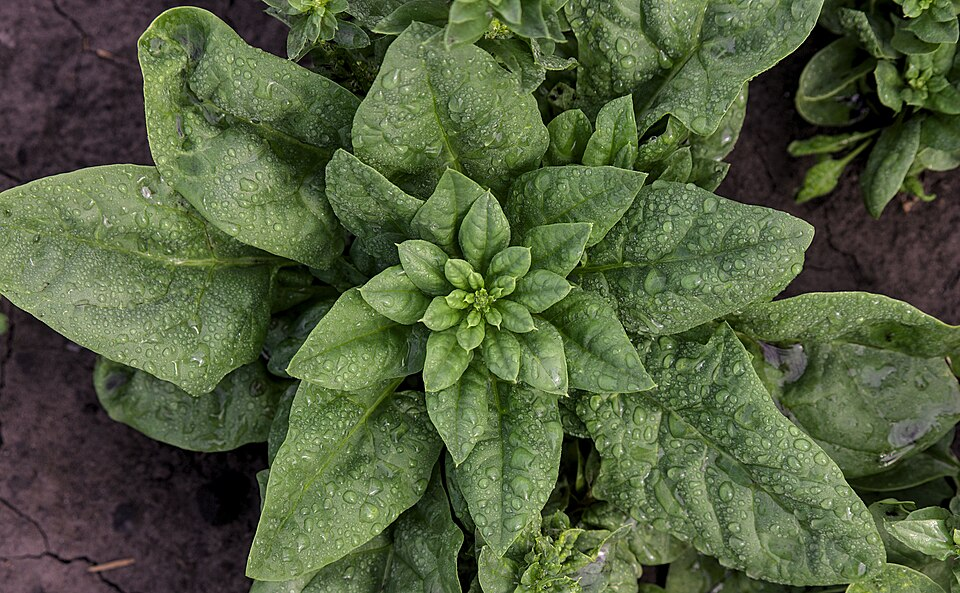
The Caryophyllales constitute an order within the group of flowering plants, specifically among the Superasterids. This lineage is notably diverse, encompassing 38 distinct families, around 692 genera, and roughly 11,000 species, accounting for about 6.3% of all eudicots. Within this botanical order are several economically and nutritionally significant plants. These include crops such as sugar beet, spinach, chard, beetroot, rhubarb, purslane, amaranth, and quinoa, all of which play an important role in human diets and agriculture.
Description of Caryophyllales
The leaves, typically simple and mostly with entire margins, are usually arranged in an opposite pattern. The flowers are commonly five-parted, reflecting a pentamerous organization. The tepals may be clearly divided into sepals and petals, although in many cases one of these floral whorls is absent.
The carpels are generally fused, forming a single ovary. A distinctive trait found in some members of this order is the presence of central placentation within the ovary. Because of this feature, the group was historically referred to as Centrospermae in older classification systems. The most frequently occurring fruit types include capsules and berries.
Classification of Caryophyllales
This order is divided into families. Among these are:
- Amaranthaceae (amaranth, chard, quinoa, spinach)
- Basellaceae (Malabar spinach)
- Cactaceae (prickly pear)
- Caryophyllaceae (carnation)
- Montiaceae (claytonia or miner’s lettuce)
- Nyctaginaceae (bougainvillea)
- Phytolaccaceae (American pokeweed)
- Polygonaceae (sorrel, buckwheat)
- Portulacaceae (purslane)
Photo(s):
1. Алексей Тараканов, CC BY-SA 2.0 https://creativecommons.org/licenses/by-sa/2.0, via Wikimedia Commons