
Carrots
Subspecies of Dacus carota (Apiaceae)
Food, Plant source foods, Plants (Plantae), Flowering plats (angiospermae), Mesangiosperms, Eudicots, Core eudicots, Superastierds, Asterids, Campanulids (Euasterids II), Apiales, Apiaceae
Subspecies name: Daucus carota subsp. sativus
Consumption area(s): We were unable to find reliable data regarding the distribution of this product, but it is likely that its distribution is concentrated in Europe, Asia, North America, Australia and New Zeland.
Note: For better understanding, please read the article on flowering plants (angiospermae) first. If you come across unfamiliar words, you can click on any highlighted term to open the glossary with definitions of key botanical terms.
Introduction
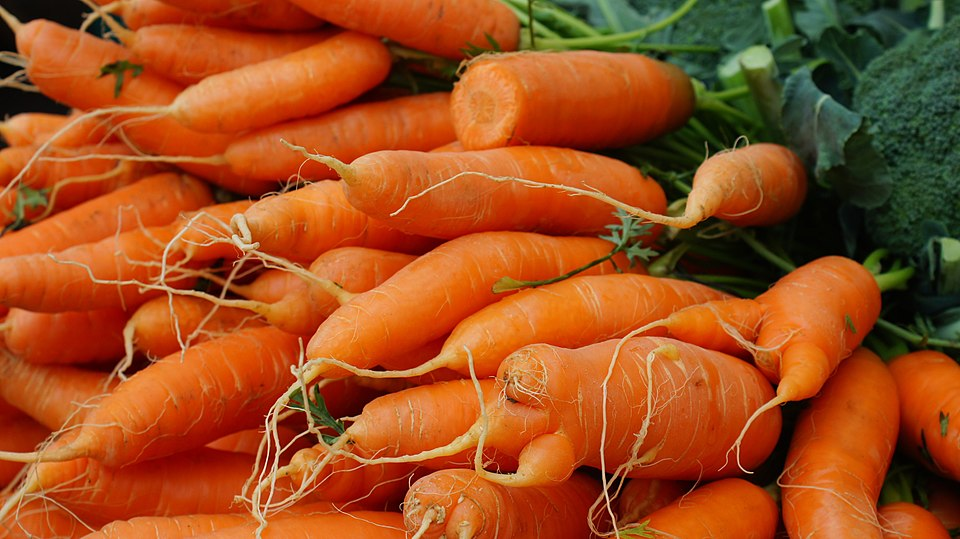
Carrots, scientifically known as Daucus carota subsp. sativus,are biennial plants belonging to the Apiaceae (or umbellifer) family. In 2022, global carrot production—often combined with turnips in statistics—reached approximately 42 million tonnes, with China contributing nearly 44% of the total output.
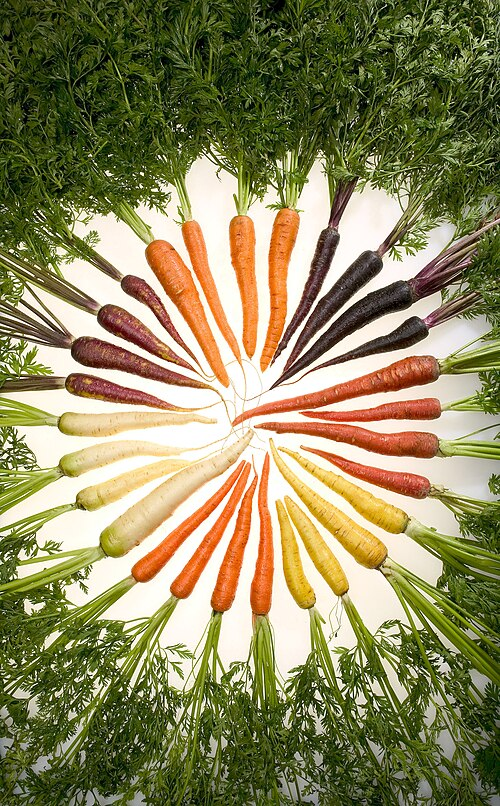
The carrot’s root—the portion most often eaten—is usually orange, although heritage varieties can display shades of purple, black, red, white, or yellow. All cultivated carrots trace their origins to the wild carrot, which is native to Europe and Southwestern Asia. The species likely originated in Iran and was initially grown for its leaves and seeds rather than its root.
Description of the plant
Carrots are biennial plants, storing energy in its taproot during the first year to support flowering in the second. Shortly after germination, seedlings show a clear separation between the stem and the root: the stem is thicker and lacks lateral roots, while the upper tip bears the seed leaf.
The first true leaf emerges around 10–15 days after germination, followed by alternating, spirally arranged, pinnately compound leaves with bases that partially enclose the stem. As growth continues, the seed leaf bases near the taproot separate, and the stem, compressed near the ground, shows no distinct internodes. When the plant begins to flower, the stem elongates, narrows at the tip, and produces a highly branched inflorescence that can reach 60–200 cm in height.
Flowering begins when the meristem transitions from leaf production to stem elongation and inflorescence formation. Carrot flowers grow in compound umbels, where each primary umbel contains smaller secondary umbels, which may further branch into tertiary and even higher-order umbels. A single large umbel can include up to 50 umbellets, each holding as many as 50 small flowers.
The flowers are generally white, sometimes tinged with green or yellow, and consist of five petals, five stamens, and a simple calyx. Male-sterile flowers either have stamens that shrivel before opening or replaced by persistent petals. Nectar is secreted from a disc atop the carpels to attract pollinators.
Carrot flowers release pollen before the stigma becomes receptive. Flowering begins at the outer edges of the primary umbels and gradually moves toward the inner flowers and to secondary and higher-order umbels. Flowering on primary umbels begins first, then progresses outward to secondary and subsequent umbels, lasting roughly 7–10 days per umbel and 30–50 days per plant. As seeds develop, the outer umbellets bend inward, transforming the umbel from flat or slightly convex to a cup-shaped “bird’s nest” structure.
The plant produces a schizocarp fruit, splitting into two mericarps, each representing a true seed. The paired seeds separate easily when dry, though premature shattering can cause seed loss. Mature seeds are flattened on one side, showing five longitudinal ribs; some ribs bear hairs, typically removed during processing. Seeds count varies widely, from under 500 to over 1000 per gram.
Description of the edible parts (root)
The carrot taproot is mainly composed of a soft outer cortex (phloem) that surrounds a firmer inner core (xylem). Carrots of superior quality usually have a larger proportion of cortex relative to the core. While it is impossible for a carrot to exist without xylem, certain varieties feature a small, deeply colored core, and in some cases, the root may seem almost uniform in color when the cortex and core shades are very similar.
Taproots generally have a long, conical shape, but some cultivars grow in cylindrical or nearly spherical forms. The diameter of the root can vary widely, from about 1 cm to 10 cm at its thickest point, while the length ranges from 5 to 50 cm, with the majority falling between 10 and 25 cm.
History of carrots as food
When carrots were first cultivated, people valued their aromatic leaves and seeds more than their roots. Archaeological evidence shows carrot seeds in Switzerland and Southern Germany dating back to 2000–3000 BC. Today, some relatives of the carrot, such as parsley, coriander (cilantro), fennel, anise, dill, and cumin, are still grown primarily for their leaves and seeds. The earliest written records mentioning the root appear in the 1st century AD, where the Romans ate a root vegetable called pastinaca, likely either the carrot or the closely related parsnip.
Illustrations and descriptions of the carrot appear in the Juliana Anicia Codex, a 6th-century Constantinopolitan copy of the Greek physician Dioscorides’ De Materia Medica, which notes that the root can be cooked and eaten. A later copy, the Codex Neapolitanes (late 6th–early 7th century), depicts the roots in purple.
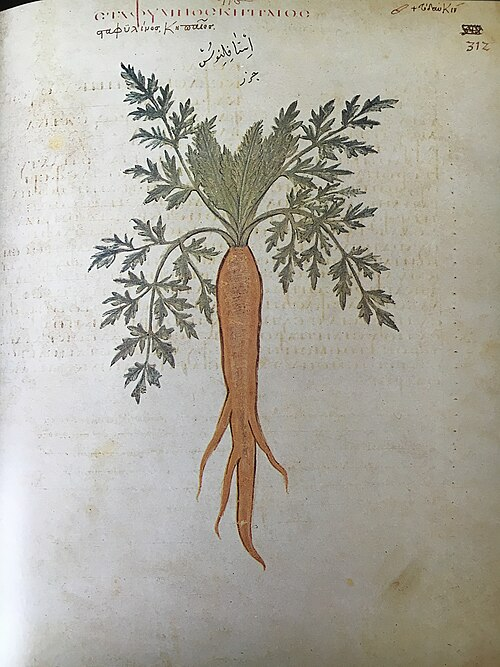
Carrots were brought to Spain by the Moors in the 8th century. By the 10th century, purple roots were common across West Asia, India, and Europe, while the modern orange carrot traces its origins to Afghanistan around this period. Historical records from the 11th-century Jewish scholar Simeon Seth and the 12th-century Arab-Andalusian agriculturist Ibn al-‘Awwam describe both red and yellow carrots. The vegetable spread further east, reaching China by the 12th century and Japan in the 16th or 17th century.
The familiar orange carrot was developed by Dutch growers. Although pictorial evidence suggests orange carrots existed as early as 512 AD, the variety became stable when the Dutch cultivated the “Long Orange” in the early 18th century. Some stories suggest this was to honor the Dutch flag and William of Orange, but it is more likely that Europeans favored orange carrots because their color did not darken soups and stews, making them more visually appealing than purple varieties.
By the 17th century, modern carrots were recorded by the English antiquary John Aubrey, who noted their introduction in Somersetshire, England. European settlers brought the carrot to colonial America during the same century. In recent years, purple carrots that are orange inside have been sold in British stores since 2002.
Production methods for carrots
Carrots are cultivated from seeds and generally take up to four months (120 days) to fully mature, although most varieties are ready in 70–80 days under favorable conditions. They thrive in full sunlight but can tolerate partial shade, and prefer temperatures between 16 and 21 °C (61–70 °F). The best soil is deep, loose, well-drained, and either sandy or loamy, with a slightly acidic pH of 6.3 to 6.8.
Fertilization should match the soil type, as carrots need low nitrogen, moderate phosphate, and high potash. Rich or rocky soils are unsuitable because they can produce hairy or misshapen roots. Irrigation is applied as necessary to keep the soil evenly moist, and once seedlings emerge, the crop is thinned to a spacing of 8–10 cm (3–4 in) and regularly weeded to reduce competition for nutrients below the surface.
Uses of carrots as food
Carrots can be prepared and consumed in numerous ways. The β-carotene in raw carrots is mostly retained during digestion, with only about 3% absorbed, but this can increase to 39% when carrots are pureed, cooked, or combined with oil. They can be boiled, steamed, fried, or incorporated into soups or stews. A classic preparation is julienned carrots, and along with onion and celery, carrots form a key component of a mirepoix, which serves as a flavor base for broths and sauces.
The leaves of the carrot are also edible, though rarely consumed by humans due to potential toxic alkaloids. When eaten, they are typically harvested young, cooked stir-fried, or used in salads. Some individuals have allergies to carrots; studies show that around 3–4% of young adults in Europe display sensitivity.
In India, carrots are highly versatile. They are included in salads, rice dishes, and dals, and a popular dessert is gajar ka halwa, where grated carrots are cooked in milk, nuts, and butter until thickened. Carrots are also used in spiced salads, mixed roasted vegetable dishes, or made into chutneys with tamarind. Since the late 1980s, baby carrots—peeled and shaped into uniform pieces—have become a convenient snack, and carrot juice is widely sold, often blended with fruit or vegetable juices as a health drink.
The natural sweetness of carrots allows them to appear in desserts. They are grated into cakes, puddings, or combined with fruits in jams and preserves. In the EU, a special regulation classifies carrots as fruit when making jams, preserving traditional Portuguese Doce de Cenoura.
Classification of carrots
Carrots are classified based on their cultivars, which are grouped into two main categories:
- Eastern carrots
- Western carrots (Chantenay, Danvers, Imperator, Nantes)
Nutritional facts table of the root
Since nutritional values can vary slightly depending on the cultivar, the figures provided below represent general averages.
| Nutrients | Per 100 g |
| Calories (kcal) | 41 |
| Total fat (g) | 0.24 |
| ———Saturated fat (g) | 0.04 |
| Cholesterol (mg) | 0 |
| Sodium (mg) | 69 |
| Total carbohydrates (g) | 9.58 |
| ———Dietary fiber (g) | 2.8 |
| ———Total sugar (g) | 4.54 |
| Protein (g) | 0.93 |
Source(s):
https://en.wikipedia.org/wiki/Carrot
Photo(s):
1. domdomegg, CC BY 4.0 https://creativecommons.org/licenses/by/4.0, via Wikimedia Commons
2. Dioscorides, Public domain, via Wikimedia Commons
3. Stephen Ausmus, Public domain, via Wikimedia Commons