
Campanulids (Euasterids II)
Clade of Asterids
Food, Plant source foods, Plants (Plantae), Flowering plats (angiospermae), Mesangiosperms, Eudicots, Core eudicots, Superastierds, Asterids
Consumption area(s): Earth
Note: For better understanding, please read the article on flowering plants (angiospermae) first. If you come across unfamiliar words, you can click on any highlighted term to open the glossary with definitions of key botanical terms.
Introduction
The Campanulids, also known as Euasterids II, represent a clade of plants within the Angiosperms. They constitute one of the two major lineages that divide the broader group of Asterids.
Description of Campanulids
Plants within this clade primarily exhibit herbaceous growth, either as annual or perennials, though some species develop shrubby or even tree-like forms, and a few possess liana structures. Several families in the group are known to contain inulin.
The leaves are mostly arranged alternately along the stem, except in Dipsacales, where they are often opposite. Stipules are either absent or very reduced, and leaves can be petiolate or sessile. The lamina may be simple or pinnately lobed, with margins that are either entire or toothed/serrated. In certain species, palmate venation is present.
Iinflorescences vary widely, occurring in both axillary and terminal positions. In some families, flowers form capitula, enclosed by multiple bracts, with a receptacle bearing two types of florets. In Apiales, a characteristic umbel structure appears, where all flower stalks originate from a single point at the top of thestem.
The flowers are generally bisexual and tetramerous, possessing the four main whorls of Angiosperms: calyx, corolla, androecium, and gynoecium. Most flowers are pentamerous, with each whorl containing five elements, though variation in organ number can help differentiate families. Floral symmetry may be actinomorphic or zygomorphic, with some flowers being having two lobes.
The calyx in this group is typically composed of of fused sepals (gamosepalous), except in Asteraceae, where it is reduced to a corona of scales and replaced by a pappus aiding seed dispersal. The corolla may have free petals or be fused at the base. In the androecium, stamens usually have the same number of parts as the sepals and petals.”, often arranged between them. Anthers are usually tetrasporangiate and basifixed; in Asteraceae, they form a tube around the style. Pollen is generally tricolpate, though other types exist.
The gynoecium usually has a superior ovary, occasionally inferior (as in Dipsacales and Apiales), with one or more locules which form a syncarpous ovary. Ovules are generally anatropous with endosperm, sometimes cellularly developed. A single style with one or two stigmas is present.
Fruits are typically capsules or achenes, less commonly berries or drupes. Some Asteraceae produce a pappus. In Aquifoliales, drupes contain a large endosperm, while in Apiales, fruits are schizocarps.
Pollination in this clade is primarily carried out by a variety of insects, involving a variety of insects like bees, wasps, butterflies, moths, flies, and beetles, as well as birds in some cases. The bright colors of the corolla and sometimes of bracts play a key role in attracting pollinators. Reproduction relies largely on flower fertilization. Seed dispersal occurs via multiple strategies: many seeds fall to the ground after being carried a short distance by the wind, but their further spread often depends on ants. In species water or birds are the main agents of dispersal.
Classification of Campanulids
This clade is divided into orders. Among them are:
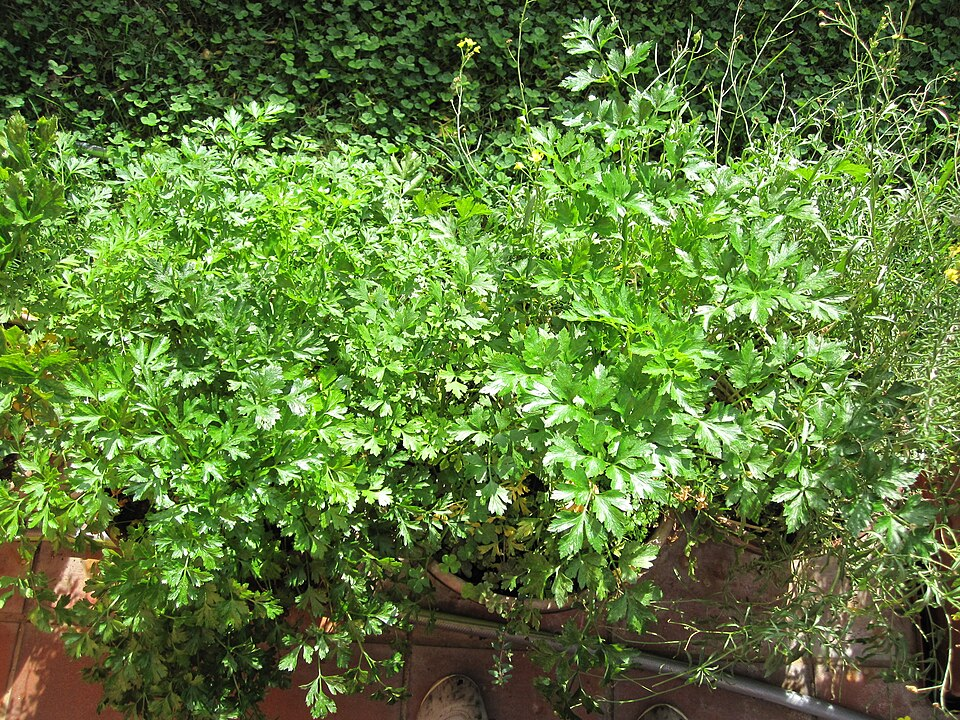
- Apiales (carrots, celery, coriander, parsley)
- Aquifoliales (holly)
- Asterales (radicchio, sunflower seeds)
- Bruniales (brunia)
- Dipsacales (sanguisorba)
- Escalloniales (escallonia)
Photo(s):
1. Petar43, CC BY-SA 3.0 https://creativecommons.org/licenses/by-sa/3.0, via Wikimedia Commons