
Brione (or polpa di spalla)
Food, Animal source foods, Animals (Animalia), Chordates (Chordata), Vertebrates (Vertebrata), Mammals (Mammalia), Therians (Theria), Placentals (Placentalia), Artiodactyls (Artiodactyla), Ruminants (Ruminantia), Bovids (Bovidae), Bovines (Bovinae), Bovini, Bos, Cattle
Species name: Bos Taurus
Consumption area(s): Italy 🇮🇹, San Marino 🇸🇲, Vatican City 🇻🇦. However, it should be noted that similar cuts may also be consumed in other countries.
Anatomy of brione (or polpa di spalla)
Brione (or polpa di spalla), does not actually belong to the shoulder itself but is obtained from the upper arm, at the level of the humerus. This section is composed of two distinct muscle groups: the biceps brachii and the deep pectoral.
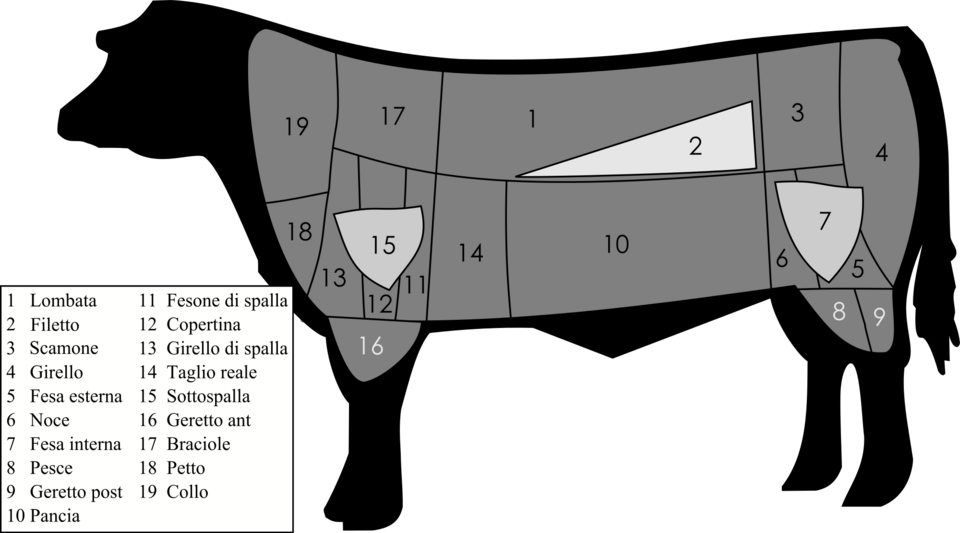
In the image, this cut corresponds to the anterior portion of numbers 16 and 13.
Similar cuts aroud the Earth
There are no similar cuts in other countries.
Uses of brione (or polpa di spalla)
Brione (or polpa di spalla) is classified among the less prized cuts, yet it contains muscles with very different characteristics. For this reason, butchers always separate them, assigning them to different culinary uses. One of the two, the biceps brachii, is a tender muscle particularly rich in connective tissue, especially in the tendon area. Its compact and oblique shape, similar to that of the “campanello” cut, makes it unique among cattle muscles. This cut is highly valued for slow cooking methods, such as boiling, stewing, or braising, where its tenderness is best expressed.
The other muscle, the deep pectoral, has a completely different structure: it is fibrous, resistant to cooking, and lacking notable qualities in terms of flavor or tenderness. Because of these characteristics, it is usually used for broths or ground meat, where its firm texture does not represent a problem.
Although both belong to the same anatomical cut, the substantial difference between the two muscles requires careful separation, allowing each part to be used to its best advantage, depending on the most suitable culinary preparations.
Nutritional facts table
It should be noted that nutritional values may slightly vary depending on the animal.
| Nutrients | Per 100 g |
| Calories (kcal) | 129 |
| Total fat (g) | 5 |
| ———Saturated fat (g) | 1.41 |
| Cholesterol (mg) | 65 |
| Sodium (mg) | 60 |
| Total carbohydrates (g) | 0 |
| ———Dietary fiber (g) | 0 |
| ———Total sugar (g) | 0 |
| Protein (g) | 19.63 |
Recipes that use this product as an ingredient:
Source(s):
https://piratasuino.it/wp-content/uploads/2024/04/QUADERNO-1-I-TAGLI-DEL-BOVINO.pdf
Photo(s):
1. Yzmo, Giglio83, CC BY-SA 3.0 https://creativecommons.org/licenses/by-sa/3.0, via Wikimedia Commons