
Brigidino di Lamporecchio (Lamporecchio Brigidino)
Foods, Culinary bases, Flour-based foods, Wafers
Consumption area(s): Valdinievole
Introduction
Brigidino di Lamporecchio (Lamporecchio Brigidino) is among the most distinctive traditional sweet of Tuscany, originating in the town of Lamporecchio, in the province of Pistoia. This delicate wafer is renowned for their crisp texture, anise-flavored aroma, and characteristic appearance.
Description of Brigidino di Lamporecchio
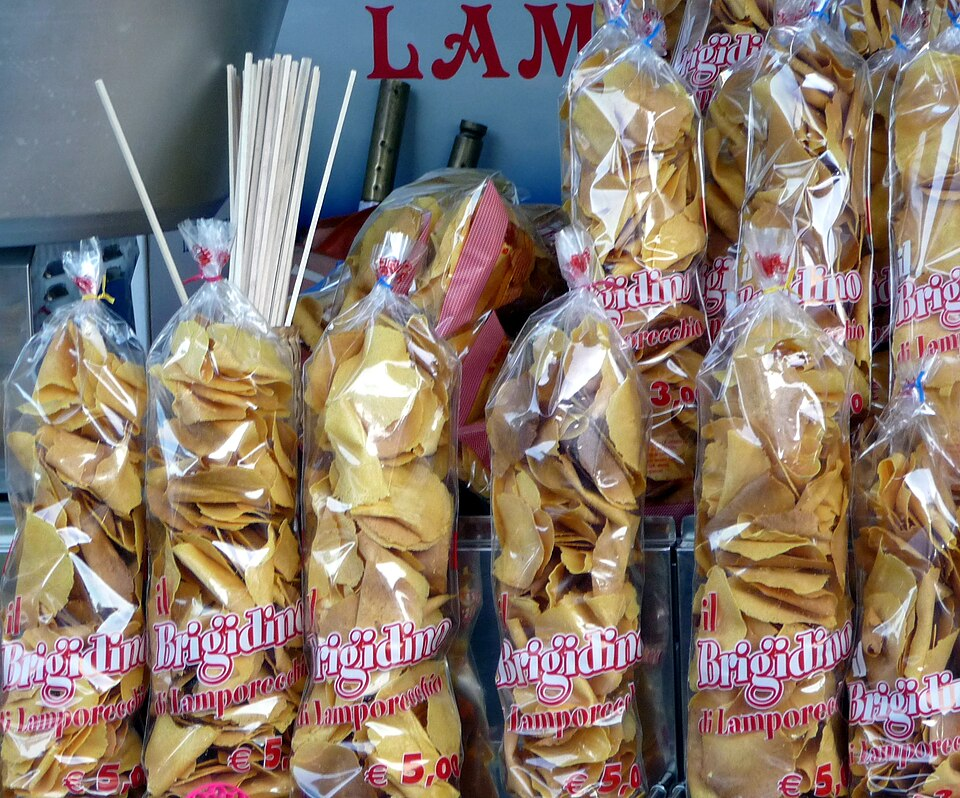
Brigidini are typically produced as thin, round discs measuring approximately 7–10 centimeters in diameter, with gently curled edges and a bright yellow-orange color resulting from the presence of eggs in the dough.
The recipe is remarkably simple, relying on a combination of soft wheat flour, sugar, eggs, and anise flavoring. Historically, whole anise seeds were commonly used, while modern production often employs liquid anise essence. Once baked, the wafers become extremely light, brittle, and crunchy, making them instantly recognizable among Tuscan confectionery specialties. Traditionally, they are sold in tall, narrow transparent bags, although cardboard boxes and paper packaging are also used.
Brigidini have become a symbol of local gastronomy and can be found throughout Tuscany at village festivals, fairs, markets, and amusement events, where they are often prepared and sold directly to the public by specialized vendors known as “brigidinai”.
History of Brigidino di Lamporecchio
The origins of Brigidini are closely linked to a local religious tradition dating back to the Renaissance period. According to popular accounts, the name derives from the Brigidine nuns, members of a convent in Pistoia devoted to Saint Bridget. During the sixteenth century, these nuns are believed to have created the sweet, giving rise to a recipe that would later become deeply associated with Lamporecchio.
A well-known legend attributes the invention of Brigidini to an accidental mistake made while preparing communion wafers. Rather than discarding an imperfect mixture, the nuns enriched it with anise, creating a new confection with a distinctive flavor and texture.
Production methods for Brigidino di Lamporecchio
The manufacture of Brigidini begins with the preparation of a smooth batter made from type “0” or “00” wheat flour, sugar, eggs, and anise flavoring. Although the ingredient list is simple, the characteristic texture and appearance of the final product depend heavily on the cooking process.
Modern production is generally carried out using a specialized rotating machine known locally as the “giostra.” The batter is placed into a hopper equipped with a dosing system that releases a precise amount of mixture onto a heated lower mold. An upper plate then presses the batter into a very thin layer while the machine rotates. Baking typically takes around one minute at temperatures approaching 200°C, allowing the wafer to develop its distinctive golden color and delicate crispness.
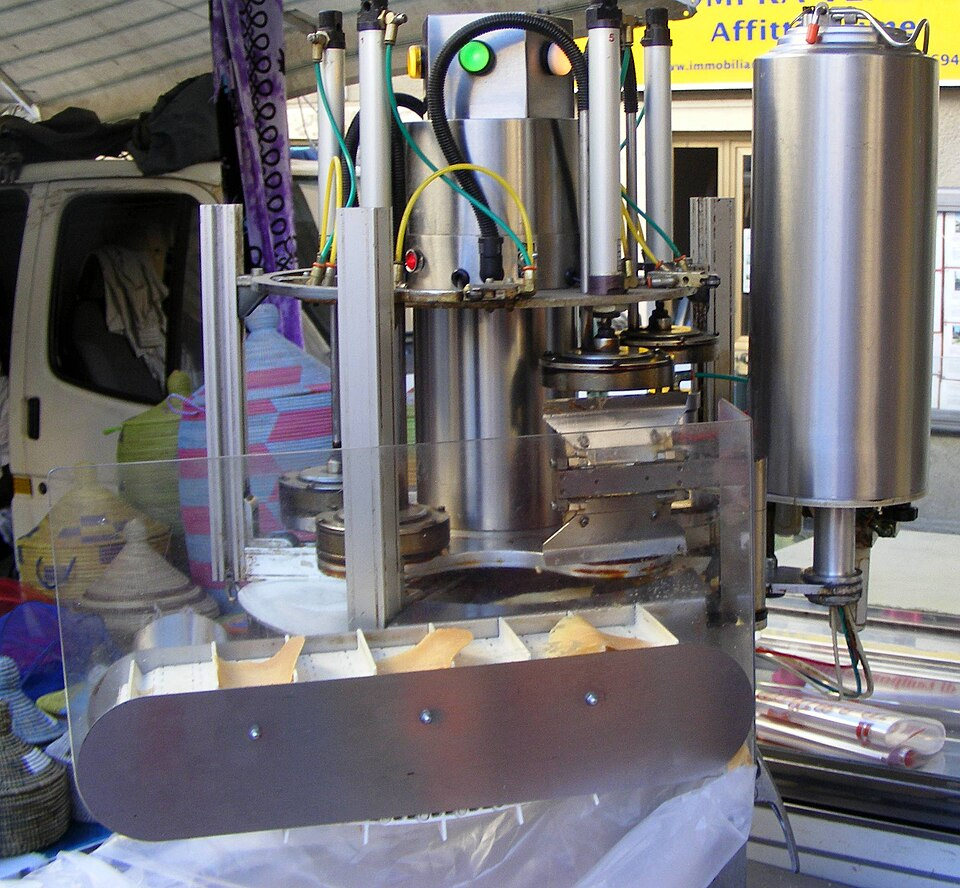
Once the cooking cycle is complete, the upper plate lifts and the finished wafer is removed with a spatula. The freshly baked Brigidini are initially flexible, but they quickly cool and harden as they travel along a conveyor system designed to shape, transport, and prepare them for packaging. The finished wafers are then packed for sale in their traditional elongated bags or alternative containers.
Before mechanization, Brigidini were produced entirely by hand. Small portions of dough were shaped individually and pressed between heavy heated metal tongs engraved with decorative motifs such as flowers, suns, and geometric patterns. These designs were transferred directly onto the surface of the wafer, giving each piece a distinctive appearance. The tongs were heated over an open flame and manually turned during baking.
Nutritional facts table
Please note that nutritional values may vary slightly depending on the ingredients used.
Source(s):
http://prodtrad.regione.toscana.it/LIB_ProdTrad/Prodotto.php?ID=151
https://it.wikipedia.org/wiki/Brigidino_di_Lamporecchio
Photo(s):
1. Lucarelli, CC BY-SA 3.0 https://creativecommons.org/licenses/by-sa/3.0, via Wikimedia Commons
2. F Ceragioli, CC BY-SA 3.0 https://creativecommons.org/licenses/by-sa/3.0, via Wikimedia Commons