
Bay laurel
Species of Laurum
Food, Plant source foods, Plants (Plantae), Flowering plats (angiospermae), Mesangiosperms, Magnoliids, Laurales, Lauraceae (Laurels)
Species name: Laurus nobilis
Consumption area(s): Albania 🇦🇱, Algeria 🇩🇿, Andorra 🇦🇩, Bosnia and Herzegovina 🇧🇦, Croatia 🇭🇷, Cyprus 🇨🇾, France 🇫🇷, Greece 🇬🇷, Israel 🇮🇱, Italy 🇮🇹, Lebanon 🇱🇧, Libya 🇱🇾, Malta 🇲🇹, Monaco 🇲🇨, Montenegro 🇲🇪, Morocco 🇲🇦, Palestine 🇵🇸, Portugal 🇵🇹, San Marino 🇸🇲, Slovenia 🇸🇮, Spain 🇪🇸, Syria 🇸🇾, Tunisia 🇹🇳, Turkey 🇹🇷, Vatican City 🇻🇦
Note: For better understanding, please read the article on flowering plants (angiospermae) first. If you come across unfamiliar words, you can click on any highlighted term to open the glossary with definitions of key botanical terms.
Introduction
Bay laurel (Laurus nobilis) is a fragrant evergreen species that can develop either as a substantial shrub or as a fully grown tree. Its foliage is dark green and notably aromatic. Originating in the Mediterranean basin, it has long been valued in the culinary sphere. Its leaves, commonly known as bay leaves, are widely employed as a seasoning to enhance flavor in numerous dishes. Among its various common designations are bay tree, bay laurel, sweet bay, true laurel, and Grecian laurel.
It is important to note that the terms “bay” and “laurel” are frequently applied to many unrelated species across different botanical families. These plants share neither close genetic ties nor placement with Laurus nobilis; rather, the shared names arise from comparable leaf shape or aromatic qualities reminiscent of the true laurel.
Description of the plant
When subjected to frequent pruning, this species commonly takes on the appearance of a shrub, varying in size according to cultivation. Left to grow freely, however, it becomes a fully developed tree, capable of attaining about 10 meters in height. Its structure is defined by thin branches without hair that shape a dense, distinctly pyramidal canopy.
The timber is permeated with a strong aromatic scent, identical to the fragrance released by the foliage. The stem grows straight and vertical, protected by a dark, greenish-black bark that gives the trunk a robust aspect.
Botanically, the plant is classified as dioecious, meaning that male and female flowers occur on separate individuals. In female specimens, small, sterile staminodes—usually two to four—remain as nonfunctional residues. In contrast, male flowers retain rudimentary female organs that are similarly infertile. The flowers are pale yellow, arranged in characteristic umbel inflorescences, and typically appear in early spring, around March and April.
The fruit is a single-seeded drupe that becomes black and lustrous upon ripening. These berries generally reach full maturity in autumn, specifically during October and November.
Description of the edible part (leaves)
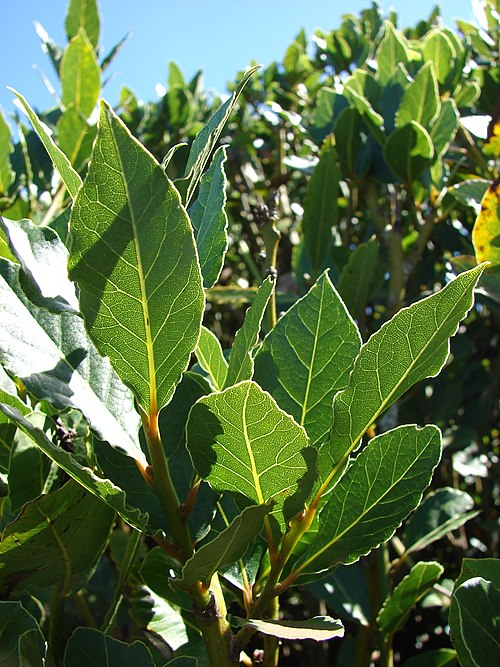
The foliage of this plant consists of ovate leaves with a rich dark green coloration and a tough, leathery consistency. The upper blade is notably shiny, whereas the lower surface appears duller. Their intense fragrance makes them particularly prized.
Production methods for bay laurel
Laurel is a particularly hardy plant, capable of adapting to a wide range of soil types. It thrives in different cultivation settings and can be grown successfully in a vegetable garden, whether exposed to full sunlight or placed in partial shade.
Its spread occurs with notable ease through seeds, which are dispersed naturally by birds feeding on its fruits. In the wild, it also reproduces vegetatively by producing suckers but, in cultivation, propagation is commonly achieved through cuttings, ensuring consistent replication of the parent specimen.
Uses of bay laurel
This species provides several widely appreciated culinary herbs as well as a notable spice, all extensively incorporated into numerous dishes, especially within Mediterranean gastronomy. The leaves are primarily valued for their aromatic properties, contributing depth and complexity to recipes rather than serving as edible components.
In most preparations, whole leaves are infused during cooking and then removed before the dish reaches the table. Under ordinary conditions of temperature and humidity, intact leaves retain their quality for roughly one year. When processed into powdered form, however, the leaf can be safely consumed and is frequently blended into soups, stocks, broths and even savory beverages such as a Bloody Mary.
Beyond the foliage, other parts of the plant also possess culinary significance. Dried berries and extracted leaf oil function as intensely flavored seasonings, while the wood, when burned, releases a pronounced aromatic smoke suitable for flavoring foods.
Classification of bay laurel
Bay laurel is classified according to the cultivar to which it belongs. Among these, we find:
- Vlaamse laurier IGP (or Flemish bay laurel)
Nutritional facts table of leaves
Since nutritional values can vary slightly depending on the cultivar, the figures provided below represent general averages.
| Nutrients | Per 100 g |
| Calories (kcal) | 313 |
| Total fat (g) | 8.36 |
| ———Saturated fat (g) | 2.28 |
| Cholesterol (mg) | 0 |
| Sodium (mg) | 23 |
| Total carbohydrates (g) | 74.97 |
| ———Dietary fiber (g) | 26.3 |
| ———Total sugar (g) | 0 |
| Protein (g) | 7.61 |
Recipes that use this product as an ingredient:
Photo(s):
1. Forest & Kim Starr, CC BY 3.0 US https://creativecommons.org/licenses/by/3.0/us/deed.en, via Wikimedia Commons