
Basidiomycetes (Basidiomycota)
Phylum of fungi
Food, Animal source foods, Fungi
Consumption area(s): Earth
Introduction
Basidiomycetes (Basidiomycota) are one of the two major fungal divisions that, together with the Ascomycota, formt the kingdom Fungi. They are characterized by specialized reproductive cells and often complex developmental cycles, features that contribute to their wide distribution and structural diversity.
Description of basidiomycetes (Basidiomycota)
Basidiomycota are mostly fungi made of hyphae and typically reproduce sexually through the development of specialized club-shaped cells called basidia, which usually produce four external meiospores known as basidiospores. Some Basidiomycota reproduce exclusively through asexual means. Even in these cases, they can generally be identified as members of this division by their overall similarity to other basidiomycetes, the presence of distinctive anatomical structures such as clamp connections and characteristic cell wall components.
Life cycle
Basidiomycota differ from animals and plants because they do not have distinct male and female forms. Most species consist of haploid mycelia made of filamentous hyphae that are morphologically similar but compatible from a genetic point of view. When two compatible haploids meet, they fuse through plasmogamy, and their nuclei pair up without immediately fusing, forming a dikaryotic hypha.
Haploid mycelia are called monokaryons, while the paired nuclei are known as a dikaryon, which is often more vigorous and can dominate the substrate. Dikaryons can persist for years, decades, or even centuries. Mating systems can be bipolar or tetrapolar, meaning that compatibility between new monokaryons after meiosis occurs in 50% or 25% of cases, respectively.
The dikaryotic state is maintained by clamp connections, specialized hyphal structures that ensure paired nuclei are properly distributed during mitotic divisions. Over time, dikaryotic mycelia produce basidia, specialized club-shaped cells where the paired nuclei fuse (karyogamy) to form a diploid nucleus. Meiosis then occurs, generating four haploid nuclei that migrate into basidiospores. These basidiospores can germinate into new haploid mycelia, continuing the lifecycle. Basidia are microscopic but are often produced within larger fruiting bodies called basidiocarps, including mushrooms. The spores form on sterigmata, curved spine-like projections, though in some species spores are not ballistic and are released through disintegration of the basidia.
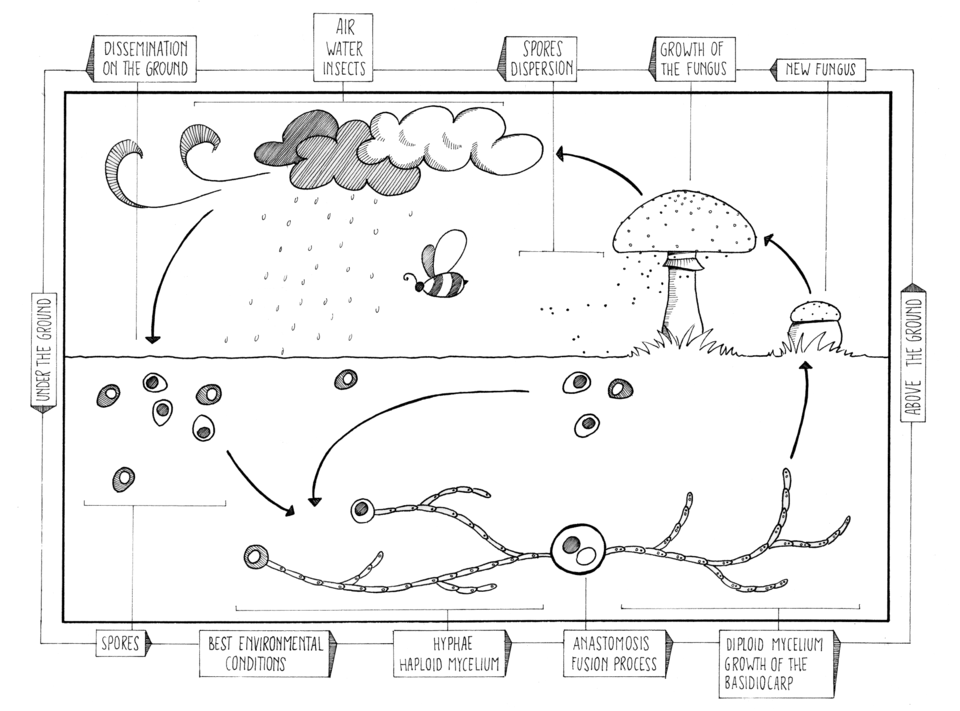
In summary, meiosis occurs in the diploid basidium, producing four haploid nuclei, each entering a basidiospore. These spores start new monokaryon, which are compatible rather than male or female. Fusion of compatible monokaryons through plasmogamy delays karyogamy, establishing a dikaryon. The dikaryon can persist for long periods and eventually forms basidia, either directly or within fruitbodies, where karyogamy and meiosis restart the cycle, producing haploid basidiospores and continuing the Basidiomycota lifecycle.
Classificatin of basidiomycetes (Basidiomycota)
Basidiomycetes are divided into classes; among these, the ones that include edible species are:
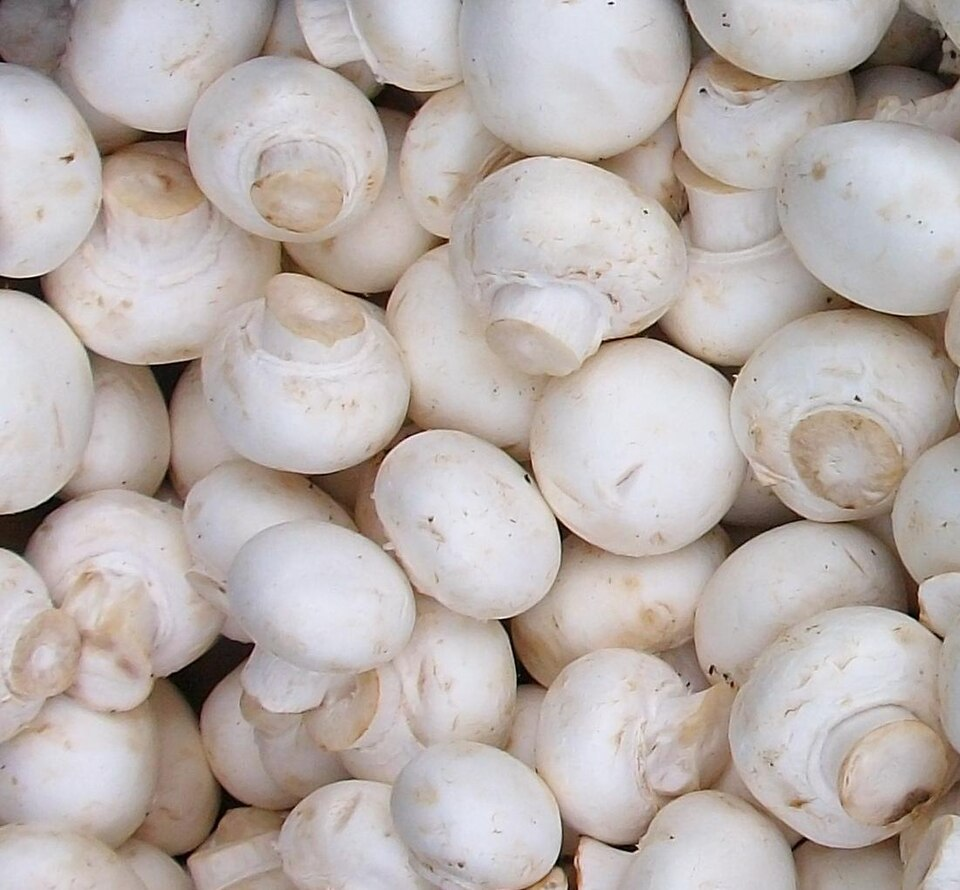
- Agaricomycetes (porcini, button mushrooms, chanterelles, parasol mushrooms, honey mushrooms)
- Dacrymycetes (orange jelly fungus, witches’ butter)
- Tremellomycetes (snow fungus, silver ear fungus, white jelly fungus)
- Ustilaginomycetes (corn smut, Mexican truffle)
Source(s):
https://en.wikipedia.org/wiki/Basidiomycota
Photo(s):
1. böhringer friedrich, CC BY-SA 2.5 https://creativecommons.org/licenses/by-sa/2.5, via Wikimedia Commons
2. .mw-parser-output .messagebox{margin:4px 0;width:auto;border-collapse:collapse;border:2px solid var(–border-color-progressive,#6485d1);background-color:var(–background-color-neutral-subtle,#fbfcff);color:var(–color-base,#202122);box-sizing:border-box;border-inline-start-width:8px}.mw-parser-output .messagebox.mbox-small{font-size:88%;line-height:1.25em}.mw-parser-output .mbox-warning,.mw-parser-output .mbox-speedy{border:2px solid var(–border-color-error,#b22222);background:var(–background-color-error-subtle,#ffdbdb);border-inline-start-width:8px}.mw-parser-output .mbox-serious,.mw-parser-output .mbox-delete,.mw-parser-output .mbox-stop{border:2px solid var(–border-color-error,#b22222);border-inline-start-width:8px}.mw-parser-output .mbox-issue,.mw-parser-output .mbox-content{border:2px solid #f28500;background:var(–background-color-warning-subtle,#ffe);border-inline-start-width:8px}.mw-parser-output .mbox-query,.mw-parser-output .mbox-style{border:2px solid #f4c430;background:var(–background-color-warning-subtle,#ffe);border-inline-start-width:8px}.mw-parser-output .mbox-shit{border:2px solid #960;border-inline-start-width:8px}.mw-parser-output .mbox-license{border:2px solid #88a;border-inline-start-width:initial}.mw-parser-output .mbox-legal{border:2px solid var(–border-color-notice,#666);background:var(–background-color-base,#fff);border-inline-start-width:8px}.mw-parser-output .mbox-honor{border:2px solid #ca3;background:var(–background-color-warning-subtle,#fcf4db);border-inline-start-width:8px}.mw-parser-output .mbox-growth{border:2px solid #8d4;background:var(–background-color-success-subtle,#d5fdf4);border-inline-start-width:8px}.mw-parser-output .mbox-move{border:2px solid #93c;border-inline-start-width:8px}.mw-parser-output .mbox-protection,.mw-parser-output .mbox-message{border:2px solid var(–border-color-base,#aaa);border-inline-start-width:8px}.mw-parser-output .messagebox .mbox-text{border:none;padding:0.25em 0.9em;width:100%}.mw-parser-output .messagebox .mbox-image{border:none;padding:2px 0 2px 0.9em;text-align:center}.mw-parser-output .messagebox .mbox-imageright{border:none;padding:2px 0.9em 2px 0;text-align:center}.mw-parser-output .messagebox .mbox-empty-cell{border:none;padding:0;width:1px}.mw-parser-output .messagebox .mbox-invalid-type{text-align:center}@media(min-width:720px){.mw-parser-output .messagebox{margin:4px 10%}.mw-parser-output .messagebox.mbox-small{clear:right;float:right;margin:4px 0 4px 1em;width:238px}}body.skin–responsive .mw-parser-output table.messagebox img{max-width:none!important}Quest’immagine è stata realizzata durante il ” DensityDesign Integrated Course Final Synthesis Studio ” al Politecnico di Milano , organizzato dal DensityDesign Research Lab nel 2015. Un ringraziamento ad Anita Righetto., CC BY-SA 4.0 https://creativecommons.org/licenses/by-sa/4.0, via Wikimedia Commons