
Amaranthaceae
Family of Caryophyllales
Food, Plant source foods, Plants (Plantae), Flowering plats (angiospermae), Mesangiosperms, Eudicots, Core eudicots, Superasterids, Caryophyllales
Consumption area(s): Earth
Note: For better understanding, please read the article on flowering plants (angiospermae) first. If you come across unfamiliar words, you can click on any highlighted term to open the glossary with definitions of key botanical terms.
Introduction
The Amaranthaceae is a family of flowering plants, named after its representative genus Amaranthus and commonly referred to as the amaranth family. This family is highly diverse, comprising roughly 165 genera and more than 2,000 species. Due to this extensive diversity, it represents the largest and most species-rich group within the order Caryophyllales.
Description of Amaranthaceae
Most members of the Amaranthaceae are annual or perennial herbs, sometimes developing into shrubs, while only a small number grow as climbers or trees. Certain species exhibit succulence, and many show thickened stem nodes. In woody forms, the stem often displays an unusual type of secondary growth.
The leaves are simple and generally arranged alternately, though in some cases they may be opposite. They lack stipules entirely and can appear either flat or cylindrical, with a highly variable morphology. Margins may be smooth or toothed, and in certain species the leaves are reduced to small scale-like structures. Typically, leaves are evenly distributed along the stem, without forming clusters at the base or apex.
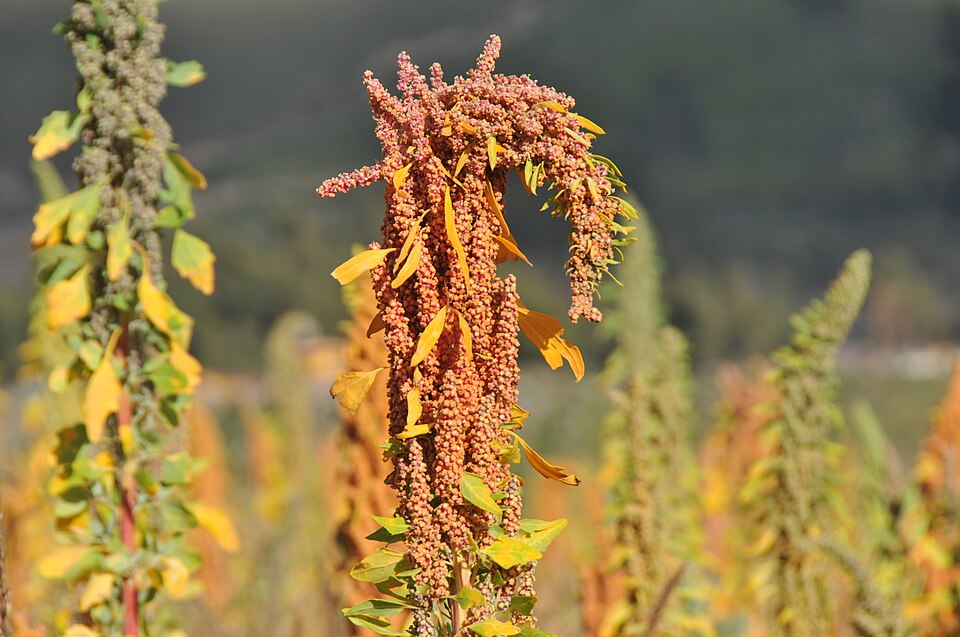
The flowers may occur individually or grouped into inflorescences such as spikes, or panicles. They are usually bisexual and radially symmetrical, although unisexual forms also exist. Associated structures like bracts can be leaf-like. The floral envelope consists of tepals, most often five, sometimes partially fused. The stamens, ranging from one to five, are positioned in relation to the tepals and arise from a hypogynous disc, which may bear additional structures. The anthers contain two or four pollen sacs, and the pollen grains are typically spherical. The carpels, usually between one and three, unite to form a superior ovary containing one, rarely two, ovules.
The diaspores consist of either seeds or fruits, commonly in the form of utricles, with the perianth often persisting and adapting to aid in dispersal. In some cases, bracts may also contribute to this function. Less frequently, the fruit develops as a capsule that opens circumferentially or as a berry. The seeds, oriented either horizontally or vertically, often possess a thick or hardened coat. The embryo is typically green or white.
Classification of Amaranthaceae
This family is further divided into subfamilies. Among these are:
- Betoideae (beet, chard)
- Chenopodioideae (spinach)
- Gomphrenoideae (amaranth)
- Suaedoideae (seablite)
Photo(s):
1. Philipp, CC0, via Wikimedia Commons