
Cattle collo/collier
Food, Animal source foods, Animals (Animalia), Chordates (Chordata), Vertebrates (Vertebrata), Mammals (Mammalia), Therians (Theria), Placentals (Placentalia), Artiodactyls (Artiodactyla), Ruminants (Ruminantia), Bovids (Bovidae), Bovines (Bovinae), Bovini, Bos, Cattle
Species name: Bos Taurus
Consumption area(s): France 🇫🇷, Italy 🇮🇹, Monaco 🇲🇨, San Marino 🇸🇲, Vatican City 🇻🇦. However, it should be noted that similar cuts may also be consumed in other countries.
Local name(s)
- Italy, San Marino, Vatican City: Collo
- France, Monaco: Collier
Anatomy of cattle collo/collier
The cattle collo/collier has a trapezoidal shape and is located immediately behind the head. This cut rests on the first seven cervical vertebrae, which determine its structure and its culinary specificity. The muscles that compose it are: the rhomboideus, the trapezius, the splenius, the semispinalis thoracis, the semispinalis capiti, the longissimus atlantis et capitis, the longus colli, the serratus ventralis cervicis, the brachiocephalicus, the sternocephalicus, and the intrasversarii cervicis.
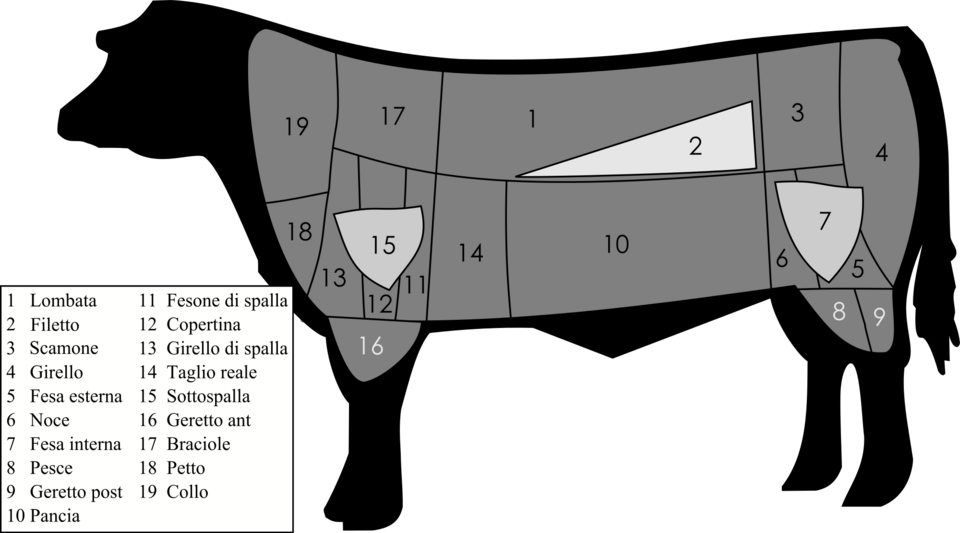
In the image, it corresponds to number 19.
Similar cuts aroud the Earth
- United States, Canada: Chuck (only the front part)
- United Kingdom, Ireland, Australia, South Africa, New Zealand: Neck and clod
- Brazil: Pescoço
- Germany: Rinderhals, Kamm or Nacken
- Russia: Шея / Sheya
- Turkey: Gerdan (only the front part)
- Portugal: Cachaço
- Netherlands: Neck
- Finland: Niska (only the front part)
- Poland: Karkówka
- Croatia: Vratina
Uses of cattle collo/collier
Cattle collo/collier comes from the front part of the animal’s neck and features a mix of lean meat and fat. As a muscle that is constantly active, the meat is relatively tough but full of rich flavor. Its structure makes it ideal for long-cooking methods such as stews and braises, where the meat slowly becomes tender and absorbs the seasonings and cooking liquids.
It is also very versatile, and can be turned into a thick, flavorful sauces by finely mincing the meat and cooking it with tomatoes, red wine, and aromatics. This preparation produces a rich, robust sauce, perfect for pasta or risotto.
Nutritional facts table
It should be noted that nutritional values may slightly vary depending on the animal.
| Nutrients | Per 100 g |
| Calories (kcal) | 299 |
| Total fat (g) | 19 |
| ———Saturated fat (g) | 8 |
| Cholesterol (mg) | 85 |
| Sodium (mg) | 60 |
| Total carbohydrates (g) | 0 |
| ———Dietary fiber (g) | 0 |
| ———Total sugar (g) | 0 |
| Protein (g) | 20 |
Recipes that use this product as an ingredient:
Source(s):
https://piratasuino.it/wp-content/uploads/2024/04/QUADERNO-1-I-TAGLI-DEL-BOVINO.pdf
Photo(s):
1. Yzmo, Giglio83, CC BY-SA 3.0 https://creativecommons.org/licenses/by-sa/3.0, via Wikimedia Commons