
Cappello del prete (or sorra, copertina)
Food, Animal source foods, Animals (Animalia), Chordates (Chordata), Vertebrates (Vertebrata), Mammals (Mammalia), Therians (Theria), Placentals (Placentalia), Artiodactyls (Artiodactyla), Ruminants (Ruminantia), Bovids (Bovidae), Bovines (Bovinae), Bovini, Bos, Cattle
Species name: Bos Taurus
Consumption area(s): Italy 🇮🇹, San Marino 🇸🇲, Vatican City 🇻🇦. However, it should be noted that similar cuts may also be consumed in other countries.
Local name(s)
Armone (Rome, Vatican City), Cappello del prete (Milan), Copertina (Parma, Verona), Girello di spalla (Belluno), Paletta (Genoa), Palotta di spalla (Verona), Sorra (Florence)
Anatomy of cappello del prete (or sorra or copertina)
It is located in the upper part of the scapula, connecting anteriorly to the girello di spalla and inferiorly to the brione (or polpa di spalla). On the lateral side, it is near the fesone di spalla. The muscles that compose it are the infraspinatus and the teres minor.
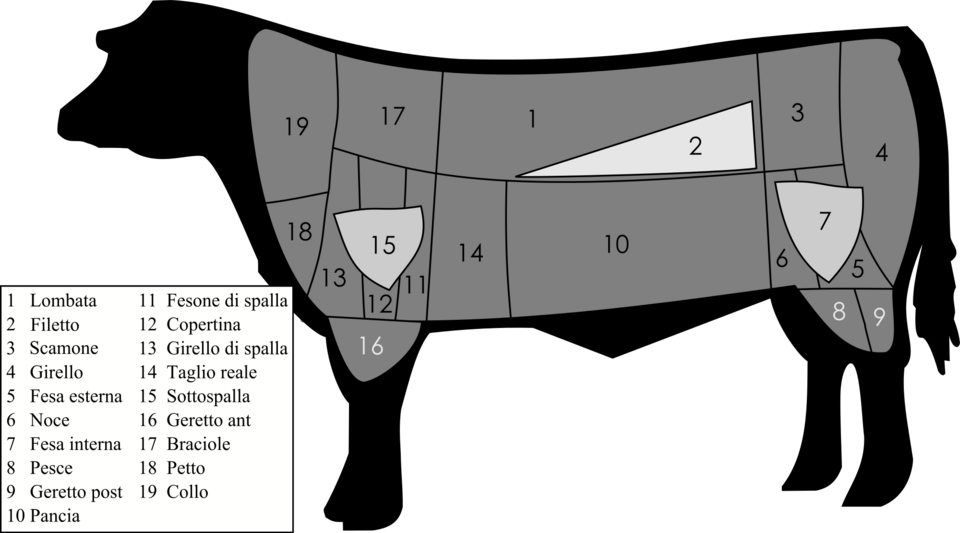
In the image, it corresponds to number 12.
Similar cuts aroud the Earth
There are no similar cuts in other countries.
Uses of cappello del prete (or sorra, copertina)
The Cappello del prete (or sorra, copertina), mostly comes from the infraspinatus muscle, known for being one of the tenderest cuts, second only to the tenderloin. Despite its natural tenderness, it performs best in long-cooking recipes, such as boiled or stewed dishes, which is why it is often sold under labels like “broth meat” or similar.
Thanks to its good fat content, during prolonged cooking it remains moist and tender, avoiding the dry and tough texture found in other cuts less suitable for slow cooking. One of the features that make this cut particularly suited for extended cooking is the presence of an internal collagen vein. With prolonged heat, the collagen slowly melts, enriching the meat with a velvety tenderness and rich flavor, making it perfect for intensely flavored dishes.
Nutritional facts table
It should be noted that nutritional values may slightly vary depending on the animal.
| Nutrients | Per 100 g |
| Calories (kcal) | 118 |
| Total fat (g) | 4 |
| ———Saturated fat (g) | 1.8 |
| Cholesterol (mg) | 65 |
| Sodium (mg) | 60 |
| Total carbohydrates (g) | 0 |
| ———Dietary fiber (g) | 0 |
| ———Total sugar (g) | 0 |
| Protein (g) | 20.03 |
Recipes that use this product as an ingredient:

Source(s):
https://piratasuino.it/wp-content/uploads/2024/04/QUADERNO-1-I-TAGLI-DEL-BOVINO.pdf
Photo(s):
1. Yzmo, Giglio83, CC BY-SA 3.0 https://creativecommons.org/licenses/by-sa/3.0, via Wikimedia Commons