
Biancostato
Food, Animal source foods, Animals (Animalia), Chordates (Chordata), Vertebrates (Vertebrata), Mammals (Mammalia), Therians (Theria), Placentals (Placentalia), Artiodactyls (Artiodactyla), Ruminants (Ruminantia), Bovids (Bovidae), Bovines (Bovinae), Bovini, Bos, Cattle
Species name: Bos Taurus
Consumption area(s): Italy 🇮🇹, San Marino 🇸🇲, Vatican City 🇻🇦. However, it should be noted that similar cuts may also be consumed in other countries.
Local name(s)
Appiccatura (Bari, Foggia), Biancostato (Milan, Vicenza), Bongiolo (Venice), Corazza (Naples), Costamozza (Trento), Costata (Bologna), Fracosta (Treviso), Gabbia (Palermo, Reggio Calabria), Oriada (Vicenza), Ossette (Genoa), Petto (Perugia, Potenza), Piatto di costa (Messina), Restringitura (Florence), Scadinata (Macerata), Scaramella (Genoa), Scorzadura (Padua), Spezzato (Turin), Spuntatura di spalla (L’Aquila), Spuntature (Rome, Vatican City), Stecca (Treviso), Taglio reale (Mantua, Parma, Rovigo, Verona)
Anatomy of biancostato
The biancostato is a cut that includes part of the animal’s abdomen together with a section of the rib cage. The muscles involved are the external abdominal oblique, internal abdominal oblique, transverse abdominal muscle, and rectus abdominis.
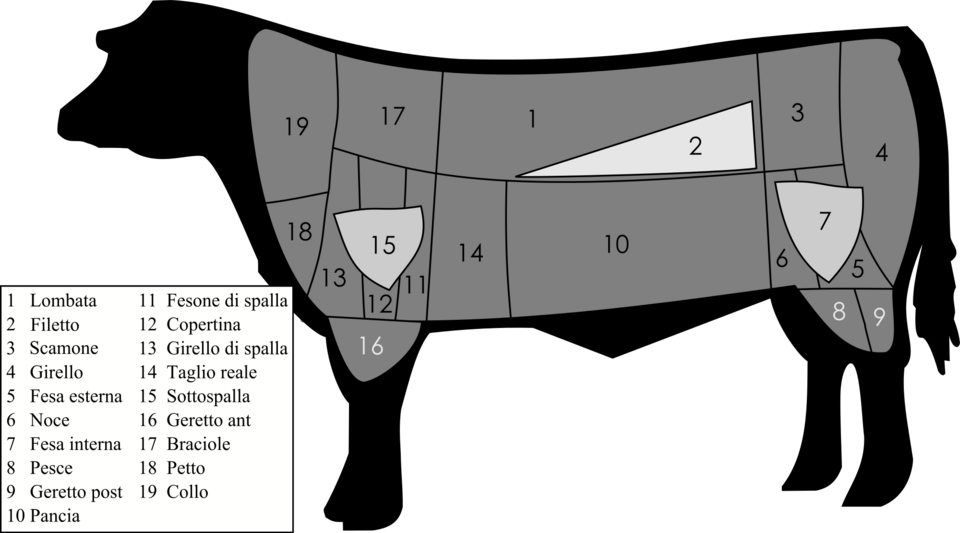
In the figure, the biancostato corresponds to the upper portion of numbers 10 and 14, as well as the area beneath the numbers indicating the shoulder (11, 12, 13, 15).
Similar cuts aroud the Earth
- America, Canada, United Kingdom, Ireland, Australia, South Africa, New Zealand: There is no similar cut, but ribs are commonly known as “ribs” and are often cut horizontally, taking the name “short ribs”.
- Brazil: There is no similar cut, but separated ribs are known as “costelas curtas”.
- Argentina, Uruguay: There is no similar cut, but ribs cut transversely are known as “asado de tira”.
- France, Monaco: There is no similar cut, but it is similar to the “plate de côtes”, although this only includes the front ribs.
- Germany: There is no similar cut, but it takes a different name depending on the district from which it is separated. These are: Querrippe (front ribs), Flachrippe (central and back ribs).
- Turkey: There is no similar cut, but it takes a different name depending on the district from which it is separated. These are: Ön kaburga (front ribs), Orta kaburga (central ribs), Arka kaburga (back ribs).
- Portugal: There is no similar cut, but it takes a different name depending on the district from which it is separated. These are: Costela do peito (front ribs), Costela do lombo (back ribs).
- Poland: There is no similar cut, but it takes a different name depending on the district from which it is separated. These are: Żebra przednie (front ribs), Żebra tylne (back ribs).
- Croatia: There is no similar cut, but it takes a different name depending on the district from which it is separated. These are: Rebra prednja (front ribs), Rebra stražnja (back ribs).
Uses of biancostato
The biancostato is a lower-grade cut of meat, usually intended for the preparation of broths, boiled dishes, and stews. Nevertheless, the muscles that compose it have different tenderness characteristics. In particular, the internal abdominal oblique is quite tender, so much so that it is considered comparable, if not superior, to the muscles of more sought-after cuts.
On the other hand, the other muscles of the biancostato are tougher and require longer cooking times. However, by isolating the tenderest part, it is possible to obtain steaks that, if cooked quickly on the grill or in a pan, are very flavorful and can be served rare, even though these preparations are more commonly used in other countries.
It should also be noted that one can distinguish between biancostato di reale (located anteriorly, under the reale, corresponding to the first five vertebrae) and biancostato di pancia (located posteriorly to the biancostato di reale), although there are few differences in terms of usage and nutritional values.
Nutritional facts table
It should be noted that nutritional values may slightly vary depending on the animal.
| Nutrients | Per 100 g |
| Calories (kcal) | 171 |
| Total fat (g) | 10 |
| ———Saturated fat (g) | 3 |
| Cholesterol (mg) | 65 |
| Sodium (mg) | 60 |
| Total carbohydrates (g) | 0 |
| ———Dietary fiber (g) | 0 |
| ———Total sugar (g) | 0 |
| Protein (g) | 19.7 |
Recipes that use this product as an ingredient:
Source(s):
https://piratasuino.it/wp-content/uploads/2024/04/QUADERNO-1-I-TAGLI-DEL-BOVINO.pdf
Photo(s):
1. Yzmo, Giglio83, CC BY-SA 3.0 https://creativecommons.org/licenses/by-sa/3.0, via Wikimedia Commons