
Gallus gallus
Species of Gallus
Food, Animal source foods, Animals (Animalia), Chordates (Chordata), Vertebrates (Vertebrata), Birds (Aves), Neognaths (Neognathae), Galliforms (Galliformes), Phasianidae, Gallus
Species name: Gallus gallus
Consumption area(s): Earth
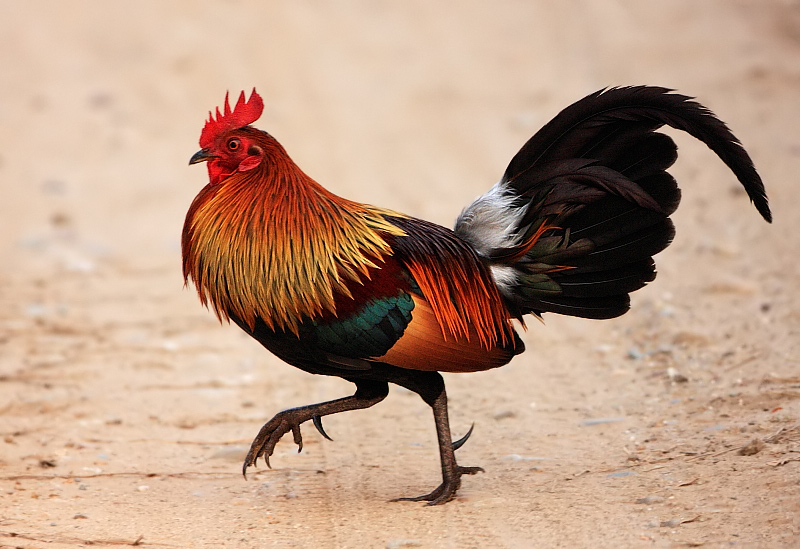
Introduction
Gallus gallus are galliform birds belonging to the family Phasianidae. Their original distribution extends across large areas of Southeast Asia and portions of South Asia, where they inhabit forests, forest edges, and other densely vegetated environments. A domesticated form of this species, commonly known as the domestic chicken, has been spread globally by human societies. Today it represents one of the most numerous vertebrate animals on Earth, with tens of billions of individuals raised worldwide. These birds are primarily kept for meat and egg production, though they are also valued for theirplumage and sometimes maintained as companion animals.
Description of Gallus gallus
Gallus gallus shows pronounced sexual dimorphism, meaning that males and females differ clearly in both size and appearance. Adult males typically reach 25.6–30.7 in (65–78 cm) in length and weigh around 1.48–3.20 lb (672–1450 g). Females are smaller, measuring about 16.1–18.1 in (41–46 cm) and weighing 1.07–2.31 lb (485–1050 g).
The male plumage is striking, especially during the breeding season. The neck carries long decorative feathers with golden, orange, and reddish shades, often lighter near the shoulders. The upper body tends to be orange-toned, while the wing feathers combine reddish coloration with darker ends. The tail is composed of elongated sickle-shaped feathers that appear dark and iridescent, reflecting green, blue, or violet hues. The upper chest is reddish, whereas the lower chest and belly are glossy black. The head is characterized by a prominent red comb, large wattles, and red facial skin. The beak is generally horn-grey and the legs are strong and adapted for scratching, with a pointed spur used by males during fights with rivals.
In contrast, the female has a much more subdued and cryptic coloration. Her plumage is mainly brown, though the neck feathers often show a slightly golden tint compared with the rest of the body. The overall coloration is relatively uniform and somewhat dusty, with the chest sometimes appearing slightly more reddish. Fine lighter streaks may be visible on the wing coverts and along the sides of the body, while the tail tends to be darker. The comb and wattles are smaller and less brightly colored, ranging from pale pink to greyish. This discreet appearance provides effective camouflage, which is especially important during incubation and while the female cares for the chicks.
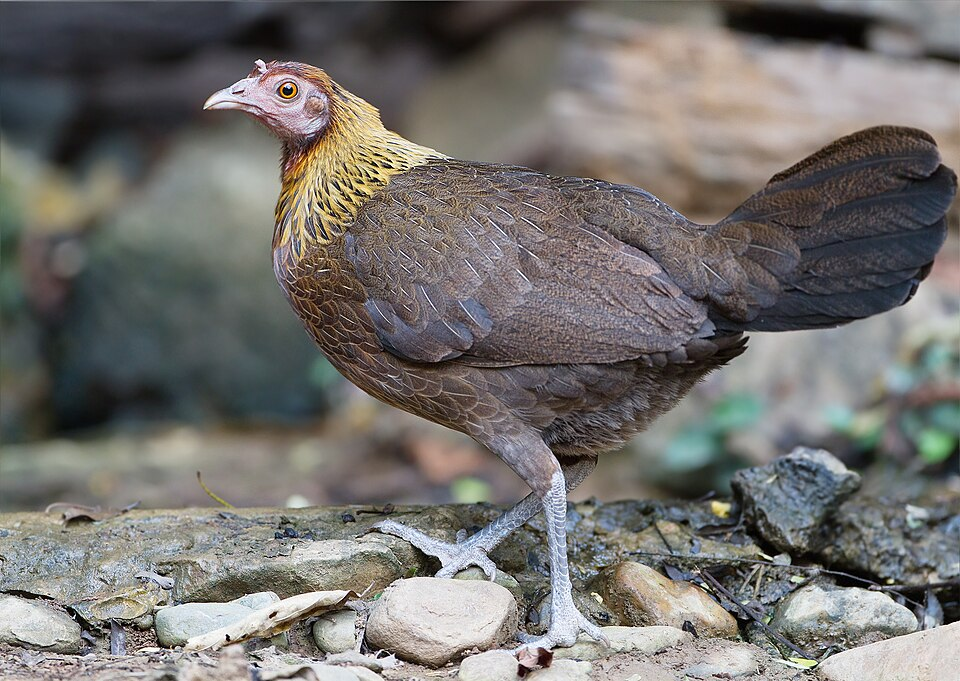
Variations among the different subspecies mainly involve the shape, length, and color of the neck feathers, particularly during the breeding season. During this time males display a distinctive plumage with long and colorful feathers. Outside the reproductive period, after the summer molt, wild forms develop a darker and less conspicuous eclipse plumage, usually present from June to September. In this phase the neck feathers become shorter and darker, the comb appears less swollen, and some of the decorative tail feathers are lost.
During winter, males and females often form small groups, but in spring dominant males establish their own territories, usually accompanied by one or more females. Within each group a strict hierarchy exists, maintained through visible signals of submission from lower-ranking individuals. When enough space is available, these birds can tolerate the presence of other galliform species, such as pheasants and peafowl.
A key feature that distinguishes a true wild form from a domestic one is the presence of an eclipse plumage phase. Domestic forms lose this double molt and instead undergo only a single molt per year, usually around August. Females are even harder to identify, since wild hens and domestic hens often appear very similar.
The species has an omnivorous diet, feeding on insects, worms, mollusks, as well as seeds and fruits, including grains such as maize and soybeans found on the ground. These birds appear unable to detect sweet tastes, although they can perceive saltiness, despite showing little attraction to it.
The breeding season in parts of South Asia, such as India, usually occurs between March and May. The nest is a shallow ground depression hidden under vegetation and lined with dry plant material. The female lays about five or six eggs, which she incubates for roughly 18–21 days. The chicks grow quickly, developing full plumage within about four to five weeks, and after roughly twelve weeks they disperse from the mother.
Classification of Gallus gallus
Gallus gallus is generally divided into five subspecies, in addition to a domesticated form. These are:
Subspecies:
- Gallus gallus subsp. murghi
- Gallus gallus subsp. spadiceus
- Gallus gallus subps. jabouillei
- Gallus gallus subsp. gallus
- Gallus gallus subsp. bankiva
Domesticated form:
Source(s):
https://it.wikipedia.org/wiki/Gallus_gallus
Photo(s):
1. Yathin S Krishnappa, CC BY-SA 3.0 https://creativecommons.org/licenses/by-sa/3.0, via Wikimedia Commons
2. JJ Harrison (https://www.jjharrison.com.au/), CC BY-SA 3.0 https://creativecommons.org/licenses/by-sa/3.0, via Wikimedia Commons