
Galliforms (Galliformes)
Order of Neognaths (Neognathae)
Food, Animal source foods, Animals (Animalia), Chordates (Chordata), Vertebrates (Vertebrata), Birds (Aves), Neognaths (Neognathae)
Consumption area(s): Earth
Introduction
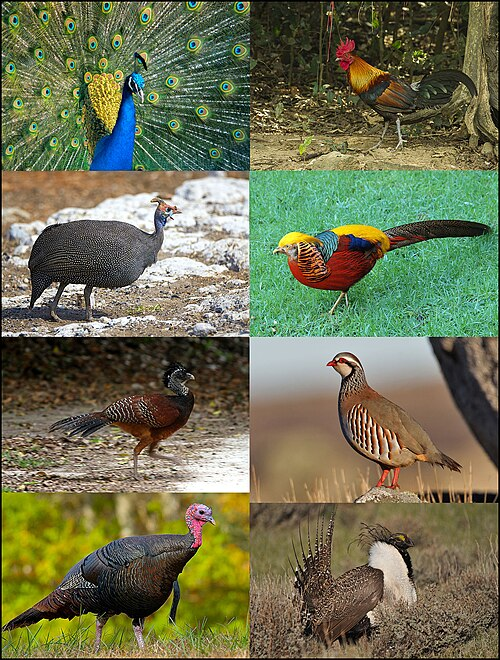
The Galliforms (Galliformes) represent an order within the class of birds, encompassing a diverse range of species. This group includes familiar birds such as turkeys, guineafowl, and domestic chickens, the latter originally native to Central Asia. Beyond these, Galliformes also feature highly ornamental species like peafowl, prized for their striking plumage, as well as numerous wild game birds including pheasants, partridges, quails, and capercaillies.
Description of Galliforms (Galliformes)
Galliformes are generally chicken-like in shape, with rounded bodies and short, rounded wings adapted for brief flights. Their size varies widely, from tiny species like the king quail at about 6 in (15 cm) to large ones like the North American wild turkey, which can reach 4ft (120 cm) and weigh over 30 lb (14 kg). They are primarily ground-dwelling, though some may roost or nest in trees.
These birds are mostly terrestrial, preferring to walk or run rather than fly. They inhabit diverse ecosystems, including forests, grasslands, and deserts, and can be found worldwide. Galliforms rely heavily on visual displays and vocalizations to communicate for mating, territory defense or fighting. Their lifespan ranges from 5–8 years in the wild to up to 30 years in captivity.
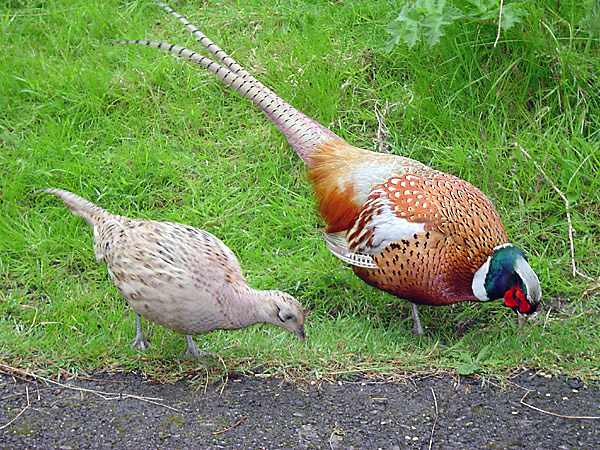
Most galliform species share a plump body, thick neck, moderately long legs, and short, rounded wings. Notable examples include grouse, pheasants, francolins, and partridges, which exhibit the classic stocky silhouette. In several lineages, adult males possess sharp leg spurs for fighting, and sexual dimorphism is pronounced and males and females can differ dramatically in size and plumage.
Flightlessness
Most Galliformes are ground-dwelling and reluctant fliers, yet none of the living species are truly flightless. Despite often being seen as weak flyers, they have powerful wing muscles, and some species even migrate. Adult snowcocks rely on gravity to take off, though juveniles can fly reasonably well.
Behaviour
Most Galliformes are largely resident, but some smaller species, like quail, undertake long-distance migrations. Altitudinal migration is common in mountain species, and a few birds in subtropical or subarctic regions must fly considerable distances to reach water or feeding areas. Species capable of extensive flights include ptarmigans, sage-grouse, crested partridge, green peafowl, crested argus, mountain peacock-pheasant, koklass pheasant, and Reeves’s pheasant.
Other species, including most New World quail, the African stone partridge, guineafowl, and eared pheasants, rely on extensive daily walking, often covering many miles in search of food. Some grassland-adapted Galliformes have distinct morphologies, with long necks, long legs, and large, broad wings, like the crested fireback, vulturine guineafowl, and malleefowl.
Species with limited sexual dimorphism generally require intensive locomotion throughout the year to forage, whereas sedentary species experiencing strong seasonal ecological changes show pronounced differences between sexes in size or appearance. Examples of low sexual dimorphism combined with wide-ranging foraging include eared pheasants, guineafowl, toothed quail, and the snow partridge.
Feeding
Most galliforms are herbivorous or slightly omnivorous, with a stout body and short, thick bills well-suited for digging for roots or consuming plant material like heather shoots. Chicks also feed on insects to meet their nutritional needs.
Some subtropical genera, including peafowl, junglefowl, and many pheasants, have very different feeding habits. The Himalayan monal, for example, digs into rotting wood to extract invertebrates, bracing itself with its squared tail. Similarly, species like the cheer pheasant forage in decaying wood for termites, ant and beetle larvae, molluscs, crustaceans, and even small rodents.
Other species, such as typical peafowl, peacock-pheasants, Bulwer’s pheasant, ruffed pheasants, and hill partridges, have narrow, delicate bills not suited for digging. They hunt live invertebrates in fallen leaves, sand, shallow pools, or along stream banks, using their long, slender legs and toes to navigate wet habitats, particularly during chick-rearing.
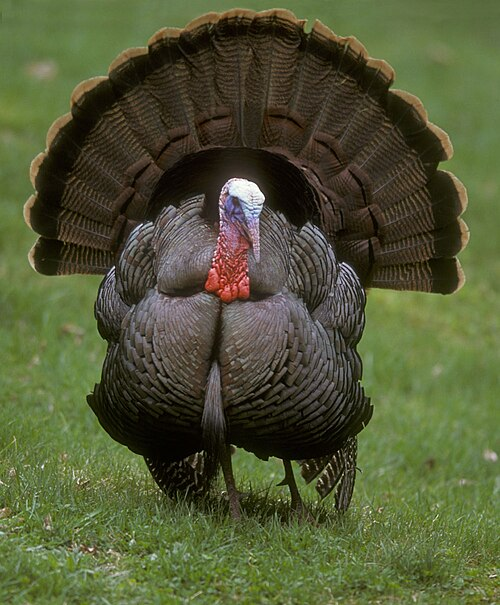
Some species are remarkably opportunistic: the blue peafowl can capture snakes, including poisonous cobras, with its strong feet and sharp bill, while Lady Amherst’s pheasant, green peafowl, Bulwer’s pheasant, and the crestless fireback forage for crustaceans and small aquatic animals, resembling the habits of rails. Wild turkeys, though primarily as herbivore, eat insects, mice, lizards, and amphibians, often wading into water; domestic chickens show similar opportunistic feeding.
During breeding season, some species shift diets: the male western capercaillie feeds mainly on bilberry leaves, which are toxic to most herbivores. Many Syrmaticus pheasants forage in tree canopies during snowy or rainy periods, when ground foraging is risky. Subtropical species like the great argus and crested argus also forage in the jungle canopy during rainy months, feeding primarily on slugs, snails, ants, and amphibians, rather than plants. How they manage this canopy foraging remains largely unknown.
Reproduction
Most galliforms are highly prolific, often producing clutches exceeding 10 eggs. Unlike many birds that remain monogamous for a breeding season, galliforms frequently exhibit polygyny or polygamy, with pronounced sexual dimorphism marking these species.
The young can follow their mother—or both parents in monogamous species—just hours after hatching. The most extreme example is the Megapodiidae, where adults do not brood; instead, eggs are incubated in mounds of rotting vegetation, volcanic ash, or hot sand. Hatchlings must dig their way out, but emerge fully feathered and capable of flying considerable distances immediately.
Classification of Galliforms (Galliformes)
Galliforms are classified according to family. Among these, we find:
- Cracidae (guans, curassows, chachalacas)
- Megapodiidae (megapodes)
- Numididae (guineafowl)
- Odontophoridae (New World quails)
- Phasianidae (domestic chickens, partridges, turkeys, pheasants, quails, grouse)
Source(s):
https://en.wikipedia.org/wiki/Galliformes
Photo(s):
1. MathKnight, CC BY-SA 4.0 https://creativecommons.org/licenses/by-sa/4.0, via Wikimedia Commons
2. ChrisO, CC BY-SA 3.0 http://creativecommons.org/licenses/by-sa/3.0/, via Wikimedia Commons
3. Riki7, Public domain, via Wikimedia Commons