
Birds (Aves)
Class of vertebrates
Food, Animal source foods, Animals (Animalia), Chordates (Chordata), Vertebrates (Vertebrata)
Consumption area(s): Earth
Introduction
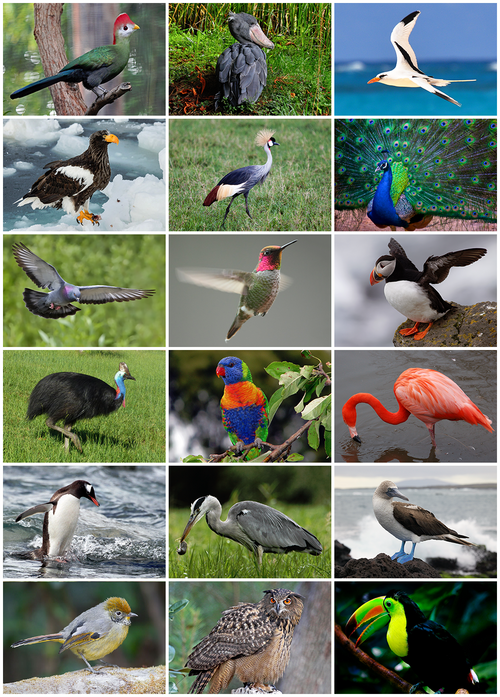
Birds (Aves) are warm-blooded animals, distinguished by feathers, beak structures without teeth, the production of hard-shelled eggs, a high metabolism, a four-chambered heart, and a light but sturdy skeleton. They inhabit nearly every corner of the globe, with sizes ranging from the tiny bee hummingbird at 5.5 cm (2.2 in) to the massive common ostrich at 2.8 m (9 ft 2 in). Currently, there are over 11,000 living species, organized into 44 orders, with more than half belonging to the passerines, commonly known as perching birds.
All birds possess wings, though their structure and function vary among species. These modified forelimbs originally enabled flight, but some lineages, including ratites, penguins, and many island-endemic species, have lost this ability over time. Additionally, species living in aquatic habitats, particularly seabirds and certain waterfowl, have evolved specialized traits for swimming and efficient movement in water.
Description of birds (Aves)
Birds are bipedal, winged, warm-blooded oviparous animals, highly adapted for flight. Their sizes range from tiny species like the Elena’s hummingbird at 5 cm to the extinct elephant bird of Madagascar, which reached up to 3 m and was incapable of flying.
Almost all birds have their forelimbs transformed into wings, a feature that enables aerial movement. This ability has driven the evolution of unique anatomical adaptations, including specialized digestive and respiratory systems. Many birds display remarkable intelligence; for instance, crows and parrots are known for their problem-solving skills. Some species can manipulate objects, use simple tools, and even pass knowledge across generations. They are social creatures, often living in colonies and communicating through signals and they engage in cooperative behaviors like hunting or defending territory.
Common features shared by all birds include a keratinous beak without teeth, which comes in various shapes depending on dietary habits. They lack a true nose, with nostrils opening directly on the upper surface of the beak. Many birds possess a nictitating membrane, an extra eyelid for eye protection. True external ears are absent, replaced by cranial openings that detect sound; in some nocturnal predators like owls, these openings are asymmetrical, allowing precise horizontal and vertical sound localization.
Birds lay eggs with hard shells made of calcium carbonate, and their hearts consist of two atria and two ventricles, with high heart rates to support the energy demands of flight. Their bodies are covered with feathers, which provide thermal insulation like mammalian hair. In species such as swans, ducks, and geese, feathers also help with waterproofing and buoyancy. Flight feathers overlying the body feathers allow precise maneuvering, while homeothermy maintains a stable body temperature, essential for sustaining high-energy activities.
Head
Birds have extraordinarily keen vision, among the sharpest in the animal kingdom. For exemple buzzards can see 6–8 times farther than humans, while owls excel in complete darkness due to specialized light-amplifying adaptations. This is supported by an extremely dense retina, numerous optic nerves, extra eye-controlling muscles, and sometimes a specialized fovea for higher image resolution. Their large eyes occupy a significant portion of the skull.
Birds also have a relatively large brain, reflecting high intelligence and advanced cognitive abilities. Migratory species possess tiny magnetite particles in the brain, allowing them to navigate using the Earth’s magnetic field over thousands of kilometers, even across open oceans where visual cues are absent.
Skeletal system
The bird skeleton is highly specialized for flight. The sternum forms a keel for strong wing muscle attachment, and most flying birds have hollow, reinforced bones connected to air sacs. Flightless birds like penguins have normal bones. Hollow bones are lightweight, lack marrow, and cannot self-repair. Birds have fewer bones overall because many are fused, and they possess the most cervical vertebrae among vertebrates (13–25), giving extreme neck flexibility. Their clavicles fuse into a furcula and uncinate ribs increase resistance to flight stress.
Beak
The beak is a versatile external structure in birds, used not only for feeding, but also for preening feathers, manipulating objects, hunting, searching for food, feeding offsprings, and sometimes even courtship. Beaks show a wide range of forms and adaptations linked to the bird’s dietary habits.
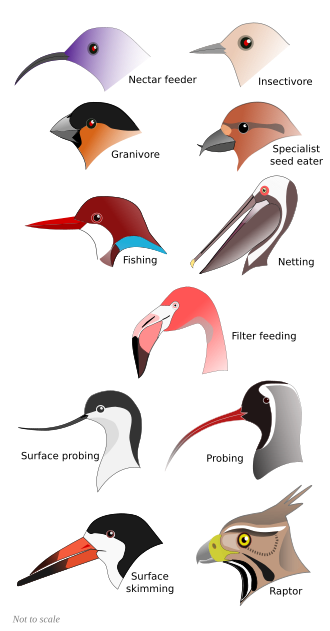
Anatomically, the beak consists of an upper (maxilla) and lower mandible, both made of bone, and covered externally by a thin keratin sheath called the rhamphotheca. Beneath this protective layer lies a vascular zone with capillaries and nerve endings. The nostrils open on the surface, connecting the respiratory system to the interior. In some birds, the nostrils are covered by fleshy structures, as in albatrosses and petrels.
Beak tips may be hardened for tasks requiring strong pressure, like cracking nuts or killing prey, or sensitive, containing nerve endings to detect objects by touch. Many chicks have a temporary egg tooth to break out of their shells. The beak wears down over time and grows continuously throughout the bird’s life.
Respiratory system
The avian respiratory system is highly specialized and efficient, supporting the intense oxygen demands of flight. It consists of three main components: anterior air sacs, lungs, and posterior air sacs. Birds typically have nine air sacs, which act as bellows rather than performing direct gas exchange.
During inhalation, most air bypasses the lungs and fills the air sacs and pneumatized bones, while a smaller portion flows directly into the lungs. During exhalation, fresh air from the sacs moves through the lungs, ensuring a constant flow of oxygen during both breathing phases. This system allows some species, like bar-headed geese, to fly at altitudes above 10,000 meters, where oxygen is scarce.
Unlike mammals, bird lungs lack alveoli and instead contain millions of tiny interconnected parabronchi. Air passes through the parabronchi walls into atria and air capillaries, where oxygen and carbon dioxide are exchanged with blood capillaries. Birds have no diaphragm, so the entire body cavity acts as a bellows, and exhalation relies on muscular contraction. The syrinx, located at the base of the trachea, is a unique vocal organ. Air passing through it causes vibrations, producing complex sounds, enabling the intricate vocalizations characteristic of birds.
Digerent system
The avian digestive system includes a stomach similar to mammals, using hydrochloric acid to break down food. Since birds lack teeth, they have a second stomach called the gizzard, which grinds food, often with the help of ingested stones, replacing the function of teeth.
Bird diet varies widely by species. Birds can be roughly grouped as granivores, insectivores, frugivores, nectarivores, piscivores, avicivores, molluscivores, carnivores, and ovivores. Most species show flexible feeding habits depending on availability and preference.
Reproductive system
Most male birds lack an external sexual organ, but all have two testes that enlarge and produce sperm during the breeding season. Female birds’ ovaries also enlarge, though usually only the left ovary is active; the right may activate if the left fails.
In species without a sexual organ, sperm is stored in the seminal glomera near the cloaca. During copulation, the female shifts her tail, and the male aligns his cloaca to transfer sperm. The act is often very brief, sometimes under half a second. Sperm can be stored in the female’s reproductive tract for days to months, allowing eggs to be fertilized individually before laying. Some birds, especially aquatic species, have a phallus, normally hidden inside the cloaca when not in use.
Feathers
Feathers are unique epidermal structures of birds, essential for flight, insulation, waterproofing, and communication through coloration. They grow from follicles and form a mostly dead structure similar to mammalian hair. Feathers are replaced periodically in a controlled molting process to maintain coverage and preserve flight ability.
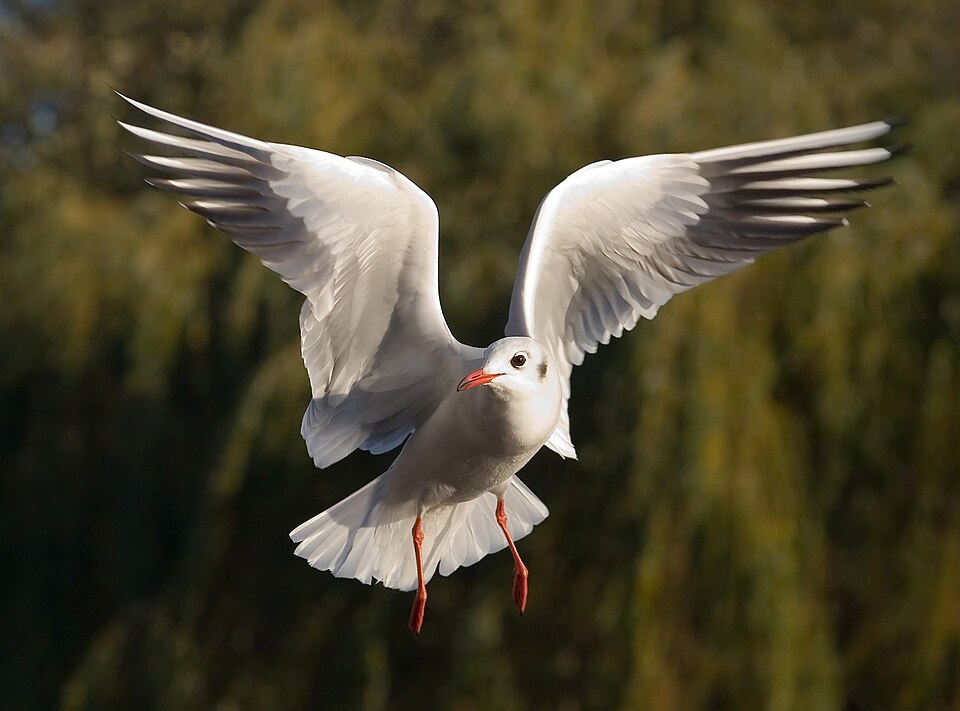
There are two main types: contour feathers covering the body and down feathers beneath them for thermal insulation. Tail and wing feathers aid in maneuvering, while some species have crest feathers for display. Feathers are organized in pterylae with bare apteria in between; this pattern, called pterylography, varies by species.
Coloration serves camouflage and sexual signaling. Colors arise from pigments like melanins (brown, black, gray) and carotenoids (red, yellow, orange) and from structural coloration (blue, green). Pigments may indicate health and diet quality.
Feathers likely evolved initially for thermoregulation and visual signaling, not solely for flight. Smaller birds have denser plumage to reduce heat loss. Most birds undergo annual molts, producing a basic plumage, while some species develop a secondary, brighter plumage for courtship.
Behaviour
Flight is not universal in birds; some species, like ratites, penguins, and many island birds, are flightless, while other animals, such as bats and insects, can fly. Birds exhibit diverse mating systems. About 91% are monogamous, 2% polygynous, and less than 1% polyandrous. Monogamy can be lifetime (e.g., parrots) or seasonal, often associated with low sexual dimorphism, and allows males to share parental care with females.
Most birds are diurnal herbivores, feeding on seeds, nectar, shoots, or fruit, but some are nocturnal (e.g., owls, nightjars) or carnivorous, consuming other animals. Birds can be resident or migratory. In temperate or harsh regions, many species migrate to milder climates for breeding, returning to their original habitats afterward.
Classification of birds (Aves)
Birds are in turn divided into two superorders:
- Neognaths (Neognathae) (domestic chicken, duck, turkey)
- Palaeognaths (Palaeognathae) (ostrich, emu, rhea)
Source(s):
https://it.wikipedia.org/wiki/Aves
Photo(s):
1. Concerto, CC BY-SA 3.0 https://creativecommons.org/licenses/by-sa/3.0, via Wikimedia Commons
2. original by Shyamalmodified by Jeff Dahl, CC BY-SA 2.5 https://creativecommons.org/licenses/by-sa/2.5, via Wikimedia Commons
3. Diliff, CC BY-SA 3.0 http://creativecommons.org/licenses/by-sa/3.0/, via Wikimedia Commons