
Italian-style meat broth (Brodo di carne all’italiana) 🇮🇹 🇸🇲 🇻🇦
Food, Culinary bases, Broths, stocks and liquid preparations
Original name: Brodo di carne all’italiana
Other names: /
Nationality: Italy 🇮🇹, San Marino 🇸🇲, Vatican City 🇻🇦
Consumption area(s): Italy 🇮🇹, San Marino 🇸🇲, Vatican City 🇻🇦
Introduction
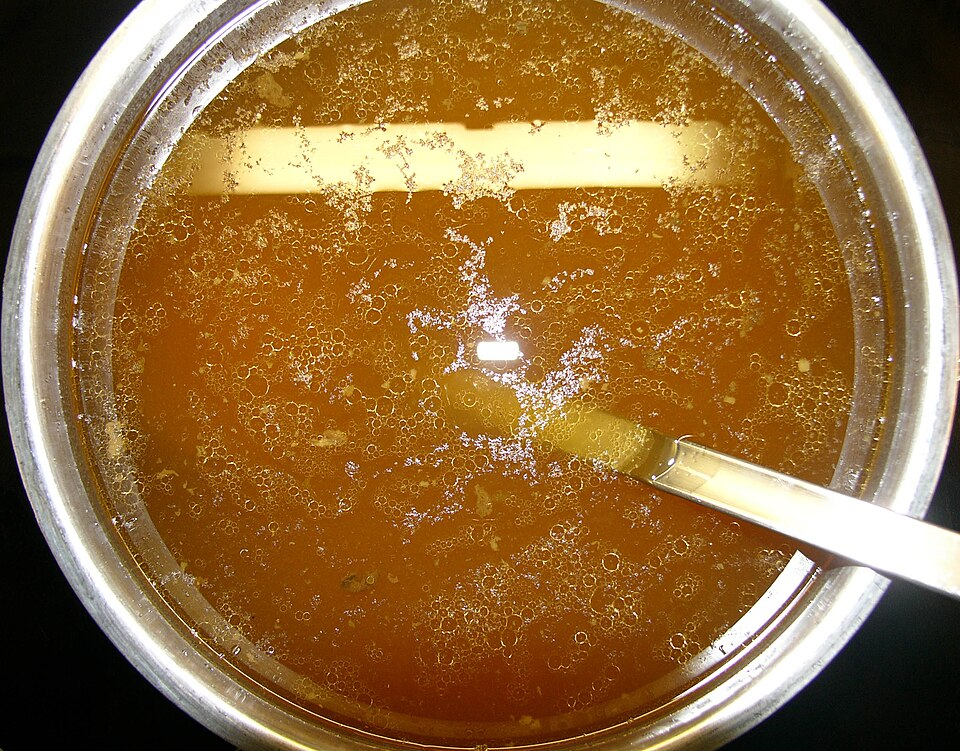
Italian-style meat broth is a traditional savory liquid obtained by gently simmering meat, often together with bones, vegetables, and herbs, in water for an extended period of time. During the slow cooking process, the liquid extracts proteins, minerals, amino acids, and numerous flavor compounds from the meat and connective tissues, producing a clear, fragrant, and nourishing preparation.
This type of broth has long been valued both as a stand-alone dish, commonly served hot as a light and restorative food, and as a foundational element in cooking. In many culinary traditions it forms the base for soups, sauces, braises, and stews, where it contributes depth, body, and umami richness. The final flavor depends greatly on the cut of meat, the proportion of bones, and the selection of vegetables and herbs used during preparation.
History of italian-style beef broth
Meat broth has deep roots in ancient Italian culinary tradition, gradually assuming a central role in both popular cooking and aristocratic cuisine. As early as the Roman period, references appear to liquid preparations made from meat. The cook Marcus Gavius Apicius, in his treatise De re coquinaria, describes meat decoctions combined with spices that were used both for nourishment and healing.
During the Middle Ages, broth acquired an additional medical and symbolic function. Monastic medical texts associated with the Schola Medica Salernitana praised meat broth as a restorative preparation, especially recommended for the sick and women after childbirth. In these writings one frequently encounters the expression “concentrated broth,” described as a therapeutic food—simple in composition yet rich in cultural significance.
With the Renaissance and the emergence of a more codified gastronomic culture, broth entered the kitchens of the aristocracy. It was often enriched with expensive spices such as, cloves and nutmeg, reflecting the influence of Arab-Norman culinary traditions in Sicily as well as the courtly cuisine of northern and central Italy. Within this context the custom developed of using broth as the cooking medium for pastas, including tortellini and cappelletti.
During the 19th and 20th centuries, beef broth became firmly embedded in bourgeois and rural food culture, turning into a typical component of festive meals and Sunday lunches. Italian households commonly used humble cuts of meat, which were transformed through long, gentle simmering, reflecting both domestic economy and the tradition of family-centered cooking.
Italian-style meat broth (brodo di carne all’italiana)
Іngredients
- 5 l
cold water (5.28 qt) - 500 g
beef (typicallycow though younger cattle can also be used), with commonly used cuts includingbiancostato ,brione (or polpa di spalla) ,cappello del prete (or sorra, copertina) ,tail ,collo ,geretto ,punta di petto orreale (17.6 oz) - 300 g
old hen (10.6 oz) - 2
cattle bones (knee joint bones or femur are preferred) (optional, not always used) - 1
yellow onion - 1
celery stalk - 1
(western) carrot - 1
ripe tomato (optional, not always used) - 1
outher leek leaf (optional, not always used) - 5
(flat-leaf) parsley stems (optional, not always used) - 1
bay leaf (optional, not always used) - 1 sprig
thyme (optional, not always used) - 2
cloves (optional, not always used) Coarse salt, to taste Ground Black pepper, to taste
Іnstructions
- Cut the onion in half and stick a clove into the round part of each half.
- Then prepare a bouquet garni by tying the bay leaf, thyme, and parsley stems inside the leek leaf.
- Place the meat, celery, carrot, the two onion halves, any bones, and the tomato into a large pot, and cover with the indicated amount of cold water.
- Heat the pot over a low temperature between 37°C and 67°C (99–153°F) to ensure maximum flavor extraction (a thermometer can be helpful). Temperatures up to 95°C (203°F) can also be suitable, as long as the water does not boil.
- Cook the broth for about 2 hours, skimming off any foam that forms on the surface from time to time.
- After the cooking time, strain the broth first through a fine-mesh sieve and then through cheesecloth or muslin.
- Finally, adjust with salt and pepper to taste and serve hot.
Notes:
Nutritional facts table
Please note that nutritional values may vary slightly depending on the ingredients used.
| Nutrients | Per 100 g |
| Calories (kcal) | 18 |
| Total fat (g) | 1 |
| ———Saturated fat (g) | 0.4 |
| Cholesterol (mg) | 8 |
| Sodium (mg) | 60* |
| Total carbohydrates (g) | 0.6 |
| ———Dietary fiber (g) | 0.2 |
| ———Total sugar (g) | 0.2 |
| Protein (g) | 2 |
*This sodium content does not include the salt added during preparation, as the amount varies depending on personal preference.
Recipes that use this product as an ingredient:

Source(s):
https://it.wikipedia.org/wiki/Brodo
Photo(s):
1. Hannes Grobe, CC BY 3.0 https://creativecommons.org/licenses/by/3.0, via Wikimedia Commons