
Broths, stocks and liquid preparations
Consumption area(s): Earth
Introduction
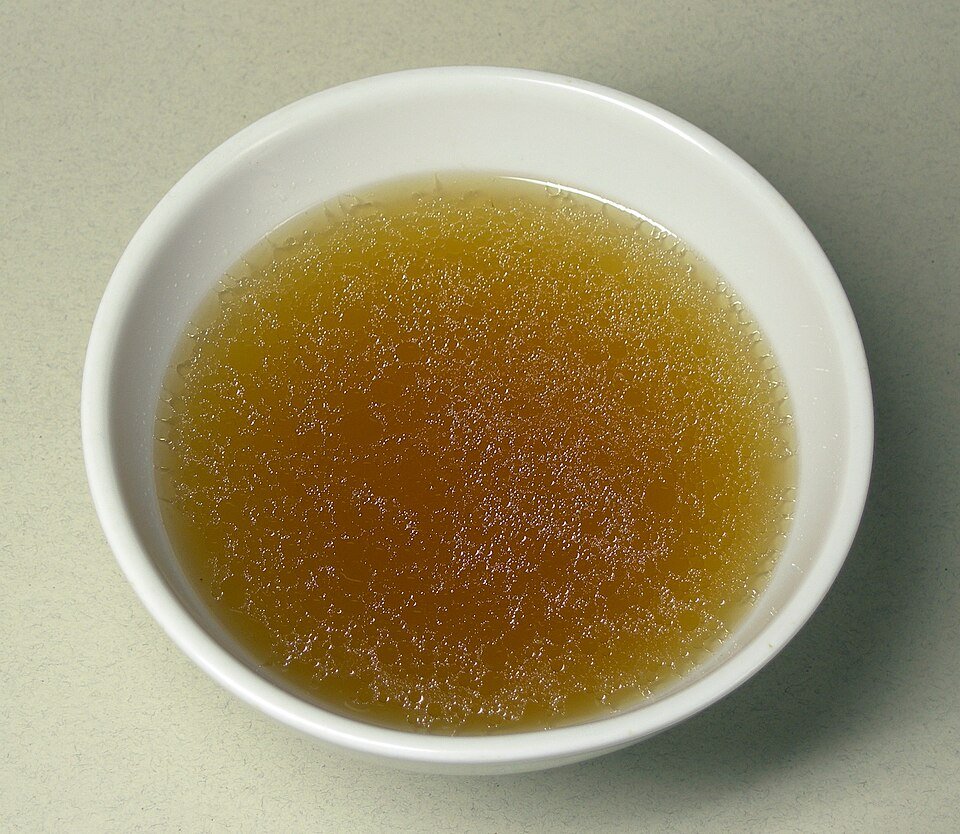
Broths, stocks and liquid preparations are savory liquid preparation obtained by slowly heating water together with meat, fish, vegetables, or a combination of these ingredients. During this gradual simmering process the liquid extracts proteins, minerals, and aromatic compounds, resulting in a flavorful base. Salt, spices, and various herbs may be incorporated to enhance complexity and depth.
While broth can be enjoyed on its own as a light, nourishing dish, it is more commonly used as a culinary building block. It forms the backbone for soups, risottos, sauces, and gravies, imparting both body and aroma. In professional cooking terminology, simmering ingredients in a somewhat dense broth may be referred to as “stewing” or “braising,” techniques that involve long, moist cooking in a concentrated liquid to deepen flavor and tenderize the ingredients.
When the liquid is prepared using a limited quantity of water—allowing for greater concentration—it becomes what is often termed a reduced broth or, adopting the French designation, a consommé, characterized by its clarity and intensified flavor profile. A specialized variant produced primarily from fish trimmings and vegetables, especially valued in seafood dishes and risottos, is commonly known as fumet, distinguished by its pronounced marine aroma.
Beyond traditional homemade preparation, broth is widely available in commercial liquid forms, including chicken, beef, fish, and vegetable varieties. Since the early twentieth century, the market has also offered dehydrated formats, most notably bouillon cubes, which provide a practical and shelf-stable alternative for rapid culinary use.
Broths vs stocks
Many chefs and culinary authors often use the words broth and stock interchangeably, reflecting a common overlap in everyday language. In 1974, the renowned American cook James Beard famously stated that stock, broth, and bouillon “are all the same thing,” highlighting this widespread conflation.
Despite this, culinary tradition sometimes draws subtle distinctions between the two. One frequently cited difference is that stock is primarily made from animal bones rather than meat, resulting in a higher gelatin content and a naturally thicker consistency. Another nuance is that stock may be simmered for a longer period, producing a richer, more concentrated flavor. Additionally, stock is often left unseasoned, intended as a neutral base for other dishes, whereas broth is typically seasoned with salt and spices, making it suitable to consume on its own.
These distinctions are not universally applied, and interpretations vary depending on tradition, region, and individual cookery style.
History of broths, stocks and liquid preparations
The preparation of broth is an extremely ancient culinary practice, likely originating as soon as humans learned to control fire, developed simple utensils, and began combining water with edible ingredients. Archaeochemical evidence suggests that early humans already cooked food in water using primitive methods. One technique consisted of heating stones in a fire and placing them into water contained in animal skins suspended over a pit, allowing the liquid to reach cooking temperature.
More than two thousand years ago, the Roman gastronome Marcus Gavius Apicius described several broth-like preparations. Medieval culinary texts, such as Le Viandier written by Guillaume Tirel in the fourteenth century, indicate that vegetables like leeks, garlic, and carrots were central ingredients in many dishes, while meat remained scarce for most people. An early and well-known preparation involved simmering a chicken carcass together with vegetables, producing a nourishing liquid considered restorative and suitable for convalescents.
During the eighteenth century, broth began to attract scientific attention. The chemist Antoine Lavoisier investigated its physical properties, contributing to the emerging chemical study of food. Around the same time, the idea of dehydrated broth appeared. The cook Vincent La Chapelle described a preparation based on veal broth and sliced ham, which was strained and then heated again until the liquid reduced into a thick caramel-like concentrate, known as a culinary glaze.
In 1742, La Chapelle also explained how to prepare compressed broth tablets designed to be easy to transport and capable of long preservation, often associated with medicinal uses. His remarks suggest that the use of such concentrated broth preparations may have already been practiced earlier, particularly under the supervision of physicians.
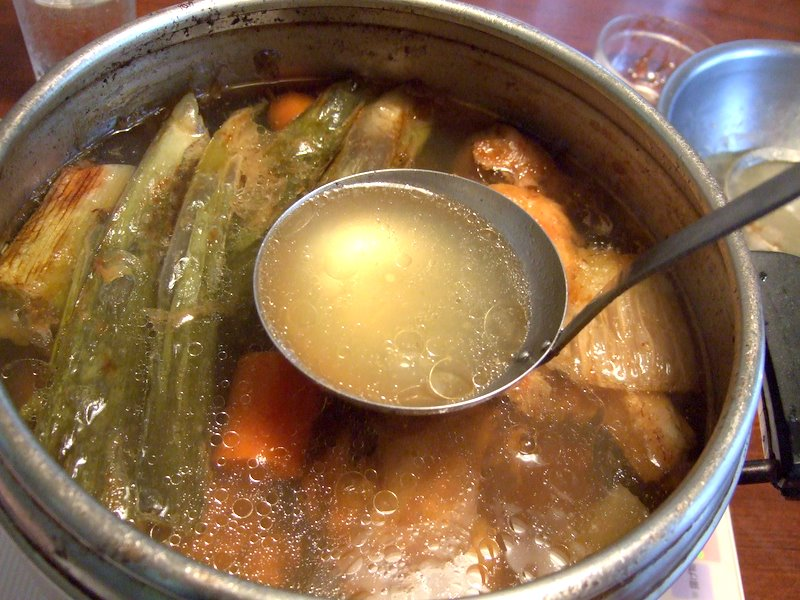
During the nineteenth century, broth became an object of systematic chemical investigation. From the 1830s onward, several researchers attempted to isolate the nutritional and aromatic compounds responsible for its flavor and strength. An important breakthrough occurred in the early 1850s when the German chemist Justus von Liebig succeeded in producing a concentrated meat extract, a development that later made possible the industrial production of dehydrated meat and vegetable broths.
By the mid-nineteenth century, the popularity of broth encouraged the emergence of inexpensive restaurants known as bouillons. The first of these was opened in Paris by Pierre-Louis Duval before 1854. The model expanded quickly, and later establishments included those created by the Chartier brothers in the late nineteenth century.
By 1900, nearly 250 bouillon restaurants operated in Paris alone. Similar affordable dining establishments soon appeared elsewhere in Europe, such as the chain founded by Carl Aschinger in Berlin in 1892 and companies like J. Lyons and Co. and Pearce & Plenty in the United Kingdom. These enterprises represented some of the earliest large-scale restaurant chains offering inexpensive meals to urban populations.
Classification of broths, stocks and liquid preparations
These products are divided into:
- Italian-style capon broth (Brodo di cappone all’italiana)
- Italian-style meat broth (Brodo di carne all’italiana)
- Italian-style vegetable broth (Brodo vegetale all’italiana)
Photo(s):
1. User:Rainer Zenz, CC BY-SA 3.0 <https://creativecommons.org/licenses/by-sa/3.0>, via Wikimedia Commons
2. Kui-Doraku, CC BY-SA 4.0 https://creativecommons.org/licenses/by-sa/4.0, via Wikimedia Commons