
Capsicum
Genus of Solanaceae (nightshades)
Food, Plant source foods, Plants (Plantae), Flowering plats (angiospermae), Mesangiosperms, Eudicots, Core eudicots, Superastierds, Asterids, Lamiids, Solanales, Solanaceae (nightshades)
Consumption area(s): Earth
Note: For better understanding, please read the article on flowering plants (angiospermae) first. If you come across unfamiliar words, you can click on any highlighted term to open the glossary with definitions of key botanical terms.
Introduction
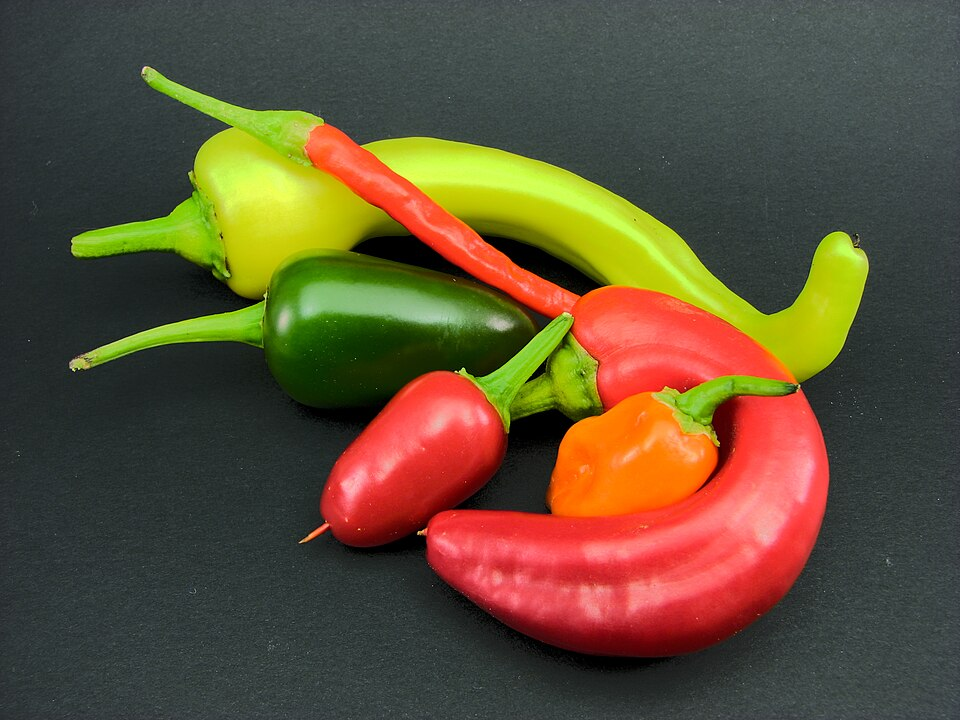
Capsicum is a botanical genus of flowering plants belonging to the Solanaceae family, originally native to the Americas. Today, these plants are cultivated globally because of their edible fruits, commonly referred to as peppers or capsicums.
Various types of chili peppers derive from five distinct Capsicum species. Among them, both sweet peppers (including bell peppers) and several mildly or intensely pungent chilies fall under Capsicum annuum, which is the most extensively grown and agriculturally significant species within the genus.
Description of Capsicum
The genus Capsicum comprises roughly 20–27 species, although only five are extensively cultivated worldwide: Capsicum annuum, Capsicum baccatum, Capsicum chinense, Capsicum frutescens, and Capsicum pubescens. Considerable variation in fruit color, size, and morphology, both across and within species, has historically complicated taxonomic classification.
A single species may encompass numerous cultivars with very different culinary uses. Within Capsicum annuum, the well-known bell pepper is marketed at different stages of ripeness, ranging from green (immature) to red, yellow, or orange (fully mature). The same species also includes varieties such as the Anaheim pepper, commonly stuffed; the poblano, which when dried becomes the ancho used in chili powder; and the jalapeño, which can be smoked and dried to produce the chipotle.
In terms of diversity, Peru is often regarded as the country with the greatest range of cultivated Capsicum types, as all five domesticated species are widely available in local markets. Bolivia, on the other hand, is notable for the consumption of a broad spectrum of wild peppers. There, consumers distinguish between two principal categories: ulupicas, characterized by small, round fruits (including species such as C. eximium, C. cardenasii, C. eshbaughii, and C. caballeroi landraces), and arivivis, which bear small, elongated fruits (such as C. baccatum var. baccatum and C. chacoense).
Uses of Capsicum
Capsicum fruits can be eaten fresh or cooked, and most culinary varieties belong to Capsicum annuum and Capsicum frutescens. Their hollow, fleshy structure makes them ideal for stuffing with ingredients such as meat, rice, or cheese. They are widely used raw in salads, sautéed in mixed dishes, roasted, fried, or blended into sauces. Preservation methods include drying, pickling, freezing, and grinding into powders such as paprika, while extracts are used in hot sauces.
After their introduction to Europe by the Spanish, and later spread by the Portuguese to Africa and Asia, chili peppers rapidly became central to many regional cuisines. In Spain, paprika defines products like chorizo and flavors numerous traditional dishes. Across Asia, chili peppers reshaped culinary traditions in countries such as India, Thailand, China, and Korea, contributing to iconic preparations like curries, tom yum, and kimchi.
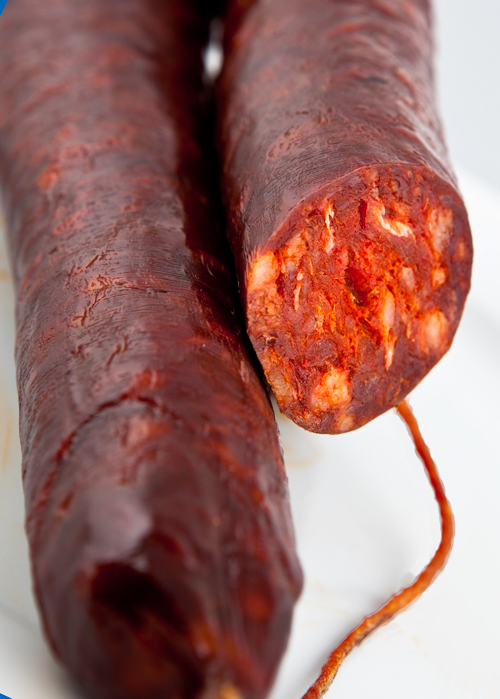
They are equally important in Hungarian, Balkan, and Italian cooking, appearing in stews, spreads such as ajvar and lyutenitsa, and spicy specialties like ’nduja. Historically, even the Maya and Aztec used Capsicum to flavor cocoa drinks. In the United States, the New Mexico chile—a cultivar group of Capsicum annuum—remains a defining element of regional cuisine.
Pungency
The pungency of chili peppers is primarily determined by capsaicin and related compounds collectively known as capsaicinoids. Pure capsaicin is a colorless, odorless, crystalline solid at room temperature. The concentration of these compounds varies according to the cultivar and the growing conditions. For example, plants exposed to water stress often produce fruits with a higher capsaicinoid content; in particular, water-deprived habanero plants may accumulate especially high levels in specific parts of the fruit.
When chili peppers are consumed, capsaicin binds to pain receptors (TRPV1 receptors) in the mouth and throat, triggering a sensation interpreted by the nervous system as heat or burning. Humans and other mammals perceive this as pain, whereas birds lack sensitivity to capsaicin, allowing them to eat extremely hot peppers without discomfort.
Capsaicin functions as a defensive mechanism against mammalian predators. Research suggests that its production may also help limit infections associated with plant damage. In particular, increased capsaicin synthesis has been observed following infection by the fungus Fusarium, which can be spread by insects. This indicates that the plant may enhance capsaicinoid production in response to biological stress as a protective strategy.
In contrast, sweet peppers do not synthesize capsaicinoids due to an inactive or nonfunctional Pun1 gene. As a result, they contain no capsaicin and register 0 Scoville Heat Units (SHU), meaning they produce no pungent sensation.
The intensity of pungency is measured in Scoville Heat Units (SHU), a system introduced in 1912 by the pharmacist Wilbur Scoville, who developed the Scoville Organoleptic Test (SOT). In this method, dried pepper samples are dissolved in alcohol to extract capsaicinoids, and the extract is then progressively diluted in a sugar solution. A panel of tasters evaluates the dilutions to determine the point at which the burning sensation is no longer detectable. The required dilution factor corresponds to the SHU value, expressed in multiples of 100.
However, this method has clear limitations. The perception of heat is subjective, influenced by individual sensitivity and by rapid sensory desensitization after repeated tasting. As a consequence, results may vary significantly, with inter-laboratory differences sometimes reaching ±50%.
Since the 1980s, measurement has become more precise through High-Performance Liquid Chromatography (HPLC), which objectively quantifies capsaicin and related compounds. The analytical data are subsequently converted into Scoville Heat Units, providing a far more accurate and reproducible assessment of pungency. By arranging SHU values in ascending order, a standardized heat scale can be constructed.
Scoville scale
| Caspicum cultivar | Scoville Heat Units |
| Pepper X | 2,693,000 |
| Carolina Reaper | 1,500,000–2,500,000 |
| Trinidad Moruga Scorpion, Naga Viper, Infinity, Ghost | 750,000–1,500,000 |
| Red savina habanero | 350,000–750,000 |
| Habanero, Scotch bonnet, Madame Jeanette | 100,000–350,000 |
| Bird’s eye (Thai chili pepper), Malagueta | 50,000–100,000 |
| Tabasco, Cayenne pepper | 25,000–50,000 |
| Serrano, Aleppo, Cheongyang | 10,000–25,000 |
| Jalapeño, Guajillo | 2,500–10,000 |
| Poblano | 1,000–2,500 |
| Cubanelle, Beaver Dam | 500–1,000 |
| Mexican bell | 0-500 |
| Bell pepper, Paprika | 0 |
Classification of Capsicum
Rather than organizing this genus strictly by botanical species (which would be the more rigorous taxonomic approach) we have chosen to begin by distinguishing peppers according to the presence or absence of capsaicin, and therefore their pungency. From a culinary perspective, this criterion is more practical and intuitive, before proceeding to further sub-classifications. Accordingly, the initial division is as follows:
- Hot chili peppers
- Sweet peppers
Source(s):
https://it.wikipedia.org/wiki/Capsicum
Photo(s):
1. Ryan Bushby, CC BY 2.5 https://creativecommons.org/licenses/by/2.5, via Wikimedia Commons
2. Embutishop, CC BY-SA 4.0 https://creativecommons.org/licenses/by-sa/4.0, via Wikimedia Commons