
Parsley
Species of Petroselinum
Food, Plant source foods, Plants (Plantae), Flowering plats (angiospermae), Mesangiosperms, Eudicots, Core eudicots, Superastierds, Asterids, Campanulids (Euasterids II), Apiales, Apiaceae, Petroselinum
Species name: Petroselinum crispum
Consumption area(s): Earth
Note: For better understanding, please read the article on flowering plants (angiospermae) first. If you come across unfamiliar words, you can click on any highlighted term to open the glossary with definitions of key botanical terms.
Introduction
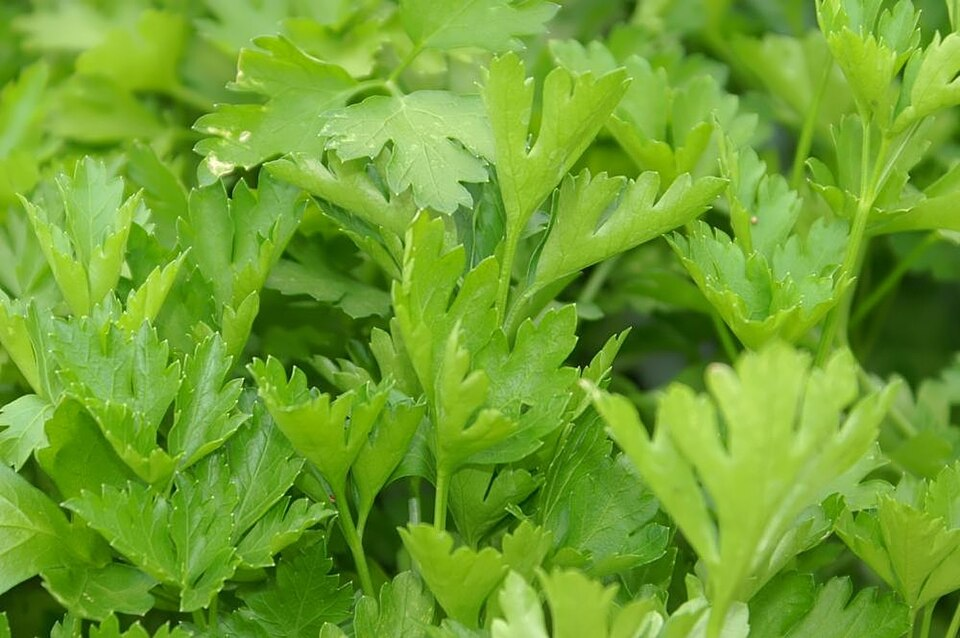
Parsley, commonly known as garden parsley is a flowering plant belonging to the Apiaceae family. Its original habitat lies in the Balkan region, although it has since spread far beyond its native range. Today, it grows naturally in many parts of Europe and in other areas with compatible temperate climates, where it has become widely established. It is extensively cultivated both as a culinary herb and as an edible vegetable.
Description of the plant
Garden parsley is a vivid green plant that typically behaves as a biennial in temperate regions, while in subtropical and tropical climates it is cultivated as an annual plant.
When grown as a biennial , its first year is devoted to vegetative development. During this phase, the plant produces a dense rosette of finely divided, tripinnate leaves measuring about 10–25 cm in length, each composed of many small leaflets approximately 1–3 cm long. At the same time, it develops a sturdy taproot, which functions as a nutrient reserve to sustain the plant through the winter months.
In the second year, parsley shifts to its reproductive stage. It sends up a more elongated flowering stem, which can reach up to 75 cm (30 inches) in height. The foliage becomes less abundant, and the plant forms characteristic flat-topped umbels, about 3–10 cm wide, carrying numerous small yellow to yellow-green flowers, each roughly 2 mm across.
The plant produces seeds measuring 2–3 mm in length, distinguished by noticeable style remnants at their tip. Among the constituents of its essential oil is apiole, a significant aromatic compound. After the seeds reach full maturity, the plant typically completes its life cycle and dies.
Production methods for parlsey
Parsley thrives in moist, well-drained soil and performs optimally when exposed to full sunlight. Its ideal growth temperature ranges between 22–30 °C (72–86 °F). Cultivation generally begins from seed, although the process requires patience: germination can take four to six weeks and is often irregular. For plants intended for leaf production, seedlings are typically spaced about 10 cm apart. In contrast, specimens grown for their edible roots require wider spacing—around 20 cm—to ensure adequate root expansion and development.
Uses of parlsey
Parsley plays a central role in numerous culinary traditions, especially within Middle Eastern, Mediterranean, Brazilian, and North American cuisines. The curly-leaf variety is frequently employed as a decorative garnish, while flat-leaf parsley is commonly added to dishes for both flavor and visual appeal. It is sprinkled over preparations such as boiled or mashed potatoes, rice dishes like risotto or pilaf, as well as fish, fried poultry, lamb, goose, steaks, and hearty meat or vegetable stews.
The plant’s seeds are also used in gastronomy, providing a more intense and concentrated aroma than the leaves. Additionally, parsley is traditionally believed to help counteract strong odors, particularly those associated with garlic consumption.
AcrossEurope, and extending into parts of Western Asia, freshly chopped parsley is routinely scattered over finished dishes. It forms part of the classic bouquet garni, the herb bundle used to enrich stocks, soups, and sauces. Finely minced parsley enhances clear soups, green salads, Olivier salad, and open-faced sandwiches topped with cold cuts or pâté. In French cuisine, the mixture known as persillade combines parsley with garlic. In Italy, parsley is fundamental to salsa verde, a piquant blend including capers, anchovies, garlic, and sometimes bread soaked in vinegar, typically paired with bollito misto or fish. Another Italian preparation, gremolata, unites parsley with garlic and lemon zest and traditionally accompanies ossobuco alla milanese.
Within Brazilian cuisine, freshly chopped parsley combined with scallions forms cheiro-verde, a foundational herb mixture used to season meat, poultry, fish, rice, beans, soups, and sauces. This blend is widely sold in markets, though in certain regions coriander may replace parsley.
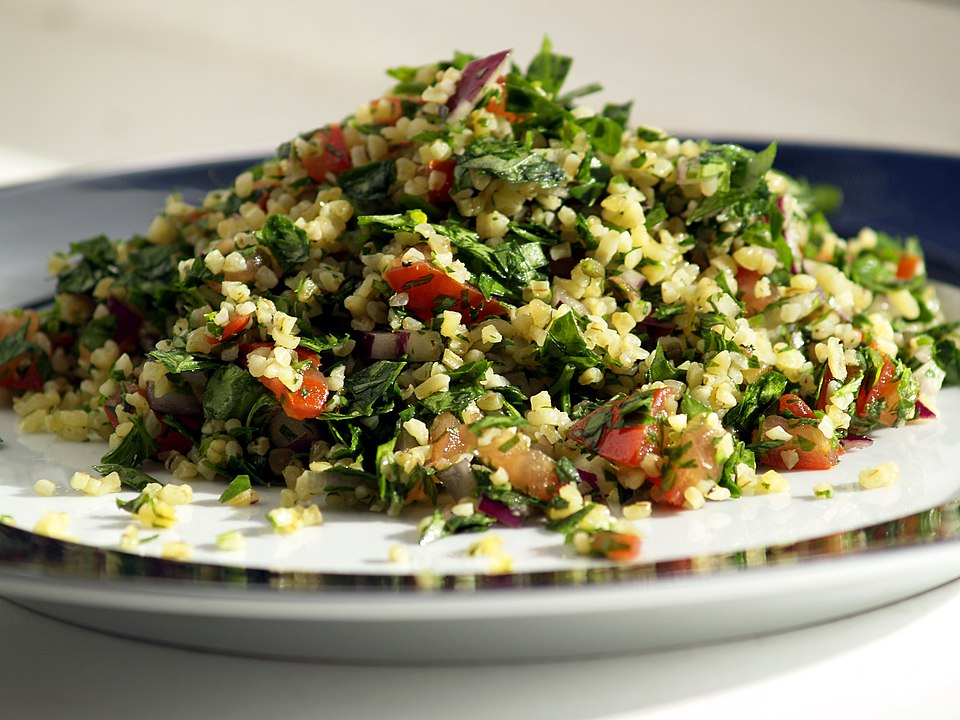
Parsley is equally indispensable in Middle Eastern dishes, serving as the principal ingredient in salads like Lebanese tabbouleh and contributing color and taste to falafel, where it imparts the characteristic green interior. It is also a defining element of the Iranian herb stew ghormeh sabzi.
Classification of parsely
This species is classified into three main varieties:
- Curly-leaf parsley (or French parsley)
- Flat-leaf parsley (or Italian parsley)
- Root parsley
Nutritional facts table of the leaves and stalks
Since nutritional values can vary slightly depending on the cultivar, the figures provided below represent general averages.
| Nutrients | Per 100 g |
| Calories (kcal) | 36 |
| Total fat (g) | 0.8 |
| ———Saturated fat (g) | 0.1 |
| Cholesterol (mg) | 0 |
| Sodium (mg) | 56 |
| Total carbohydrates (g) | 6.3 |
| ———Dietary fiber (g) | 3.3 |
| ———Total sugar (g) | 0.9 |
| Protein (g) | 3 |
Source(s):
https://en.wikipedia.org/wiki/Parsley
Photo(s):
1. Photo by David J. Stang, CC BY-SA 4.0 https://creativecommons.org/licenses/by-sa/4.0, via Wikimedia Commons
2. cyclonebill, CC BY-SA 2.0 https://creativecommons.org/licenses/by-sa/2.0, via Wikimedia Commons