
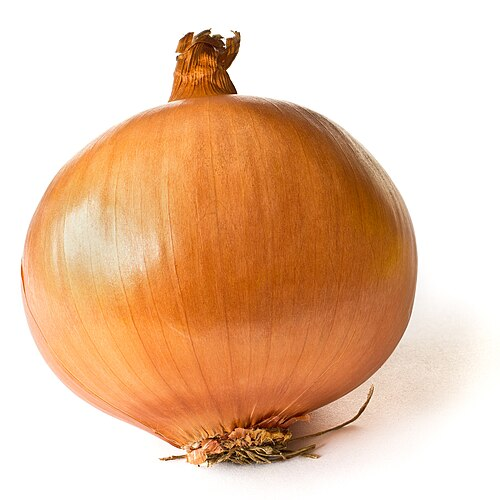
Yellow onions
Food, Plant source foods, Plants (Plantae), Flowering plats (angiospermae), Mesangiosperms, Monocots, Asparagales, Amaryllidaceae, Allium, Onions
Species name: Allium cepa
Consumption area(s): Earth
Note: For better understanding, please read the article on flowering plants (angiospermae) first. If you come across unfamiliar words, you can click on any highlighted term to open the glossary with definitions of key botanical terms.
Introduction
Yellow onions, also known as the brown onions, are a type of onion characterized by a robust and intense taste. On the inside they appear pale yellow to white, while the outer layers form a thin, papery skin with a brownish hue that protects the bulb. Compared to white onions, this variety contains a greater concentration of sulphur compounds, a factor that contributes to its deeper, sharper, and more layered flavour profile. These sulphur-based substances are largely responsible for the onion’s pungency and aromatic complexity.
There are numerous cultivars of yellow onion, each adapted to different growing seasons throughout the year. Although their nutritional values vary slightly, they consistently provide quercetin, a flavonol known for its presence in many plant-based foods.
Description of yellow onions
Yellow onions are generally harvested from spring through autumn and then kept in storage so they can be sold year-round. They are the dominant onion type cultivated in northern Europe and account for the vast majority of onion production in the United States. For everyday storage, they should be kept at a cool ambient temperature, away from light. If they need to be preserved for longer periods, wrapping them in paper and placing them in the refrigerator is recommended. Once an onion has been cut or peeled, it must be sealed in plastic and refrigerated, though its shelf life is reduced to only a few days.
In the kitchen, yellow onions are appreciated for their full, pronounced flavour, which makes them suitable for a wide range of preparations. They are commonly used in French onion soup, as well as in soups, stews, and braised dishes, where their taste develops with slow cooking. They also perform well in sautéed recipes and on shish kebabs. When cooked gently over time, they undergo caramelization, becoming soft, glossy, and noticeably sweet, which enhances the depth of many dishes.
Nutritional facts table of the bulb
Since nutritional values can vary slightly depending on the cultivar, the figures provided below represent general averages.
| Nutrients | Per 100 g |
| Calories (kcal) | 42 |
| Total fat (g) | 0.08 |
| ———Saturated fat (g) | 0.026 |
| Cholesterol (mg) | 0 |
| Sodium (mg) | 3 |
| Total carbohydrates (g) | 10.11 |
| ———Dietary fiber (g) | 1.4 |
| ———Total sugar (g) | 4.28 |
| Protein (g) | 0.92 |
Recipes that use this product as an ingredient:

Source(s):
https://en.wikipedia.org/wiki/Yellow_onion
Photo(s):
1. CHK46, CC BY-SA 4.0 https://creativecommons.org/licenses/by-sa/4.0, via Wikimedia Commons