
Apium graveolens
Species of Apium
Food, Plant source foods, Plants (Plantae), Flowering plats (angiospermae), Mesangiosperms, Eudicots, Core eudicots, Superastierds, Asterids, Campanulids (Euasterids II), Apiales, Apiaceae, Apium
Consumption area(s): Earth
Note: For better understanding, please read the article on flowering plants (angiospermae) first. If you come across unfamiliar words, you can click on any highlighted term to open the glossary with definitions of key botanical terms.
Introduction
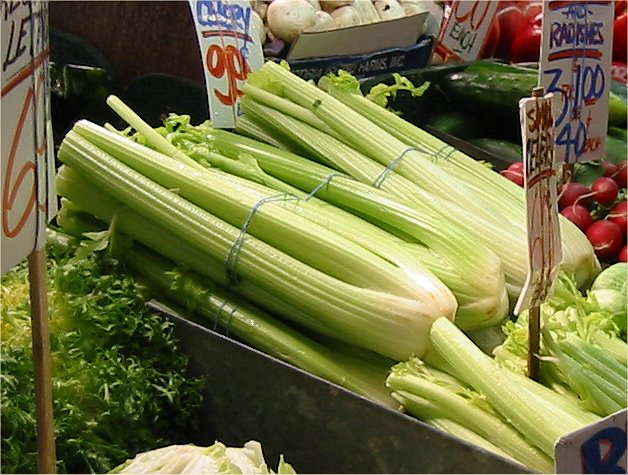
Apium graveolens is a flowering plant belonging to the Apiaceae family. This species has spread far beyond its original habitat and is now widely naturalized in many regions. Humans cultivate it primarily as a vegetable, with different varieties developed for distinct parts: some for the stalks (typical celery), others for a large bulb-like hypocotyl known as celeriac, and some for their leaves (leaf celery).
Description of Apium graveolens
Apium graveolens is a robust herb that can live for two years as a biennial or sometimes longer as a perennial, meaning it only flowers and produces seeds once, usually in its second year or later. The plant can reach about 1 meter (3 feet) in height, and every part emits a distinctive celery scent. Its stems are firm and marked with noticeable grooves, giving them a textured appearance.
The leaves range from bright green to slightly yellowish-green and are 1- to 2-pinnate, featuring leaflets of varied shapes, often rhomboid, up to 6 cm (2½ in) long and 4 cm (1½ in) wide.
Flowers appear in umbels, usually with short stalks, and each umbel has four to twelve rays. Individual blooms are creamy-white to greenish-white, small, about 2–3 mm across. The fruit is a schizocarp, roughly broadly oval to nearly spherical, measuring approximately 1–1.5 mm in both length and width.
Wild celery is native to a broad area of Europe and Asia, stretching from Ireland in the west, across northern Europe including Scotland, Denmark, and Poland, eastward to the Caucasus, Central Asia, and the western Himalayas, and extending through Macaronesia and North Africa to West Asia and the Arabian Peninsula. Beyond this natural range, it has become widely naturalized in regions such as Scandinavia, North and South America, Africa, India, southern and eastern Asia, and New Zealand.
This plant thrives in moist environments, often near coastal areas where the soil contains salt, commonly along tidal rivers, ditches, dyke edges, saltmarshes, and sea walls. North of the Alps, wild celery grows primarily in foothill zones on soils with some salinity.
Historically, it was valued for its medicinal properties and used as a flavoring by the Ancient Egyptians, Greeks, Romans, and also in China. From the 16th century onward, it was further cultivated as a vegetable, especially in Italy.
Classification of Apium graveolens
This species is further divided according to its subspecies:
- Celeriac
- Celery
- Leaf celery
Source(s):
https://en.wikipedia.org/wiki/Apium_graveolens
Photo(s):
1. Eric Hunt, CC BY-SA 3.0 http://creativecommons.org/licenses/by-sa/3.0/, via Wikimedia Commons