
Alcoholic beverages
Consumption area(s): It can be assumed that this product is distributed almost globally, with the exception of countries with a strong Muslim majority, where this type of food is not consumed for religious reasons.
Introduction
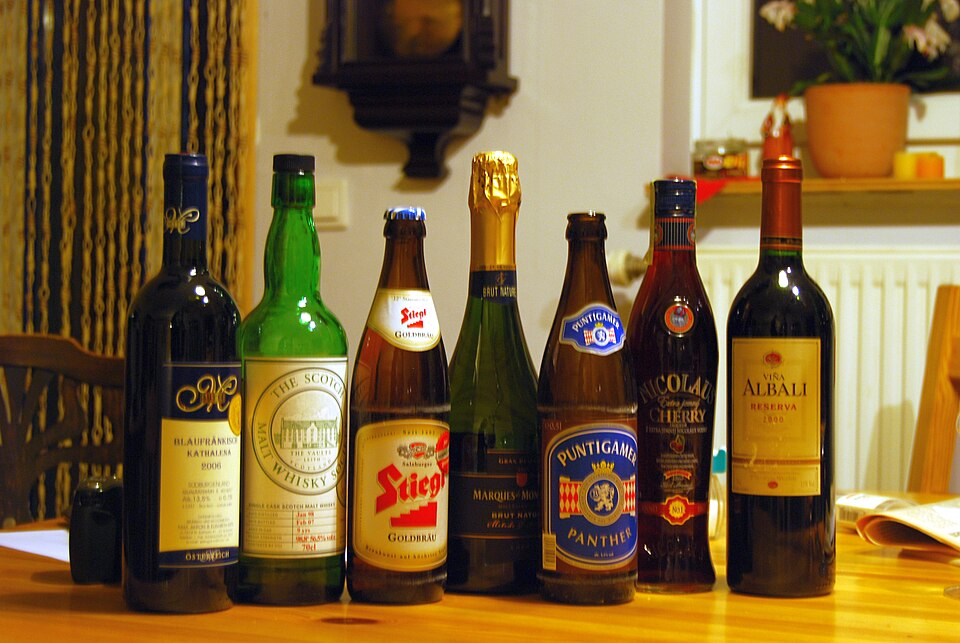
Alcoholic beverages are a distinct category of drinks characterized by the presence of ethanol, with an alcohol content that can vary widely. Some beverages, containing only minimal amounts of alcohol, are considered non-alcoholic. Throughout history, many cultures have developed traditions around their consumption, often incorporating them into festive occasions. At the same time, various countries have established precise regulations governing their production, sale, and use.
Ethanol has a flavor that can be bitter or slightly sweet, and is notable for its ability to dissolve fats and essential oils. This property makes it ideal for the creation of flavored beverages, especially those obtained through distillation. Aromas can derive from the original ingredients or be added at different stages of the production process. Some products are aged in oak barrels, contributing to the development of their taste, while others contain herbs or fruit directly in the bottle.
Wine is not only a beverage but also an essential culinary ingredient, capable of enhancing flavors thanks to its acidity. It is used in elaborate preparations, particularly in stocks and slow-cooking, and in certain sauces where it serves as a primary ingredient. The alcohol content of wines can vary significantly, with most falling within an intermediate range. There are also fortified wines, enriched with distillates, which reach higher alcohol levels.
History of alcoholic beverages
The earliest evidence of fermented beverages dates back to the Neolithic period, as demonstrated by archaeological findings in Israel, where a primitive form of beer made from wheat and barley was already being produced 13,000 years ago. In China, between 7000 and 5600 BCE, alcoholic drinks were prepared from a mixture of grapes, honey, and rice.
Winemaking developed in Georgia around 6000 BCE, while the earliest chemical evidence of beer dates to 3500 BCE in Iran. In Greece and Rome, wine became a central element of daily life and social rituals, with Pliny the Elder describing the 2nd century BCE as the golden age of Roman viticulture.
During the Middle Ages, the production and consumption of alcohol were transformed by the spread of distillation techniques. Muslim scholars such as Jābir ibn Ḥayyān and al-Rāzī experimented with methods to obtain more concentrated alcohol, knowledge that later reached Europe through Latin texts. By the 13th century, Taddeo Alderotti refined fractional distillation, leading to the widespread production of distilled spirits across the continent. At this time, brandy and other distilled beverages were primarily used for medicinal purposes, but they soon became common consumables in various European countries.
From the 17th century onwards, the production of liquors increased due to economic incentives, such as in England, which promoted the distillation of brandy and corn-based spirits. In North America, beer and wine were often preferred over water, as water sources were frequently contaminated. The widespread availability of alcoholic beverages also led to political tensions, including the Whiskey Rebellion in the United States and the Rum Rebellion in Australia.
Over time, various countries sought to regulate consumption through state monopolies, as in Sweden and Russia, and through the temperance movement, which culminated in Prohibition in the United States (1920–1933) and other nations.
Classification of alcoholic beverages
Alcoholic beverages are mainly categorized based on their production process, distinguishing between:
- Distilled beverages or spirits
- Fermented alcoholic beverages (beer, wine)
- Liqueurs
Source(s):
https://en.wikipedia.org/wiki/Alcoholic_beverage
Photo(s):
1. TrafficJan82, Public domain, via Wikimedia Commons