
Bovids (Bovidae)
Family of ruminants
Food, Animal source foods, Animals (Animalia), Chordates (Chordata), Vertebrates (Vertebrata), Mammals (Mammalia), Therians (Theria), Placentals (Placentalia), Artiodactyls (Artiodactyla), Ruminants (Ruminantia)
Consumption area(s): Earth
Introduction
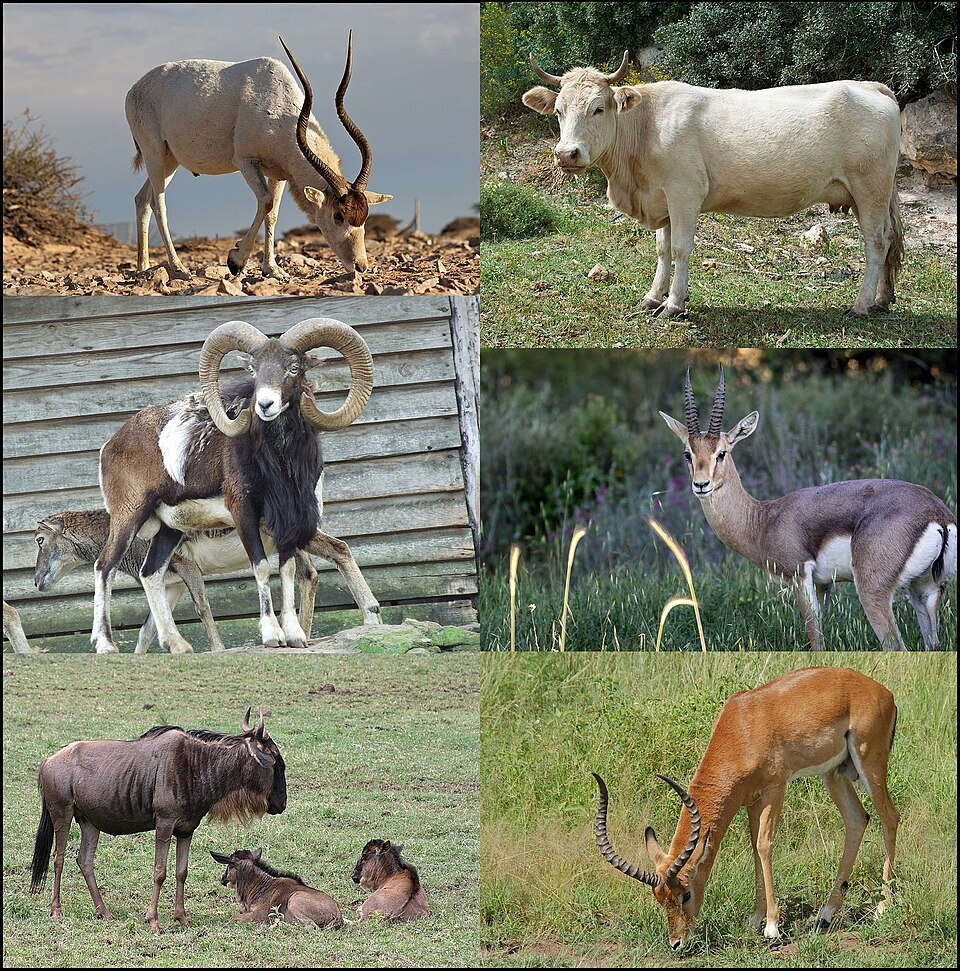
Bovids are a family of artiodactyl mammals that includes cattle, buffalo, antelopes, sheep, and goats. There are about 143 living species, with origins dating back to the early Miocene, around 20 million years ago. These animals vary greatly in size, fur coloration, and horn structure. Except in some domesticated cases, males — and often females — possess horns, which are bony cores covered by a keratin sheath and may be spiraled or ridged. Most bovids have 30 to 32 teeth, adapted for chewing fibrous vegetation.
The greatest diversity of bovids occurs in Africa, especially across the savannas of East Africa, though some also inhabit Europe, Asia, and North America. Several species — particularly cattle, sheep, and goats — have been domesticated for meat, milk, wool, and leather, forming a crucial part of human agriculture and economy.
Descriprion of bovids (Bovinae)
All bovids share a similar body shape, featuring a broad snout, one or more pairs of horns (usually in males), oval ears, a distinct neck, slender limbs, and a tail whose size and thickness vary by species. Most show sexual dimorphism, with males larger and heavier than females, especially in medium or large species. Each foot has four toes, but only the two central hooves bear weight, while the smaller dewclaws rarely touch the ground.
Their size ranges widely—from the massive gaur, weighing over 3,300 lb (1,500 kg) and standing 87 in (2.2 m) tall, to the tiny royal antelope, just 9.8 in (25 cm) high and about 6.6 lb (3 kg). The klipspringer is a small antelope reaching 18–24 in (45–60 cm) in height and 22–44 lb (10–20 kg) in weight.
Fur coloration varies from white in the Arabian oryx to black in the wildebeest, though browns and reddish tones are most common. In many species, males darken with age, while females and juveniles remain lighter. Some, such as the addax, even change color seasonally.
Nearly all males have horns, and in many species females do too. These are bony cores sheathed in keratin, typically unbranched but sometimes spiraled or fluted. While most species have one pair, exceptions include the four-horned antelope and Jacob sheep. Horn form reflects fighting style: long horns for wrestling, curved ones for ramming, and inward-pointing horns for monogamous males, while outward-pointing types belong to polygynous species.
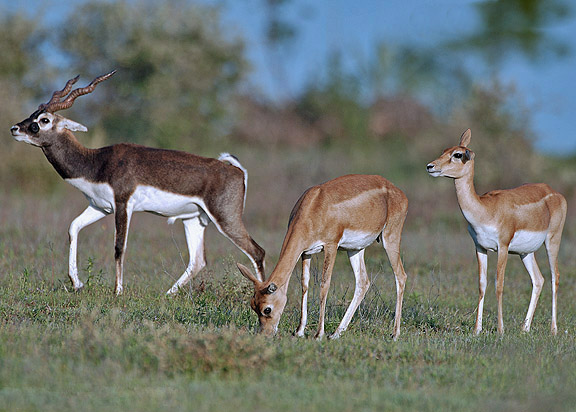
Male horns develop larger and more intricate shapes in highly competitive species, such as the giant eland, whereas small monogamous antelopes have short, simple horns. When females possess horns, they are smaller and primarily serve for defense or territorial purposes. Only about half of all bovid genera have horned females, which tend to be heavier and more dominant, using their horns mainly to ward off predators or protect their young.
Anatomy
As ruminants, bovids have a four-chambered stomach: the rumen (80%), omasum, reticulum, and abomasum. Some microorganisms in the rumen ferment plant matter into fatty acids, which are then absorbed. They also have an elongated small intestine, reaching 95–161 ft (29–49 m) in cattle. The right lung, with 4–5 lobes, is roughly 1.5 times larger than the left, which has 3 lobes.
Bovids typically have 30–32 teeth. They lack upper incisors, and upper canines are either reduced or absent. Instead, they have a thick dental pad to grip vegetation. The lower incisors and canines project forward, followed by a long toothless gap, the diastema.
Most bovids are strictly herbivorous, though some, like duikers, are omnivorous. Their four-chambered stomach allow digestion of fibrous plant material such as grasses, which many other animals cannot utilize. Like other ruminants—and some animals such as kangaroos, rabbits, and termites—they rely on microorganisms in their gut to ferment cellulose efficiently.
Ecology and behaviour
Bovids display varied social behaviour, ranging from solitary to gregarious, with subtypes being territorial or non-territorial. Small species like klipspringer, oribi, and steenbok are generally solitary and territorial, forming monogamous pairs and using some substances to mark territory. Most African bovids are gregarious and territorial, with males dispersing at sexual maturity to establish territories, while females may remain in herds.
Bovids are mostly diurnal, with peaks of feeding and social activity at dawn and dusk, and rest during midday and night. They communicate using vocalizations and postures involving head, horns, and ears. Some species, like springbok, stot to signal fitness to predators. Males vocalize or roar during mating or fights, while mothers use sounds to locate calves. Combat styles vary: gazelles box or fence, ibex and sheep clash upright, wildebeest head-butt, and muskoxen ram. Fights generally target the head, rarely causing serious injury.
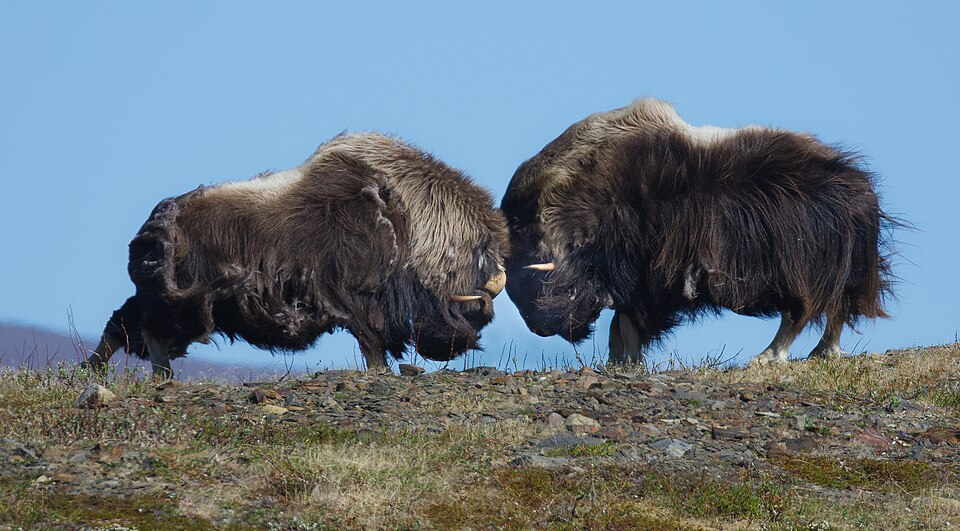
Diet is primarily herbivorous, including grass, foliage, and fruits, with feeding strategies linked to size and habitat. Small bovids forage in dense areas, while large species graze on open grasslands. Feeding alternates with rumination throughout the day.
Most bovids are polygynous, although small species like duikers are monogamous, reducing male-male competition. Sexual maturity varies: for example, impala males mature physically at one year but mating at four, whereas Barbary sheep females may mate before full maturity. Gestation ranges from 120–150 days in duikers to 300–330 days in African buffalo, usually producing a single offspring capable of standing and moving within an hour.
Lifespan is typically 10–15 years, longer for large species (up to 30 years for gaur). Males often have shorter lifespans due to competition, predation, and high nutritional needs, while some females mimic male traits like horns to protect their young.
Classification of bovids (Bovinae)
Bovids are divided according to their subfamily. Among these are:
- Aepycerotinae (impala)
- Alcelaphinae (gnu, hartebeest)
- Antilopinae (dwarf antelope, royal antelope, dik-dik, gazelles)
- Bovines (Bovinae) (bison, buffalo, cattle)
- Caprines (Caprinae) (goats, sheep, ibex)
- Hippotraginae (addax, bluebuck, sable antelope, oryx)
- Reduncinae (reedbuck, kob, lechwe, redunca)
Source(s):
https://it.wikipedia.org/wiki/Bovidae
Photo(s):
1. MathKnight, CC BY-SA 4.0 https://creativecommons.org/licenses/by-sa/4.0, via Wikimedia Commons
2. Mr Raja Purohit, CC BY-SA 2.5 https://creativecommons.org/licenses/by-sa/2.5, via Wikimedia Commons
3. Gregory “Slobirdr” Smith, CC BY-SA 2.0 https://creativecommons.org/licenses/by-sa/2.0, via Wikimedia Commons