
Therians (Theria)
Subclass of mammals
Food, Animal source foods, Animals (Animalia), Chordates (Chordata), Vertebrates (Vertebrata), Mammals (Mammalia)
Consumption area(s): Earth
Introduction
Therians are mammals that include both placentals and marsupials but exclude monotremes, the egg-laying mammals.
Description of therians (Theria)
Therians give birth to live young rather than laying eggs, with a placenta enabling maternal-offspring exchange, even in its simplest form as seen in marsupials. Both marsupials and placentals descend from a common therian ancestor that enabled live birth by modulating the mother’s immune system. Marsupials retained a strategy of birthing underdeveloped young after a short gestation, while placentals evolved longer gestation allowing more complete fetal development.
Therians show a separation between the urogenital openings and the anus, and their mammary glands connect directly to teats for nursing. Unlike monotremes, they have lost the coracoid bone.
Another distinctive feature is the presence of external ears, though some species like seals have lost them secondarily. Their flexible, protruding nose, unique among vertebrates, arises from modified cells originally involved in upper jaw development in other species. Almost all therians also possess whiskers, adding a key sensory adaptation to their anatomy.
Clssification of therians (Theria)
Therians are divided into 2 infraclasses:
- Marsupials (Marsupialia) (kangaroos, koalas, wombats)
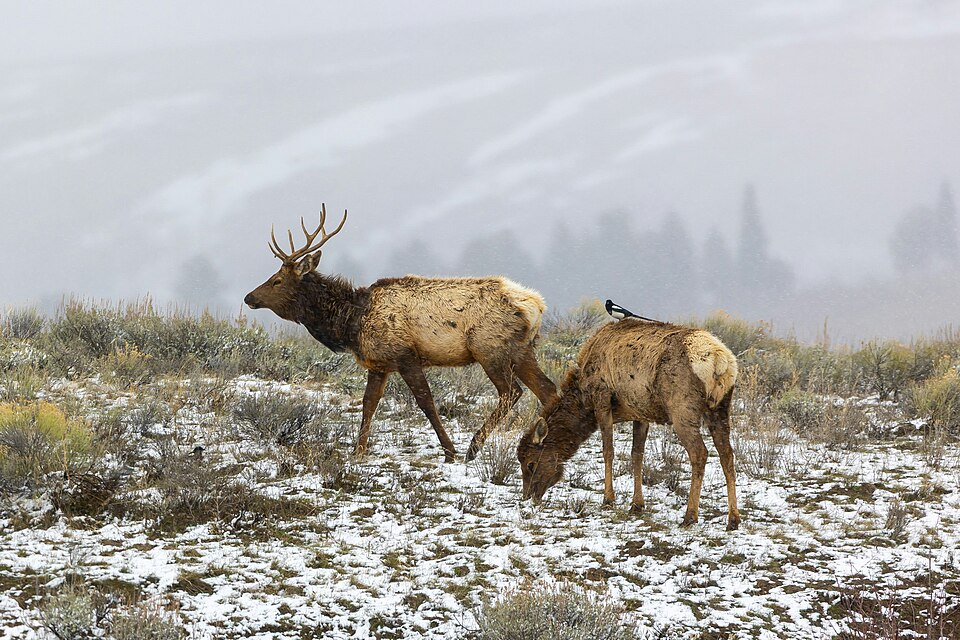
- Placentals (Placentalia) (bears, cattle, elephants, giraffes, horses, lions, pigs, tigers)
Source(s):
https://en.wikipedia.org/wiki/Theria
Photo(s):
1. DallasPenner, CC BY 4.0 https://creativecommons.org/licenses/by/4.0, via Wikimedia Commons