
Vertebrates (Vertbrata)
Subphylum of chordates
Food, Animal source foods, Animals (Animalia), Chordates (Chordata)
Consumption area(s): Earth
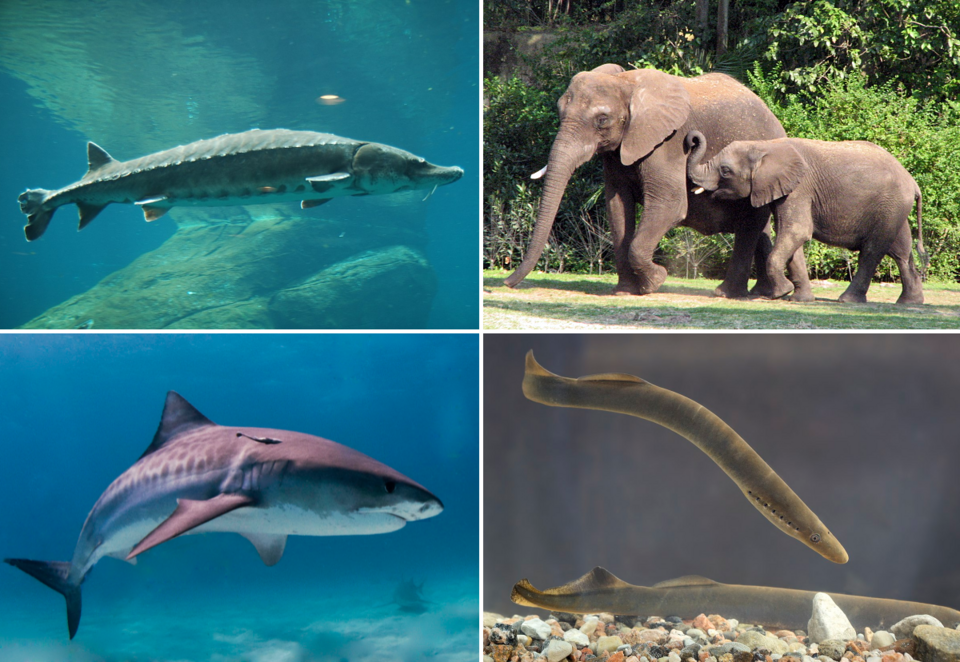
Introduction
Vertebrates, also known as craniates, are animals characterized by the presence of a vertebral column and a cranium. The vertebral column encloses and protects the spinal cord, while the cranium safeguards the brain. Vertebrates comprises roughly 65,000 species, making it the largest subphylum within the phylum Chordata. Yet, despite this evolutionary success, vertebrates account for less than five percent of all described animal species.
Description of vertebrates (Vertebrata)
Vertebrates are members of the phylum Chordata, characterized by five key anatomical traits: a notochord, a hollow dorsal nerve cord, pharyngeal slits, a post-anal tail, and an endostyle (which becomes the thyroid gland in most species). These features link vertebrates to other chordates, but vertebrates possess additional structures that distinguish them from all other animals.
They have a vertebral column, a cranium made of bone or cartilage, a complex brain, and a multi-chambered heart. Their sense organs (eyes, ears, and nose) and digestive system are highly developed. Vertebrates exhibit bilateral symmetry and move using segmental muscles supported by a flexible vertebral column.
During embryonic development, vertebrates first form a notochord, later replaced by a vertebral column. The neural tube develops into the spinal cord and brain, while pharyngeal arches give rise to gills in fish or various head structures in tetrapods. The concentration of sensory organs in the head, evolved to improve environmental awareness during movement.
Vertebrates possess a digestive tract that stretches continuously from the mouth to the anus, while their vertebral column often extends beyond the posterior opening, forming a tail.
Most ancestral vertebrates, along with many species alive today, are aquatic and rely on gills for respiration. These gills are intricately branched, allowing blood to come into close contact with water for efficient gas exchange. Located just behind the head, the gills are supported by cartilaginous or bony branchial arches. In jawed vertebrates, the first pair of these arches transformed into jaws, while in amphibian larvae and some early bony fishes, external gills emerge from the gill arches.
Within a closed circulatory system, oxygen is transported from the gills to the body, and carbon dioxide returns to the gills, propelled by a chambered heart. As tetrapods evolved, they lost gills, converting the swim bladder—originally used for buoyancy in fish—into lungs for breathing air. Their circulatory system adapted to this new function, and their bony fins became two pairs of limbs for terrestrial locomotion.
Classification of vertebrates (Vertebrata)
In this context, vertebrates are categorized into the following classes:
- Amphibians
- Birds (Aves) (domestic chickens)
- Bony fishes (Osteichthyes) (all other fishes)
- Cartilaginous fishes or Chondrichthyes (sawfishes, sharks, rays)
- Jawless fishes or Agnatha (hagfishes, lampreys)
- Mammals (Mammalia)
- Reptiles
Source(s):
https://en.wikipedia.org/wiki/Vertebrate
Photo(s):
1. User:FollixUser:Jamez42User:Albert kokUser:Tiithunt, CC BY-SA 4.0 https://creativecommons.org/licenses/by-sa/4.0, via Wikimedia Commons