
Sugar (Sucrose)
Consumption area(s): Earth
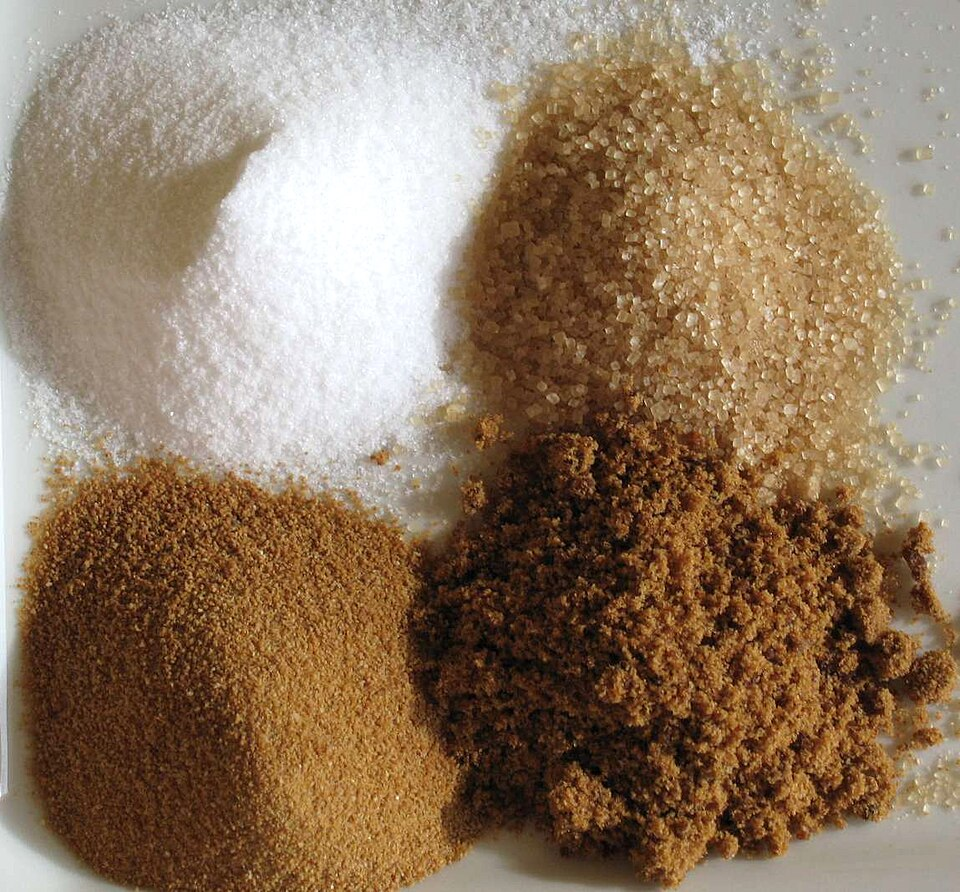
Chemical formula: C₁₂H₂₂O₁₁ (commercially, it is not found in pure form but is always mixed with other components in varying proportions)
Chemical/physical properties:
Melting point: None — it decomposes at 186°C
Density: 1.5879 g/cm³
Solubility in water: 2.01 g/mL (at 20°C)
Introduction
Sucrose is a disaccharide composed of glucose and fructose, naturally occurring in plants and serving as the primary component of white sugar. At room temperature, it appears as solid crystals or in dissolved form. For human consumption, sucrose is extracted and refined from either sugarcane or sugar beets. Sugar mills, located mainly in tropical regions where sugarcane grows, produce raw sugar, which is later shipped to refineries. In temperate climates, beet factories directly process the roots into refined sugar.
Description of sugar
Sucrose is present in many plants, especially in their roots, fruits, and nectars, where it acts as an energy reserve formed through photosynthesis. Numerous animals — including mammals, birds, insects, and bacteria — feed on sucrose. While honeybees consume it, the honey they produce is mainly composed of fructose and glucose, containing only trace amounts of sucrose. During fruit ripening, sucrose levels increase significantly, although some fruits — such as grapes, cherries, blueberries, figs, and tomatoes — contain little to none.
When exposed to high temperatures, sucrose undergoes caramelization, a chemical transformation that turns sugar into caramel, widely used in the food industry for coloring and flavoring. This process begins with sugar melting at around 160–170°C, forming light caramel, and continues up to 165–177°C, where dark caramel develops. If the temperature rises further, the caramel begins to burn, becoming bitter and unsuitable for culinary use. Beyond 250°C, sucrose combusts rapidly, releasing carbon dioxide and hydrogen, and leaving behind a residue of sugar charcoal.
History of sugar
The production of sugar has its ancient origins in the Indian subcontinent, where sugarcane was cultivated and processed to extract its sweet juice. The techniques of crystallizing cane juice were first developed in India and later spread to China and other regions through trade routes, aided by sailors and Buddhist monks. In antiquity, sugar was considered a rare and precious commodity, used mainly for medicinal purposes, as recorded by the Greek physician Dioscorides and the Roman scholar Pliny the Elder. Its introduction to Europe was slow, later accelerated by the Crusades and Venetian trade, which transformed sugar into a luxury good during the Middle Ages.
In the 15th and 16th centuries, the colonization of tropical islands such as Madeira and the Canaries led to the establishment of large sugarcane plantations, making the product more accessible. This new abundance fueled a rising demand, turning Europe into a hub of sugar refining and consumption. Sugar also gained artistic and symbolic value, as seen in the decorative sugar sculptures featured at royal banquets across Europe. However, its production became deeply tied to colonial systems, heavily reliant on enslaved labor in the New World plantations, introduced by Christopher Columbus and the Portuguese in South America.
A major turning point occurred in the 18th century with the development of the beet sugar industry in Europe. German chemists Andreas Marggraf and Franz Achard pioneered cost-effective methods to extract sugar from beets, making this sweetener widely available and reducing Europe’s dependence on tropical cultivation. The first industrial plant, opened in 1801 in Prussia, marked the beginning of a more self-sufficient sugar economy and a democratization of consumption.
By the 19th century, sugar had become an essential household staple across Europe, with consumption rising rapidly, particularly in Britain, where it evolved from a luxury item to an everyday necessity. The growing demand reshaped the global economy and social landscape, fueling colonial expansion and new production models. The abolition of slavery and the introduction of migrant labor in plantations represented another key historical shift in the industry. Today, sugar remains a fundamental product, bearing a complex legacy that mirrors both technological progress and social transformation.
Production methods for sugar
Sugar is primarily extracted from sugar beets in Europe and from sugarcane in the rest of the world, while other sources such as maple and date palm play a minor role.
Sugarcane
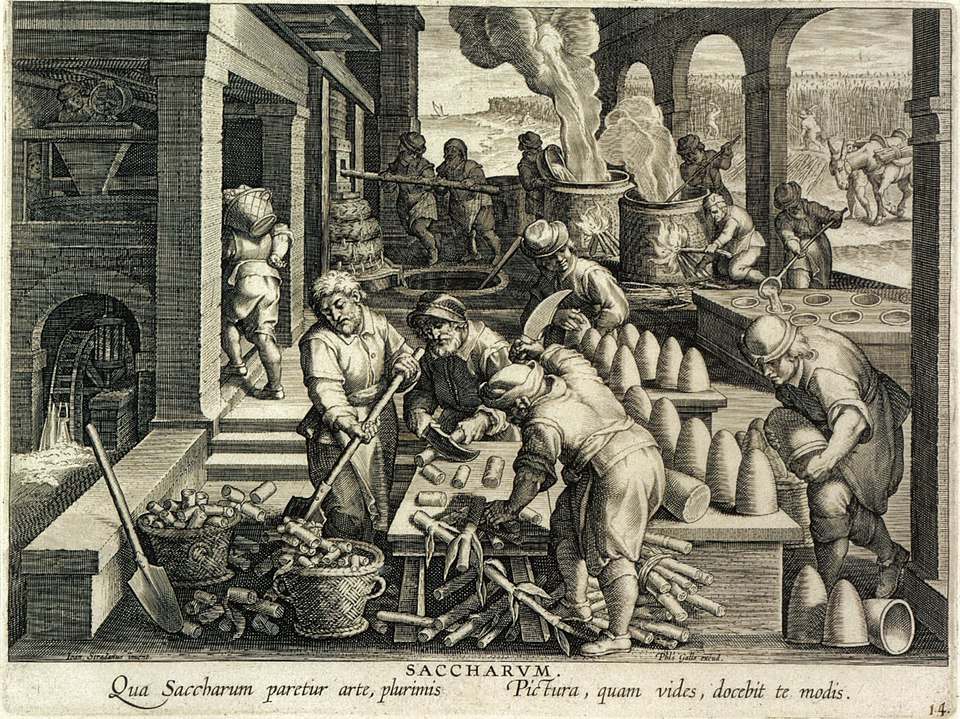
Sugarcane, grown in tropical climates, requires abundant rainfall and is harvested either mechanically or by hand. The following processes are then carried out:
- Juice extraction: The stalks are washed, mechanically crushed, and the juice is extracted using water or diffusion methods.
- Clarification: The juice is treated with lime to remove impurities and heated to destroy enzymes.
- Concentration: The solution is concentrated by evaporation to remove water, producing a thick syrup.
- Crystallization: The concentrated syrup, now supersaturated, is seeded with small sugar crystals, which act as nuclei, allowing sucrose to solidify around them and promoting uniform crystal growth. The resulting raw sugar crystals are then separated and dried.
These raw crystals can be consumed as they are or undergo further refining. Byproducts of this process include:
- Molasses: A residue of crystallization used in various food and industrial applications.
- Bagasse: The fibrous residue of the stalks, used as fuel or organic fertilizer.
Sugar beet
Sugar beets, in contrast, are grown in temperate regions and harvested in autumn. After harvesting, the roots are cleaned and the leaves removed, followed by these steps:
- Preparation: The roots are washed and cut into small pieces called cossettes, about 4 cm long and dark brown. These pieces undergo diffusion, being immersed in water at 70°C to extract the sugary compounds.
- Purification: The extracted liquid, called juice, is clarified with lime and carbon dioxide.
- Concentration: The juice is filtered, decolorized, and concentrated to obtain a cooked mass.
- Crystallization: The mass is cooled and seeded with sugar crystals to promote the formation of new crystals. The resulting raw crystallized sugar is then separated by centrifugation and dried.
In this case, the raw sugar produced is usually unpleasant to taste and always undergoes refining.
Refining
Refined white sugar is produced from raw sugar, whether from sugarcane or sugar beet, through a process that removes molasses and undesired impurities. In many cases, raw sugar is shipped to the destination country for refinement. The main subprocesses include:
- Polishing: The raw sugar crystals are immersed in a concentrated syrup, which softens and removes the sticky brown coating without dissolving the crystals. The crystals are then separated from the liquid (known as liquor) and dissolved in water to form a sugary syrup.
- Purification: The syrup is treated using carbonation or phosphatation, which causes a fine solid to precipitate, trapping impurities. The liquid is then filtered to remove these impurities, resulting in a purer syrup. Color removal is achieved using granular activated carbon or ion-exchange resins.
- Crystallization: The purified syrup is concentrated by boiling, then cooled and seeded with sugar crystals to initiate the formation of new crystals. The formed crystals are subsequently separated by centrifugation.
- Drying and packaging: The white crystals are dried with hot air, making them ready for use or packaging. The remaining liquid (liquor) is converted into refiner’s molasses, which can be used for other purposes.
Classification of sugar
Various types of sugar are available on the market, classified according to their source:
- White sugar (refined)
- Raw cane sugar
- Grape sugar
- Maple sugar
- Palm sugar
- Coconut sugar
There are also specialty sugars, which contain additional components besides sucrose (such as water), including:
- Molasses
- Instant sugar
- Candied sugar
- Syrups
Recipes that use this product as an ingredient:
Source(s):
https://en.wikipedia.org/wiki/Sucrose
https://it.wikipedia.org/wiki/Saccarosio
Photo(s):
1. Romain Behar, Public domain, via Wikimedia Commons
2. Philip Galle, Public domain, via Wikimedia Commons