
Honey
Consumption area(s): Earth
Chemical composition:
Fructose: approx. 38%
Glucose: approx. 32%
Water: approx. 17%
Other sugars: approx. 13%
Chemical/physical properties:
Density: 1.38–1.45 kg/L at 20 °C
Introduction
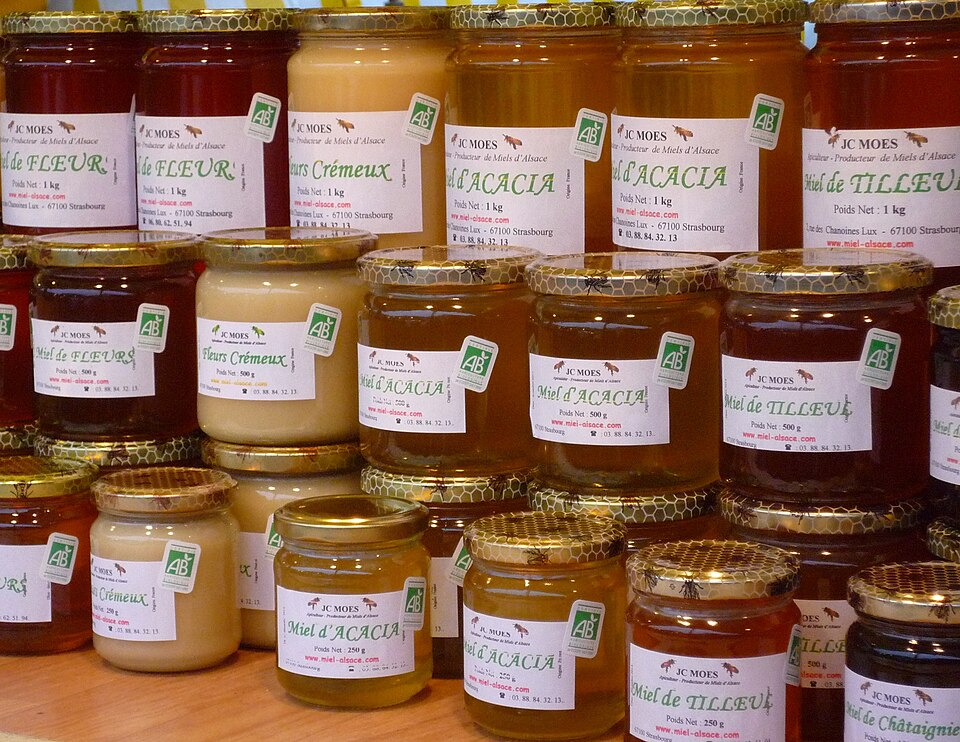
Honey is a dense, sugary substance produced by various species of bees, with the honeybee being the most well-known. Bees create it to feed their colony, gathering nectar from flowers or honeydew secreted by other insects, such as aphids. During this process, the nectar is collected, digested, and concentrated through the evaporation of water, which gives honey its viscous texture. This transformation occurs both inside the bee—through enzymatic activity and regurgitation—and inside the hive, where the honey is stored and preserved.
Description of honey
Honey is stored in the hive within a wax structure known as the honeycomb, made up of hexagonal cells where bees deposit their honey. Other bee species, such as stingless bees, use different types of structures to preserve it. The honey intended for human consumption typically comes from domesticated honeybees, though it can also be harvested from wild colonies. Large-scale production is known as beekeeping, while that of stingless bees is referred to as meliponiculture.
This substance is exceptionally sweet due to its high concentration of fructose and glucose, and its sweetening power is comparable to table sugar. One tablespoon of honey provides about 46 kilocalories of energy. It also exhibits unique chemical properties that make it valuable in cooking and baking, and it contributes a distinct flavor when used as a sweetener. Honey’s shelf life is remarkably long, as microorganisms cannot thrive in it, and sealed honey does not spoil over time. In fact, archaeological findings have revealed ancient honey that remained edible after thousands of years.
In addition to honeybees, other insect species—such as bumblebees and certain wasps—also produce honey. While honeybees remain the primary source, species like the Brachygastra lecheguana wasp, native to Central and South America, are likewise capable of making honey, though in much smaller quantities.
History of honey as foods
For centuries, honey was humanity’s only source of concentrated sugars. The earliest evidence of constructed hives dates back to the 6th millennium BCE, marking the first attempts to domesticate this precious natural product.
In ancient Egypt, honey held great cultural and practical importance. As early as 4,000 years ago, Egyptian beekeepers moved along the Nile River, following the seasons and the flowering cycles of plants. Honey was even placed beside mummies to accompany them on their journey to the afterlife. Beyond its culinary use, it served medicinal purposes, treating digestive disorders and being incorporated into ointments for wounds and ulcers.
Among the Sumerians and Babylonians, honey was also highly valued. The Sumerians mixed it with clay, water, and cedar oil to create therapeutic pastes, while the Babylonians used it in flatbreads made with flour, sesame, dates, and honey. The Code of Hammurabi even included laws protecting beekeepers from honey theft, underscoring its economic and symbolic significance.
To the Greeks, honey was the food of the gods, an essential element insacred rituals. Homer described its collection, while Pythagoras recommended it as a key to longevity. The Romans, who imported honey from Crete, Cyprus, Spain, and Malta, used it not only as a sweetener, but also to produce and sweet-and-sour sauces, and as a preservative for food.
During the Middle Ages, honey retained its importance, mainly as a preservative and sweetener. However, with the rise of refined sugar, it gradually lost its dominance. In recent times, though, honey has regained popularity, celebrated for its natural health benefits and its role as a wholesome, organic alternative to processed sugar.
Production methods for honey
The processing of honey involves a series of carefully managed steps that extract the product from the honeycombs and make it ready for sale. This process begins only after the bees have completed their work — when the nectar collection ends and the honeycombs are sealed with wax, signaling that the honey has fully matured.
The first step is the removal of the supers, the frames where bees store honey. Beekeepers use tools such as a blower, which quickly clears bees from the frames, or a bee escape, a gentler but slower method that requires two passes to empty the super. Once removed, the supers are taken to the processing facility, where the moisture content of the honey is checked using a honey refractometer. If the honey contains too much moisture, it undergoes a dehumidification treatment to ensure stability and prevent fermentation.
Next comes the uncapping stage, where the wax seals that close each cell are removed. This process, called uncapping, can be done manually using specialized tools or with an automatic machine. Once uncapped, the frames are placed in a centrifugal extractor, which spins them to separate the honey from the combs. The extracted honey is then transferred to settling tanks, where it is filtered to remove any impurities, such as wax residues or small debris.
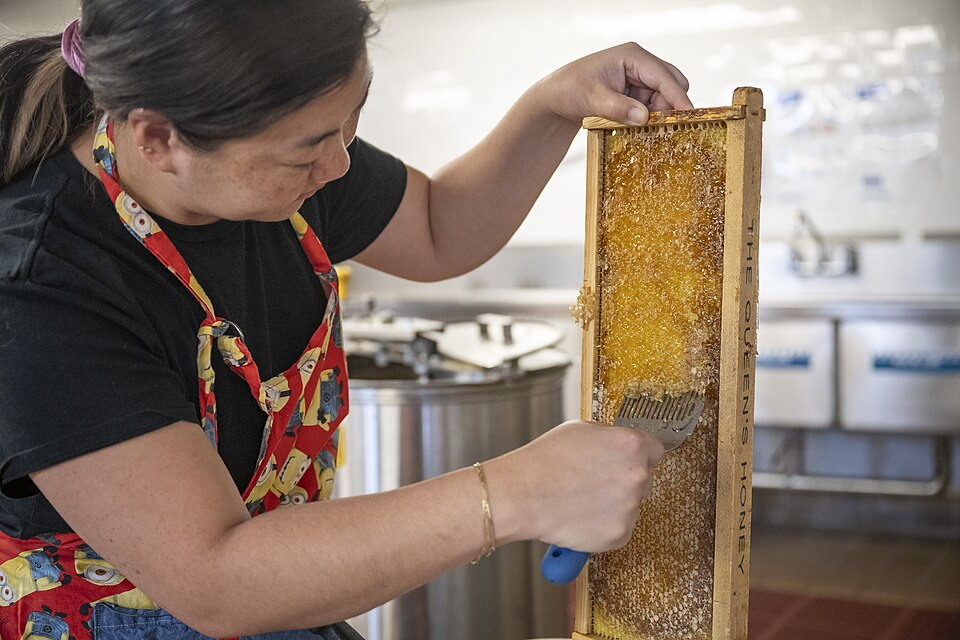
After filtration, the honey is left to rest and settle in the tanks, allowing for natural decantation. Lighter particles like wax rise to the surface, while heavier impurities sink to the bottom. Once this process is complete, the honey is ready for bottling, which can be done by hand or with automated machinery.
An important characteristic of honey is its crystallization, a natural process determined by its sugar composition. Depending on the variety, honey may crystallize quickly or over time. For honeys meant to remain liquid, pasteurization may be used, although this process reduces some nutritional properties. Alternatively, controlled crystallization can produce a smooth, creamy texture by adding fine seed crystals and stirring the honey under precise conditions — maintaining its natural chemical qualities while improving its consistency.
Finally, proper storage is essential to preserve the honey’s quality. It should be kept away from heat and direct light, as high temperatures or UV exposure can alter its flavor, aroma, and beneficial properties.
Classification of honey
Honey is primarily classified according to the source of its nectar. Therefore, we can distinguish:
- Acacia honey
- Alfalfa honey
- Almond honey
- Asphodel honey
- Borage honey
- Buckwheat honey
- Carob honey
- Chestnut honey
- Cherry blossom honey
- Clover honey
- Dandelion honey
- Eucalyptus honey
- Goldenrod honey
- Lavender honey
- Maple honey
- Phacelia honey
- Onion honey
- Raspberry honey
- Rhododendron honey
- Rosemary honey
- Sunflower honey
- Thyme honey
- Wildflower honey/Millefiori honey
Nutritional facts table
Since nutritional values can vary slightly depending on the source of nectar.
| Nutrients | Per 100 g |
| Calories (kcal) | 304 |
| Total fat (g) | 0 |
| ———Saturated fat (g) | 0 |
| Cholesterol (mg) | 0 |
| Sodium (mg) | 0 |
| Total carbohydrates (g) | 82.4 |
| ———Dietary fiber (g) | 0 |
| ———Total sugar (g) | 82 |
| Protein (g) | 0.3 |
Recipes that use this product as an ingredient:
Source(s):
https://en.wikipedia.org/wiki/Honey
https://it.wikipedia.org/wiki/Miele
Photo(s):
1. CClaude Truong-Ngoc, CC BY-SA 3.0 https://creativecommons.org/licenses/by-sa/3.0, via Wikimedia Commons
2. DHSgov, Public domain, via Wikimedia Commons