
Piperaceae
Family of Piperales
Food, Plant source foods, Plants (Plantae), Flowering plats (angiospermae), Mesangiosperms, Magnoliids, Piperales
Consumption area(s): Earth
Note: For better understanding, please read the article on flowering plants (angiospermae) first. If you come across unfamiliar words, you can click on any highlighted term to open the glossary with definitions of key botanical terms.
Introduction
The pepper family, scientifically known as Piperaceae, includes a wide array of flowering plants, totaling around 3,600 confirmed species divided among five genera. However, nearly all of these belong to just two groups: Piper, which holds over 2,100 species, and Peperomia, home to more than 1,000.
The most famous representative, Piper nigrum, is the source of most of the peppercorns used in cooking, including black pepper. Still, the family includes many other species valued for their aromatic properties. Despite the name similarity, Piperaceae have no relation to the Solanaceae family, which contains chili peppers and sweet peppers. That confusion dates back to the early European explorers, who misidentified the pungent fruits of American plants as a variation of the familiar black pepper they knew from Asia.
Description of Piperaceae
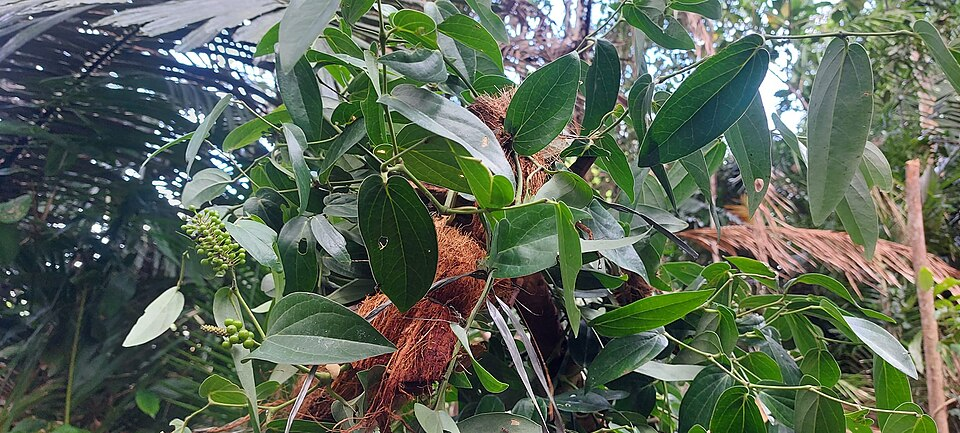
Members of the pepper family can appear as shrubs, small trees, or herbaceous plants, either perennial or annual. Many of them grow from rhizomes, and they can develop either on the ground or attached to other plants. Their stems may grow straight or branch out in different directions.
The leaves are typically simple in shape with entire margins, and can be arranged at the base of the plant or spread along the stem. Their position varies—they may be alternate, opposite, or whorled. Stipules and petioles are usually present, and the foliage often releases a distinct aroma when crushed.
The flowers grow on spike-like inflorescences, which can be found at the tips of stems, opposite a leaf, or in the axils. Each flower is bisexual and lacks a perianth, but is accompanied by a small, shield-shaped bract. There are usually between 2 to 6 stamens, located beneath the ovary, with anthers divided into two compartments. Most flowers feature 3 to 4 stigmas attached to a single pistil, which may be composed of one or a few carpels. The ovary is positioned above the other floral parts and contains a single chamber.
The fruit resembles a drupe, containing just one seed. These seeds include a very small embryo surrounded by a floury perisperm, serving as a nutrient source.
Classification of Piperaceae
This family is divided into genera. Among these are:
- Peperomia (pepper elder)
- Piper (kava, black pepper)
Photo(s):
1. Tyo Satriany, CC BY-SA 4.0 https://creativecommons.org/licenses/by-sa/4.0, via Wikimedia Commons