
Pasta alla Carbonara (Carbonara) 🇮🇹 🇻🇦
Original name: Pasta alla Carbonara
Other names: /
Nationality: Italy 🇮🇹, Vatican City 🇻🇦
Consumption area(s): Lazio, Vatican City
Introduction
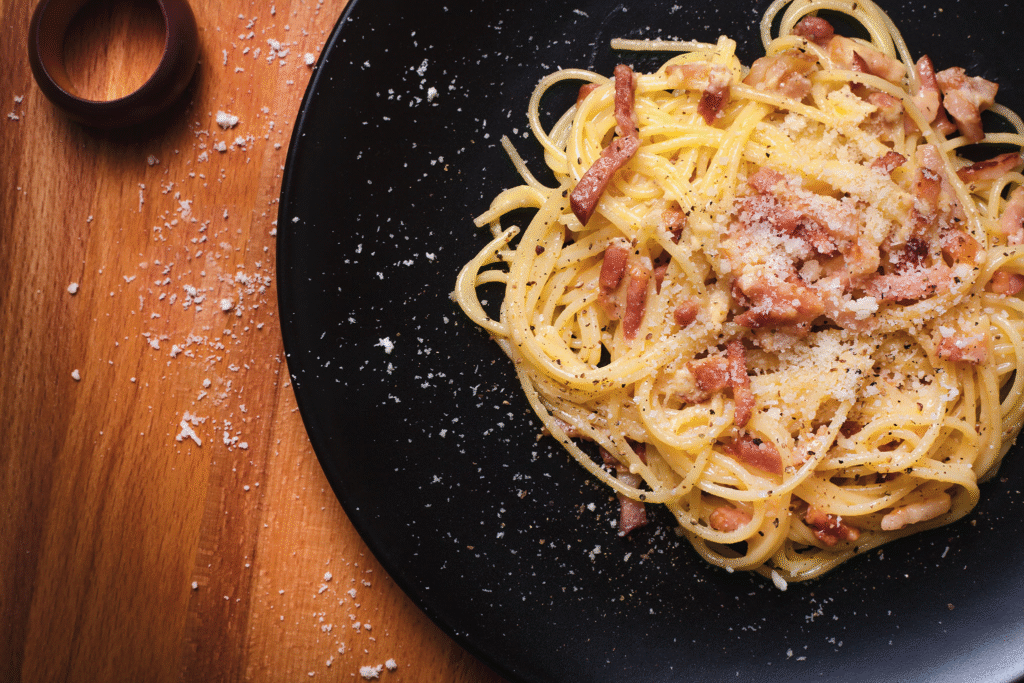
Pasta alla Carbonara (Carbonara) is a celebrated dish rooted in Italian culinary tradition, closely associated with the city of Rome and widely enjoyed throughout the Lazio region. Over the years, it has come to symbolize the essence of Roman cuisine, becoming one of its most recognizable specialties.
Although several theories exist regarding its origins, there is still no absolute certainty. Like many traditional recipes, its history remains partly unclear. However, recent studies suggest that carbonara likely emerged shortly after 1944, during the aftermath of the war.
According to these findings, the dish may have been born from a blend of Italian pasta and ingredients introduced by the Allied forces, such as eggs and bacon, found in military rations. This unexpected fusion appears to have given rise to what is now one of Italy’s most beloved and recognizable pasta dishes.
History of pasta alla Carbonara
The origin of carbonara, like many classic dishes, is wrapped in uncertainty. While various stories circulate, most agree it comes from the Lazio region, though its precise roots remain unclear. It’s commonly grouped with other pasta dishes that feature cured pork, cheese, and black pepper, such as pasta alla gricia. Another close relative is cacio e uova, an older recipe made with melted lard, eggs, and cheese, but notably lacking meat and pepper. Records of this dish go back to 1839, and some older Italians recall the term “cacio e uova” being used for what we now know as carbonara.
The name “carbonara” itself sparks even more debate. Some think it was a filling meal for charcoal workers, based on the word carbonaro. In the U.S., this theory inspired the nickname coal miner’s spaghetti. Others tie it to the Carbonari, a secret revolutionary group from the 19th century. Still, many believe carbonara originated as a modern Roman creation, especially since no mention of it appears in pre-WWII Roman cookbooks like Ada Boni’s 1930 edition.
A dish resembling carbonara appeared in Umbria in the early 1930s, made with whipped eggs, sausage, and pork fat, though it lacked cheese. The term “carbonara” itself first appeared in print in 1950, when the Italian newspaper La Stampa described it as a Roman favorite among American soldiers after the city’s liberation in 1944.
One theory credits an Italian army cook, Renato Gualandi, with inventing the dish during a dinner for U.S. officers, using ingredients the Americans had on hand — bacon, cheese, powdered eggs, and cream. Food historians like Alan Davidson and Luca Cesari support the idea that carbonara was born in Rome around 1944, its creation linked to the influx of American ingredients. Cesari even cites its appearance in a 1951 Italian film, and the first known written recipe in a 1952 Chicago cookbook by Patricia Bronté.
Some scholars argue that carbonara was exported to the U.S. by American troops or Italian-Americans who encountered it in Rome. Italian professor Alberto Grandi controversially claimed the dish’s first real recipe was American, a view that has faced backlash in Italy.
By 1954, carbonara made its official debut in Italy through La Cucina Italiana magazine, though this early version included pancetta, garlic, and even Gruyère. That same year, it was also featured in Elizabeth David’s English-language cookbook Italian Food, marking the start of its international fame.
Recipe
Pasta alla Carbonara
Іngredients
- 400 g
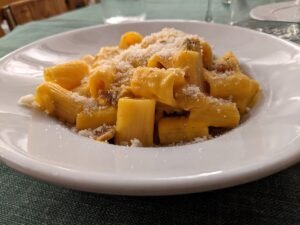
pasta (usually dry pasta; commonly spaghetti, rigatoni, or mezze maniche) (14 oz) - 220 g
guanciale (7,76 oz), sliced very thickly - 85 g pastorized
egg yolks* (1/3 cup) - 150 g
Pecorino Romano DOP (1 1/2 cup) - 4 g
black peppercorns (2 tsp)
For cooking pasta
- 4 l
water (1 gal) - 20 g
coarse salt (1 tbsp)
Іnstructions
- Begin by heating the water in a large pot over medium-high heat. Once it starts to simmer, add the coarse salt. When the water reaches a steady, rolling boil, add the pasta and stir briefly to prevent sticking.
- In the meantime, take the guanciale, remove the rind and the peppered outer layer, and cut it into strips.
- Let the guanciale sizzle in a non-stick pan over medium heat, without adding any oil. Allow it to cook until the fat has melted. At this point, pour the rendered fat into a bowl and return the guanciale to the heat to make it crispy. Then turn off the heat, drain the guanciale, and pat it dry on paper towels.
- Grind the black peppercorns using a mortar and pestle until you achieve a medium grind; if you don’t have one, any other suitable tool will do. Toast the freshly ground pepper in a preheated dry pan over medium heat for a couple of minutes, until it releases a fragrant aroma.
- Meanwhile, whisk the egg yolks together with the grated pecorino (reserving two tablespoons for later) and the toasted black pepper, leaving about a teaspoon aside for garnish. Mix well using a whisk.
- Add one tablespoon of pasta cooking water and all of the reserved guanciale fat to the egg and cheese mixture to make it creamy and smooth.
- Set aside a glass of pasta cooking water. Cook the pasta according to the time indicated on the package, but drain it about one minute earlier to keep it al dente. The best way to check is to taste it: it should be tender but still firm to the bite.
- Transfer the pasta into a cold pan or bowl — you can use the one where you cooked the guanciale, but make sure it’s completely cooled down; otherwise, the heat will cause the egg to curdle. Add the egg yolk and pecorino cream along with a ladle of pasta water. Stir thoroughly to combine everything.
- If the pasta seems too dry, add a bit more pasta water, aiming for a creamy consistency without it becoming too loose.
- When the carbonara is nice and creamy, stir in the crispy guanciale (saving a few pieces for garnish) and plate. Finish with a sprinkle of pecorino and a dusting of black pepper.
Notes:
Nutritional facts table
Please note that nutritional values may vary slightly depending on the ingredients used.
| Nutrients | Total (4 people) | Per serving |
| Calories (kcal) | 3760.3 | 940.1 |
| Total fat (g) | 219.86 | 54.96 |
| ———Saturated fat (g) | 87.14 | 21.78 |
| Cholesterol (mg) | 1334.5 | 333.6 |
| Sodium (mg) | 3654.3* | 913.6* |
| Total carbohydrates (g) | 303.66 | 75.91 |
| ———Dietary fiber (g) | 14.6 | 3.65 |
| ———Total sugar (g) | 11.12 | 2.78 |
| Protein (g) | 122.79 | 30.70 |
*Sodium content may vary depending on how much salt is absorbed by the pasta during cooking and how much cooking water is used in the final dish.
Photo(s):
1. Javier Somoza, CC BY-SA 4.0 https://creativecommons.org/licenses/by-sa/4.0, via Wikimedia Commons
2. LuKePicci, CC BY-SA 4.0 https://creativecommons.org/licenses/by-sa/4.0, via Wikimedia Commons