
Lathyrus (or Pisum)
Genus of Faboideae
Food, Plant source foods, Plants (Plantae), Flowering plats (angiospermae), Mesangiosperms, Eudicots, Core eudicots, Superrosids, Rosids, Fabids (Eurosids I), Fabales, Fabaceae (Leguminosae), Faboideae
Consumption area(s): While precise data on the spread of this subfamily is lacking, it can be reasonably assumed, with minimal uncertainty. that its geographical range largely mirrors that of the Fabaceae family.
Note: For better understanding, please read the article on flowering plants (angiospermae) first. If you come across unfamiliar words, you can click on any highlighted term to open the glossary with definitions of key botanical terms.
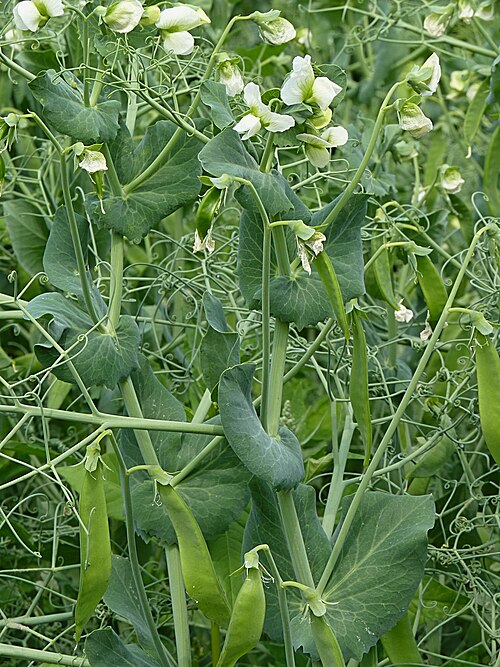
Introduction
Lathyrus is a genus of flowering plants belonging to the Fabaceae family. The genus includes mainly small herbaceous species, which may be either annual or perennial. Its members are characterized by the distinctive papilionaceous flowers, a typical floral structure widely found among Fabaceae. Lathyrus species are distributed across a variety of habitats and include both cultivated and wild plants.
Description of Lathyrus
The Lathyrus species display a diverse range of growth forms, occurring as either climbing or herbaceous plants with annual or perennial life cycles. The root system may include tuberous roots, while in some species additional roots develop from an underground rhizome. The stems are generally herbaceous and slender ad underground rhizome is also frequently present.
The leaves are usually pinnately compound, generally bearing a small number of relatively large leaflets. The leaf rachis commonly extends into an upper tendril, which may be simple or branched and allows climbing species to attach themselves to surrounding vegetation. Leaflets range from ovate to lanceolate or linear and the base of the petiole commonly bears a pair of conspicuous stipules.
The inflorescences are generally racemes carried on relatively long peduncles, although the individual flowers may sometimes be pendulous. Flower coloration is highly variable and can include wine-red, pink, purple, violet, blue, white, and yellow.
The flowers are hermaphroditic, pentamerous, and zygomorphic, with five sepals and five petals. Their characteristic papilionaceous flowers consists of a corolla with an upper standard petal, two lateral petals, and two lower petals fused into a structure enclosing the reproductive organs. The calyx forms a bell-shaped, somewhat oblique tube ending in five teeth, which may differ in length.
The androecium normally contains ten stamens, which may be monadelphous, forming a single group, or diadelphous, with nine stamens fused and one remaining free. The gynoecium consists of a superior ovary formed from a single carpel. The style is curved and flattened, with hairs on its inner surface, and terminates in an upper stigma.
The fruit is a linear, flattened legume containing several seeds. At maturity, it is dehiscent, splitting longitudinally into two parts to release its seeds.
Uses of Lathyrus
Several species of Lathyrus have been used as food by different human populations. Indigenous communities in North America, for example, traditionally consumed the seeds of Lathyrus ochroleucus, while some groups in Nebraska ate the entire pods of Lathyrus ornatus. In parts of New Mexico, the pods of Lathyrus polymorphus were also used as a food resource.
In Europe, one of the most significant edible species is chickpea, traditionally known as Lathyrus sativum. It has been cultivated and consumed particularly in Italy, Spain, and Turkey, with more limited traditional use in France and England. The seeds are an important source of plant protein and carbohydrates and have historically been valued as a hardy crop capable of growing under relatively difficult agricultural conditions.
A notable food plant associated with the genus is the common pea. It is traditionally known as Pisum sativum, but some modern taxonomic treatments place it under Lathyrus oleraceus. The plant is cultivated extensively for its edible seeds, which are consumed fresh, preserved, frozen, or dried.
The nutritional use of some Lathyrus species requires caution. In particular, chickpea can contain β-ODAP, a neurotoxic compound that, when consumed in substantial amounts over prolonged periods, may cause lathyrism. Consequently, although chickpea has considerable nutritional and agricultural value, prolonged consumption as a major staple is undesirable without appropriate dietary management.
Other members of the genus have been exploited for more specific purposes. The seeds of Lathyrus vestitus were reportedly used by some Arctic Indigenous populations as a coffee substitute, while Lathyrus tuberosus has been valued for its tuberous roots, which contain edible starch and can be used as a food source.
Classification of Lathyrus
Asian rice is divided into species, including:
- Chickpeas
- Common peas
Photo(s):
1. Jamain, CC BY-SA 3.0 https://creativecommons.org/licenses/by-sa/3.0, via Wikimedia Commons