
Bony fish (Osteichthyes)
Class of vertebrates
Food, Animal source foods, Animals (Animalia), Chordates (Chordata), Vertebrates (Vertebrata)
Consumption area(s): Earth
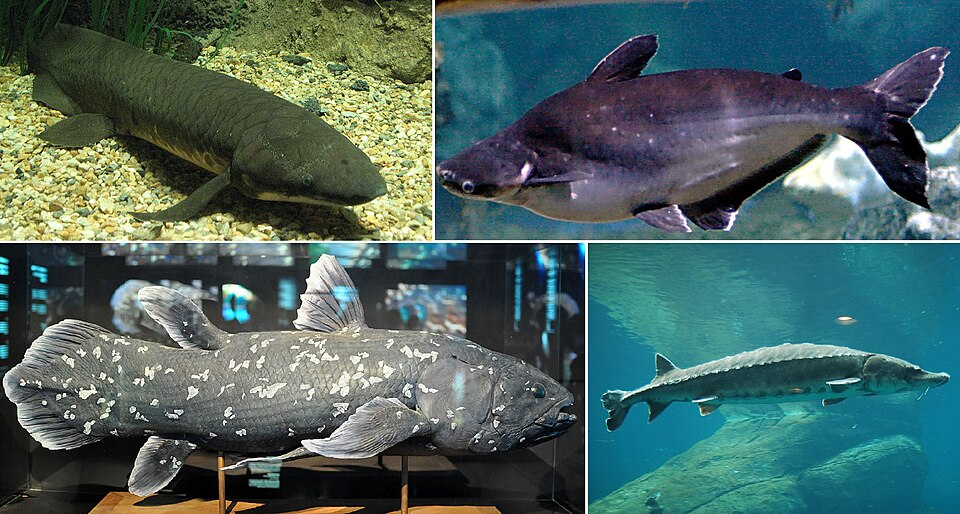
Introduction
Bony fish (Osteichthyes), represent a highly varied group of vertebrates characterized by an endoskeleton mainly formed by bones. This clade differs from groups such as Chondrichthyes because those animals possessed skeletons composed primarily of cartilage rather than bone. Most living fish species belong to the Osteichthyes, making this clade one of the largest and most abundant among vertebrates. The group contains around 45 orders, more than 435 families, and over 28,000 species, reflecting an enormous biological diversity.
Although they are known as bony fish, the earliest primitive representatives of this lineage had skeletons that were still largely cartilaginous, because bone structures were not yet fully developed. One of the most important characteristics distinguishing these early forms from other fish groups was the presence of specialized foregut sacs. Over evolutionary time, these structures later gave rise to the swim bladder and the lungs.
Description of bony fish (Osteichthyes)
Bony fish are defined by a relatively conserved arrangement of cranial bones, along with a medially positioned insertion of the jaw musculature on themandible. The head skeleton and pectoral girdles are typically reinforced by extensive bone structures. The eye region is often supported by a scleral ring made of small ossified elements, although this feature is reduced or absent in many derived lineages. Inside the skull, the inner ear contains relatively large otolith structures, while the neurocranium is commonly subdivided into anterior and posterior regions separated by a structural cleft.
In early forms, respiration involved simple paired digestive outpouchings extending from the esophageal region, which allowed supplemental air intake in oxygen-poor waters. In ray-finned lineages, these structures were modified into swim bladders, regulating buoyancy and body density. In lobe-finned relatives close to the origin of terrestrial vertebrates, these same structures became increasingly specialized for direct air breathing and eventually contributed to the evolution of lungs in amphibians, reptiles, birds, and mammals.
Primitive forms lacked fin spines and instead possessed fleshy, paddle-like appendages, whereas lobe-finned groups developed internal skeletal elements within fins that later formed the basis of terrestrial limbs. A key innovation was the appearance of paired opercular structures, enabling active water flow across the gills without continuous swimming.
The integument of bony fish lacks placoid scales and instead bears scales embedded beneath the outer skin layer. These scales are categorized into cosmoid, ganoid, and teleost types. Within teleosts, further differentiation produces cycloid and ctenoid scales. Although all scales originate from a bony foundation, they differ in layering: teleost scales are relatively simple, ganoid scales include multiple layers including enamel-like tissue, and cosmoid scales incorporate dentin-like material between structural layers.
All members of this group possess functional gills, which represent the primary respiratory system in most species. However, some lineages such as lungfish and other derived osteichthyans can also use lungs, modified swim bladders, or even supplementary surfaces such as the skin, intestine, or stomach for gas exchange. Most species are ectothermic, relying on environmental temperatures to regulate metabolism, although large predators such as tuna, swordfish, and opah have independently evolved partial forms of endothermy.
From a nutritional perspective, bony fish display wide diversity, including omnivory, carnivory, herbivory or detritivory. Reproductive strategies are equally variable: some species are hermaphroditic or capable of parthenogenesis, and fertilization may be external or internal. Development is generally oviparous, but ovoviviparity and viviparity also occur. Parental care is usually absent, though in certain species eggs may be guarded, hidden, or brooded.
Classification of bony fish (Osteichthyes)
This class is categorized into the following classes:
- Lobe-finned fish (Sarcopterygii) (West African lungfish)
- Ray-finned fish (or Actinopterygians, Actinopterygii) (cods, eels salmons, sardines, trouts, tuna)
Source(s):
https://en.wikipedia.org/wiki/Osteichthyes
Photo(s):
1. Prehistoricplanes, CC BY-SA 4.0 https://creativecommons.org/licenses/by-sa/4.0, via Wikimedia Commons