
Corn oil (maize oil)
Food, Plant source foods, Vegetable oils and derivatives
Consumption area(s) (countries that consumed more than 0.5 kg per person annually in 2023):
Argentina 🇦🇷, Azerbaijan 🇦🇿, Bahrain 🇧🇭, Belgium 🇧🇪, Bulgaria 🇧🇬, Canada 🇨🇦, China 🇨🇳, Croatia 🇭🇷, Estonia 🇪🇪, France 🇫🇷, Germany 🇩🇪, Greece 🇬🇷, Honduras 🇭🇳, Hungary 🇭🇺, Israel 🇮🇱, Italy 🇮🇹, Jordan 🇯🇴, Kuwait 🇰🇼, Libya 🇱🇾, Monaco 🇲🇨, Mozambique 🇲🇿, North Korea 🇰🇵, Oman 🇴🇲, Palestine 🇵🇸, Paraguay 🇵🇾, Qatar 🇶🇦, San Marino 🇸🇲, Saudi Arabia 🇸🇦, Serbia 🇷🇸, Slovenia 🇸🇮, South Africa 🇿🇦, Suoth Korea 🇰🇷, Spain 🇪🇸, Saint Lucia 🇱🇨, Tanzania 🇹🇿, Tunisia 🇹🇳, United Arab Emirates 🇦🇪, United Kingdom 🇬🇧, United States of America 🇺🇸, Uruguay 🇺🇾, Vatican City 🇻🇦, Venezuela 🇻🇪, Zimbabwe 🇿🇼
Chemical/physical properties:
- Saponifiable fraction: ~99%
- Saturated fatty acids: ~2-12%, including 8.0–19% palmitic acid, 0.5–4% stearic acid, and trace amounts of behenic acid (<0.5%), arachidic acid (<0.5%), plus minor contributions from other saturated fatty acids
- Unsaturated fatty acids: ~83-97%, including 19.5–50% oleic acid, 34–62% linoleic acid, and 0.1–2% linolenic acid, with minor contributions from gadoleic acid (<0.5%), plus trace amounts of other unsaturated fatty acids
- Unsaponifiable fraction: ~1%
Chemical/physical properties:
- Smoke point: 232° (refined)
- Density: 0.92 kg/l a 15 °C
Introduction
Corn oil, referred to as maize oil in British English, is a type of vegetable oil derived from the germ portion of maize kernels. It is widely utilized in the food industry because of its versatility and large-scale availability. One of its most important characteristics is its resistance to high temperatures, which makes refined corn oil particularly appropriate for frying and other heat-intensive cooking methods. In addition, it is commonly included in the formulation of certain margarine products and processed foods. Compared with many other vegetable oils, corn oil is often considered a more economical option.
Description of corn oil
Corn oil is characterized by a high concentration of linoleic acid, making polyunsaturated fatty acids its predominant lipid component. Although it provides a substantial amount of omega-6 fatty acids, it contains only minimal levels of omega-3s, which may reduce its suitability as a major fat source in a well-balanced diet when consumed excessively. Another notable property of corn oil is its content of vitamin E, a natural antioxidant that helps delay oxidative deterioration and slows the development of rancidity. As a result, even unrefined varieties can maintain a relatively long shelf life.
Refined corn oil is especially appreciated for high-temperature cooking because its smoke point is close to 200 °C, allowing it to tolerate intense heat with reduced formation of harmful degradation compounds. In addition, the oil contains relatively low amounts of cholesterol, making non-hydrogenated forms potentially compatible with low-cholesterol dietary patterns. However, this advantage may be diminished in products such as some margarines, where hydrogenation processes are commonly applied.
Corn oil production methods
Corn oil can be produced either through mechanical pressing—performed at low or high temperatures—or by using chemical solvent extraction techniques. Once refined, the oil is generally colorless, odorless, and neutral in taste, characteristics that make it suitable for a broad range of food applications. Its typical yellow appearance is often achieved by adding beta-carotene, while the incorporation of tocopherols or vitamin E helps enhance oxidative stability and extend storage life. In contrast, cold-pressed or virgin corn oil naturally shows a more intense reddish-yellow coloration.
The manufacturing process is relatively resource-intensive, requiring approximately 100 kilograms of corn to obtain a single liter of oil. Because crude corn oil contains significant amounts of wax, it must undergo a dewaxing process before being suitable for culinary use.
Classification of corn oil
Sunflowerseed oil can be divided in:
- Refined corn oil
- Unrefined corn oil
Nutritional facts table
Please note that nutritional values can vary slightly depending on corn oil type
| Nutrients | Per 100 g |
| Calories (kcal) | 828 |
| Total fat (g) | 99.9 |
| ———Saturated fat (g) | 12,9 |
| Cholesterol (mg) | 0 |
| Sodium (mg) | 0 |
| Total carbohydrates (g) | 0 |
| ———Dietary fiber (g) | 0 |
| ———Total sugar (g) | 0 |
| Protein (g) | 0 |
Photo(s):
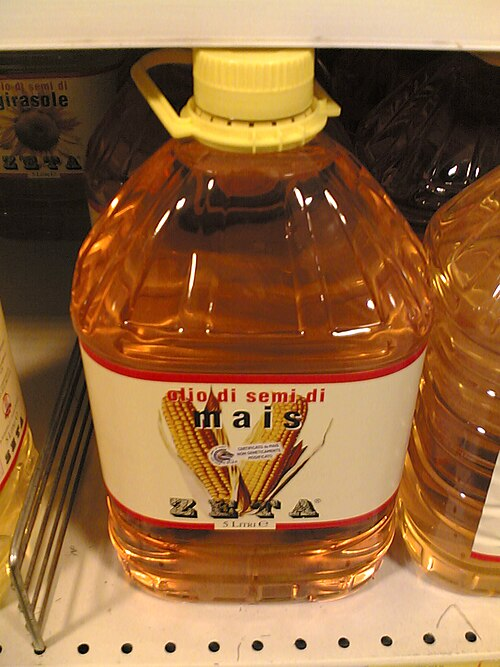
1. Basilicofresco, CC BY-SA 3.0 https://creativecommons.org/licenses/by-sa/3.0, via Wikimedia Commons