
Parmigiano Reggiano DOP
Food, Animal source foods, Dairy products, Cheeses
Main characteristics: Hard cheese, Cow milk cheese, Raw milk cheese
Consumption area(s): Italy 🇮🇹
Production area (s): Province of Bologna (west of the Reno River), Province of Mantua (south of the Po River), Province of Modena, Province of Parma, Province of Reggio Emilia
Introduction
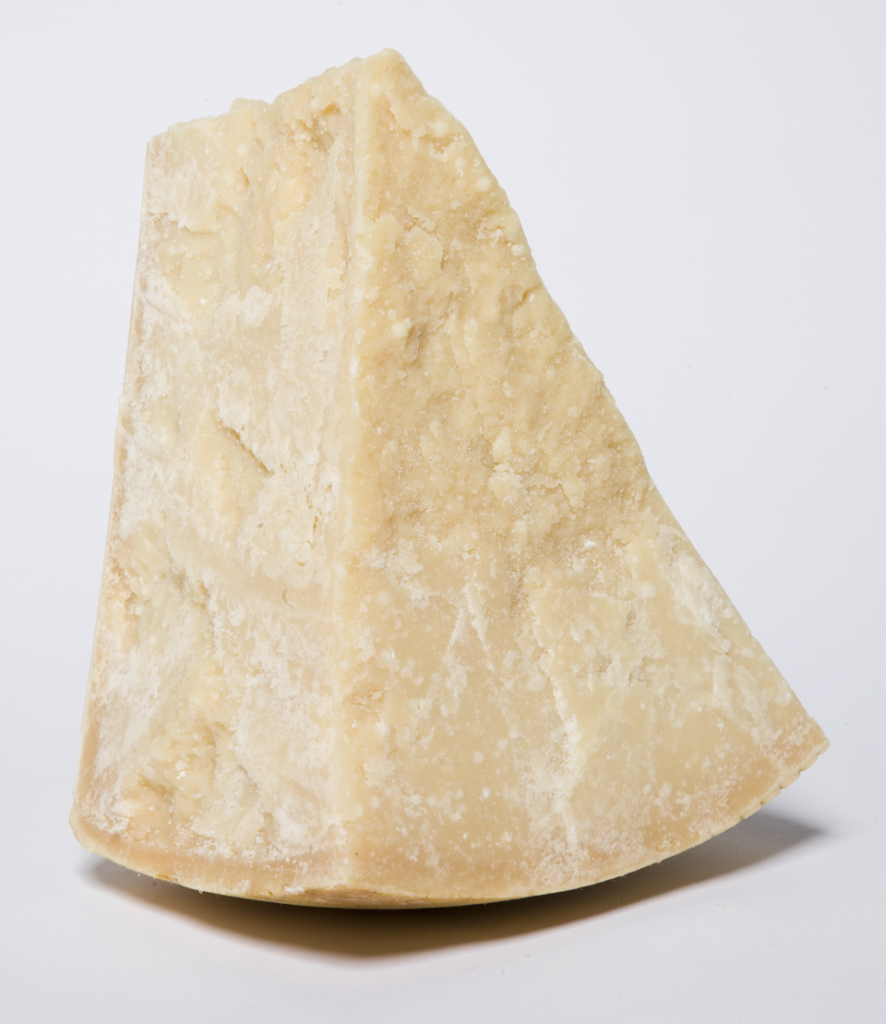
Parmigiano Reggiano DOP is a traditional Italian cheese known for its firm texture and grainy structure, produced solely from cow milk. A defining aspect of this product is its extended aging process, which must last at least twelve months to develop its characteristic flavor and consistency. In regions outside the European Union or countries not adhering to the Lisbon Agreement, various imitations of this cheese are manufactured. These alternatives often replicate the name or style but do not fully comply with the official production regulations, resulting in products that differ in authenticity and quality.
Description of Parmigiano Reggiano DOP
The name “Parmigiano Reggiano” originates from its geographical roots, specifically the provinces of Parma and Reggio Emilia, whose adjectival forms give rise to the designation. Production also includes Modena, the western area of Bologna (beyond the Reno River), and the southern part of Mantua, located on the right bank of the Po River.
All authentic producers are members of the Consortium of Parmigiano Reggiano, established in 1928, which is responsible for enforcing PDO regulations and coordinating promotion and marketing activities. This institution ensures that every wheel meets strict quality and origin standards.
From a culinary perspective, this cheese is highly versatile: it is commonly grated over pasta, incorporated into soups and risottos, or consumed on its own in flakes. Even the rinds are valued, as they can be simmered in broths or sauces to enhance flavor; when free of coatings, they may also be grilled, used to infuse oils, or added to steam baskets for vegetables.
It can be enjoyed either grated or in shavings, adapting to different preparations. The most widespread aging periods are 12, 24, and 30 months, though more mature varieties—such as those aged 36, 48, or even 72 months—are appreciated for their increasingly intense and complex taste.
History of Parmigiano Reggiano DOP
The origins of Parmigiano Reggiano date back to the 12th century, in the monastic communities of the Benedictines and Cistercians located between Parma and Reggio Emilia. By the 13th and 14th centuries, the cheese had already evolved into a form very close to its modern one, suggesting even older historical roots. Some scholars propose a relationship with Piacentino di Piacenza and Granone Lodigiano, both hard cheeses, the latter even mentioned in certain Roman-era sources.
Ancient accounts link the birth of Parmigiano Reggiano to medieval monasteries and castles, where the first true dairies emerged. These were small, often square or polygonal structures, dedicated to milk processing. The main religious centers supporting production were the Benedictines of San Giovanni Evangelista in Parma and San Prospero in Reggio Emilia, as well as the Cistercians of San Martino di Valserena and San Bernardo di Fontevivo, both in the Parma area.
The presence of abundant spring water enabled the development of extensive pasturelands, such as those north of Parma between Fontanellato and Fontevivo, and in the Reggio area between Montecchio Emilia and Campegine. Medieval documents also refer to a cheese called Formadio around the year 1000, produced on lands belonging to Countess Matilda of Canossa in Frombolara (Carpineti), where monks from Marola were active. Additionally, the salt pans of Salsomaggiore ensured a reliable supply of salt, essential for cheese production.
Parmigiano Reggiano also appears in literature: Giovanni Boccaccio, in the Decameron, describes a mountain of grated cheese over which macaroni and ravioli were cooked. Later, in the 18th century, Giacomo Casanova criticized the widespread misuse of the name “Parmigiano” across Europe, noting that similar cheeses were being produced elsewhere, including in Lodi, Lombardy.
Production methods for Parmigiano Reggiano DOP
Parmigiano Reggiano is made from raw cow milk, sourced exclusively from cows fed on grass and hay. The process begins by blending the morning milk with the partially skimmed evening milk, resulting in a naturally semi-skimmed mixture. This is transferred into traditional copper vats, whose thermal properties ensure uniform heating and contribute trace amounts of copper ions to the curd.
A whey starter culture, containing thermophilic lactic bacteria, is then added, and the mixture is brought to a temperature of 33–35°C. Subsequently, calf rennet is introduced, triggering coagulation within approximately 10–12 minutes. The resulting curd is broken down into fine granules resembling rice grains, after which the temperature is raised to about 55°C. Following a resting phase of roughly one hour, the curd is collected and wrapped in muslin cloth, then placed into moulds. The residual whey is traditionally repurposed as feed for pigs used in the production of Prosciutto di Parma.
The cheese is shaped using a cylindrical mould, secured initially with a spring clamp to maintain structure. After one or two days, the clamp is removed and replaced with a plastic band bearing the Parmigiano Reggiano marking, the factory identification number, and the production date, which is imprinted onto the rind within 24 hours. The wheels are then immersed in a brine bath for 20–25 days using Mediterranean sea salt.
After salting, the wheels are transferred to aging rooms, where they mature for at least 12 months. They are placed on wooden shelves and turned weekly to ensure uniform maturation.
At 12 months, each wheel undergoes official inspection by the Parmigiano Reggiano Consortium. A specialist known as a “battitore” taps the wheel with a small hammer to detect internal defects such as cracks or voids. Based on this evaluation, the cheese is classified into three categories: the highest quality is fire-branded, the second receives identifying marks on the rind, while the third category is left unmarked and typically declassified.
Nutritional facts table
| Nutrients | Per 100 g |
| Calories (kcal) | 402 |
| Total fat (g) | 29.7 |
| ———Saturated fat (g) | 19.6 |
| Cholesterol (mg) | 83 |
| Sodium (mg) | 650 |
| Total carbohydrates (g) | 0 |
| ———Dietary fiber (g) | 0 |
| ———Total sugar (g) | 0 |
| Protein (g) | 32.4 |
Recipes that use this product as an ingredient:

Source(s):
https://en.wikipedia.org/wiki/Parmesan
https://it.wikipedia.org/wiki/Parmigiano_Reggiano
Photo(s):
1. Consorzio del Parmigiano Reggiano, CC BY-SA 3.0 https://creativecommons.org/licenses/by-sa/3.0, via Wikimedia Commons
2. Consorzio del Formaggio Parmigiano-Reggiano, Public domain, via Wikimedia Commons