
Grana Padano DOP
Food, Animal source foods, Dairy products, Cheeses
Main characteristics: Hard cheese, Cow milk cheese, Raw milk cheese
Consumption area(s): Italy 🇮🇹
Production area (s): Province of Alessandria, Province of Asti, Province of Biella, Province of Bergamo, Province of Bologna (east of the Reno River), Province of Brescia, Province of Como, Province of Cremona, Province of Lecco, Province of Cuneo, Province of Ferrara, Province of Forlì-Cesena, Province of Lodi, Province of Mantua (north of the Po River), Province of Milan, Province of Monza and Brianza, Province of Novara, Province of Padua, Province of Pavia, Province of Piacenza, Province of Ravenna, Province of Rimini, Province of Rovigo, Province of Sondrio, Province of Turin, Province of Trento, Province of Treviso, Province of Varese, Province of Venice, Province of Verbano-Cusio-Ossola, Province of Vercelli, Province of Verona, Province of Vicenza and, for milk production, also the comuni of Anterivo, Lauregno, Proves, Senale-San Felice and Trodena
Introduction
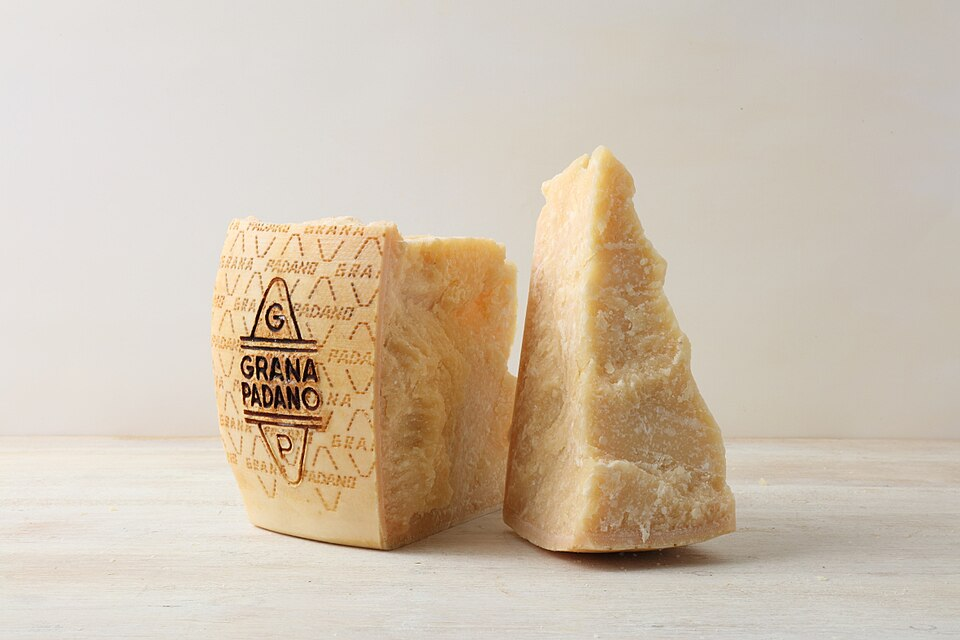
Grana Padano DOP is an Italian cheese recognized for its hard consistency, use of raw milk, and slow maturation process. It belongs to the broader family of “grana” cheeses, distinguished by their granular texture and long aging. Its production spans thirty-two provinces across Emilia-Romagna, Lombardy, Piedmont, Veneto, and Trentino-Alto Adige. Within the Autonomous Province of Trento, it is specifically known as Trentingrana. Every stage of the process—ranging from cattle farming to aging and even grating—must strictly occur within the designated geographical area of origin, ensuring compliance with the official production standards.
Description of Grana Padano DOP
A wheel of Grana Padano has a cylindrical shape, with a slightly convex or nearly straight rind edge and flat faces. Its size typically ranges between 35 and 45 cm in diameter and 15 to 18 cm in height, while the weight varies from 24 to 40 kg. The rind, relatively thin, displays a characteristic straw-yellow color.
This cheese is marketed according to different aging stages. In its earlier phase, between 9 and 16 months, it retains a certain creaminess and only a mildly grainy texture. After 16 months, the structure becomes more crumbly, and the flavor intensifies significantly.
Once maturation exceeds 20 months, it is labeled “Riserva”. At this stage, the paste is distinctly granular, with a very friable consistency and a rich, full-bodied taste. Inside the cheese, one can observe characteristic protein crystals, mainly composed of tyrosine, which appear as small granular or semi-solid formations.
History of Grana Padano DOP
According to some traditions, this cheese originated in 1135 at the Abbey of Chiaravalle, near Milan, although this attribution remains uncertain, as another monastery with the same name also existed in the Po Valley, between Piacenza and Fidenza. Its development is often interpreted as an indirect response to land reclamation projects, which transformed areas into pasture and farmland, leading to a significant surplus of milk that exceeded immediate consumption needs. To avoid waste, monks sought methods to create long-lasting foods, likely refining techniques already used in other monastic communities experienced in cattle farming.
Production took place within monasteries using large cauldrons, which can be seen as precursors to modern dairies. The monks referred to this product as caseus vetus (“old cheese”) to distinguish it from fresh varieties, while local populations, unfamiliar with Latin, began calling it “Grana”, referring to the characteristic white grains in the paste formed by calcium crystals. The name was often combined with the production area, giving rise to regional labels.
The earliest documented reference dates back to 1254, preserved in the State Archives of Genoa, mentioning a casei paramensis (Parmigiano cheese). About a century later, Giovanni Boccaccio, in the Decameron, described grated “Parmigiano” in his depiction of the mythical land of Bengodi. Over time, the cheese became highly valued in noble banquets, as evidenced by a 1504 letter from Isabella d’Este, who sent it to her family in Ferrara. Gradually, thanks to its long shelf life, it also became an important food among lower social classes, especially during periods of famine.
In 1951, during the Stresa Conference, European dairy experts established rules for cheese naming, formally distinguishing Grana Lodigiano (later Grana Padano) from Parmigiano Reggiano. Two years later, with support from Federlatte and Assolatte, the Grana Padano Protection Consortium was founded. In 1955, Grana Padano received official recognition as a designation of origin, defining strict rules regarding production area, shape, size, and aging.
Finally, in 1996, the European Union, through Regulation EC No. 1107, granted Grana Padano the status of Protected Designation of Origin (PDO), confirming its place as one of the most emblematic products of Italian cheesemaking tradition.
Production methods for Grana Padano DOP
Grana Padano DOP is produced throughout the entire year using exclusively raw cow milk sourced from the designated geographical area defined by the production regulations. The feeding regime of cows, as well as heifers over 7 months must rely on forages and feedstuffs originating from the same territory. At least 50% of daily dry matter intake must come from forage, maintaining a forage-to-feed ratio ≥ 1, while at least 75% of the forage component must be cultivated within the production zone.
Permitted feed includes fresh forages such as clover, oats, and wheat, as well as their corresponding hay, along with cereal straw and maize silage (the latter excluded in the production of Trentingrana). Allowed concentrates include cereals, oil seeds, tubers, sugar-industry by-products, and selected additives such as vitamins and antioxidants.
Historically, Grana Padano was classified according to the season of production: Vernengo for winter cheese, Maggengo for spring–summer production (often considered the finest), and Tardivo for autumn cheese. These distinctions reflected changes in animal feeding regimes, which influenced the aroma and colour of the milk: winter feeding based on dry hay produced a whiter, fattier cheese, while fresh pasture grazing in spring and summer resulted in more complex sensory profiles. This practice has largely disappeared due to modern standardisation of feeding techniques.
Milk used for production must meet strict hygiene standards, particularly regarding bacterial load and somatic cell count. After milking, it is stored at a minimum temperature of 8°C, and up to two milkings may be combined, one of which must be naturally partially skimmed. The milk is then poured into copper vats (or copper-lined), typically in batches of about 1000 litres, producing two twin wheels per batch. After adding whey starter culture (and, where permitted, lysozyme), the milk is coagulated with calf rennet at 31–33°C. Following curd breaking with a spino tool, the mixture is cooked up to a maximum of 56°C.
After cooking, the curd remains in the whey for up to 70 minutes, then is divided into two portions and wrapped in linen cloths. The forms are placed into an initial moulding frame, followed after 12 hours by a second plastic mould, which imprints the serial number, province, month, year of production, and Consortium logo. A casein plate with a unique identifier is also applied. After one day, the plastic mould is replaced with a domed steel band, giving the characteristic convex rind shape. The wheels are then submerged in brine for 14–30 days, followed by drying in a dedicated warm room.
Aging must last at least 9 months in controlled environments maintained at 15–22°C. During maturation, wheels are cleaned and turned approximately every 15 days, initially by hand and now mostly using automated systems. After 8 months, wheels that meet quality standards (notably alkaline phosphatase activity) undergo official inspection: those deemed suitable receive a fire brand mark, while non-compliant wheels have their identification markings removed.
Nutritional facts table
| Nutrients | Per 100 g |
| Calories (kcal) | 398 |
| Total fat (g) | 29 |
| ———Saturated fat (g) | 18.4 |
| Cholesterol (mg) | 98.3 |
| Sodium (mg) | 600 |
| Total carbohydrates (g) | 0 |
| ———Dietary fiber (g) | 0 |
| ———Total sugar (g) | 0 |
| Protein (g) | 33 |
Recipes that use this product as an ingredient:

Source(s):
https://it.wikipedia.org/wiki/Grana_Padano
https://en.wikipedia.org/wiki/Grana_Padano
Photo(s):
1. Claudia Castaldi, CC BY-SA 4.0 https://creativecommons.org/licenses/by-sa/4.0, via Wikimedia Commons
2. Consorzio Formaggi Grana Padano – upload: Giov.c, Public domain, via Wikimedia Commons