
Pomodoro San Marzano dell’agro sarnese-nocerino DOP (Agro Sanrese-Nocerino San Marzano tomatoes PDO)
Cultivar of Tomato (Solanum lycopersicum)
Food, Plant source foods, Plants (Plantae), Flowering plats (angiospermae), Mesangiosperms, Eudicots, Core eudicots, Superastierds, Asterids, Lamiids, Solanales, Solanaceae, Solanum, Tomatoes
Species name: Solanum lycopersicum
Others name: Pomodoro San Marzano
Consumption area(s): Italy 🇮🇹, San Marino 🇸🇲, Vatican City 🇻🇦
Consumption area(s): Agro sarnese-Nocerino
Introduction
The Pomodoro San Marzano dell’Agro Sarnese-Nocerino DOP (Agro Sarnese-Nocerino San Marzano tomatoes PDO) region is an Italian horticultural product recognized under the Protected Designation of Origin (PDO) system. This certification identifies it as a geographically specific agricultural variety with legally protected status.
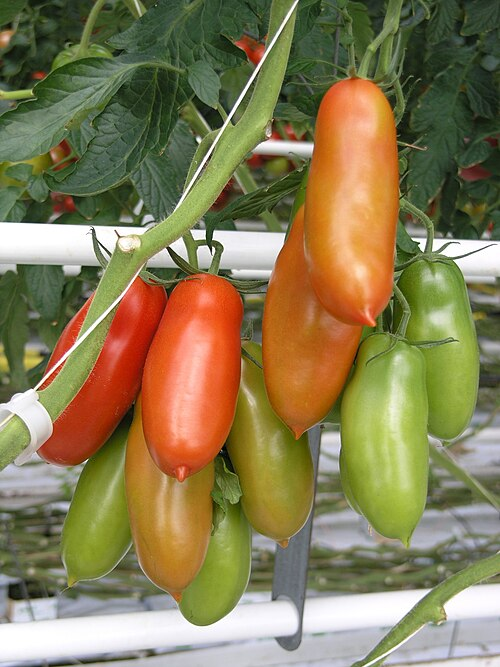
Its name derives from the town of San Marzano sul Sarno, where the cultivar originally developed. The fruit is typically elongated in shape and is especially valued within the food processing industry, where it is widely used for making pomodori pelati (peeled tomatoes) and passata di pomodoro (tomato purée). The variety is characterized by a dense, meaty flesh, a relatively low water content, and a limited number of seeds. These properties make it particularly suitable for rapid cooking methods, which help preserve a more intense and fresh tomato flavor in sauces and processed preparations.
History of Pomodoro San Marzano dell’Agro Sarnese-Nocerino DOP
According to some unverified accounts, the earliest introduction of the Pomodoro San Marzano in Campania dates back to 1770, when seeds were reportedly gifted by the Viceroy of Peru to the King of Naples. These seeds were planted in the area now known as San Marzano sul Sarno, where they adapted successfully due to the nutrient-rich volcanic soil, which proved highly favorable for cultivation.
In the United States, this tomato is often regarded as the genetic foundation of another widely cultivated type, the “Roma” variety, itself commonly described as a hybrid derivative influenced by San Marzano characteristics.
The industrial processing of this tomato began relatively late, around 1926, marking the transition from local agriculture to structured production systems. However, the original San Marzano cultivar was later devastated by a viral disease, leading to its official removal from the national varietal registry in 1991.
Modern production under the D.O.P. regulations relies on newly selected varieties that retain portions of the original genetic profile. Among these are KIROS (formerly known as Selezione Cirio 3), San Marzano 2, and several related ecotypes, including 20 SMEC 3, developed through targeted breeding initiatives supported by the Campania Region and conducted between 1995 and 1997 by the Consorzio per la Ricerca Applicata in Agricoltura (CRAA). Today, KIROS stands as the primary reference cultivar, accounting for the vast majority of current agricultural production of San Marzano.
Production methods for Pomodoro San Marzano dell’Agro Sarnese-Nocerino DOP
Only plant lines derived from genetic improvement of the San Marzano ecotype may be used for production, provided that both the breeding process and the cultivation phase take place strictly within the designated geographical area and that the resulting tomatoes comply with the quality parameters established by the official production standards.
The regulation specifies that, in order to use the D.O.P. designation, both agricultural production and industrial processing must occur within a clearly defined territory. This area lies mainly in the northern part of the province of Salerno, extending into nearby zones of the Vesuvian and Avellino regions. Cultivation is limited to flat, irrigated or irrigable land, excluding hilly or elevated zones due to unsuitable conditions.
The production zone corresponds to the Sarno plain, characterized by soils largely composed of volcanic pyroclastic materials. These soils are deep and rich in organic matter, with high levels of available phosphorus and exchangeable potassium, creating highly favorable agronomic conditions. The region also benefits from abundant water resources, including natural springs and groundwater reserves.
From a climatic perspective, the area is moderated by the influence of the sea, resulting in limited temperature fluctuations and only brief occurrences of sub-zero conditions. Hail events are uncommon, while prevailing winds include the Mistral from the north and the Sirocco from the south. Rainfall is concentrated in autumn, winter, and spring, whereas summers are dry, though air humidity remains relatively high. Transplanting generally takes place in early April, but may extend into the first ten days of May.
Harvesting must be performed entirely by hand, following a staggered schedule, and only when the fruits reach full ripeness, requiring multiple harvest passes. The harvested tomatoes are placed in plastic containers with a capacity of about 25 kg (approximately 55 lb). For transport to processing facilities, they may then be transferred into larger crates, each individually identified, with a maximum capacity of 2.5 quintals (about 250 kg, equivalent to roughly 551 lb).
Nutritional facts table for the fruit
| Nutrients | Per 100 g |
| Calories (kcal) | 23 |
| Total fat (g) | 0.1 |
| ———Saturated fat (g) | 0 |
| Cholesterol (mg) | 0 |
| Sodium (mg) | 8 |
| Total carbohydrates (g) | 5 |
| ———Dietary fiber (g) | 4 |
| ———Total sugar (g) | 1 |
| Protein (g) | 1 |
Recipes that use this product as an ingredient:

Photo(s):
1. Goldlocki, CC BY-SA 3.0 http://creativecommons.org/licenses/by-sa/3.0/, via Wikimedia Commons