
Myristicaceae
Family of Magnoliales
Food, Plant source foods, Plants (Plantae), Flowering plats (angiospermae), Mesangiosperms, Magnolids, Magnoliales
Consumption area(s): Earth
Note: For better understanding, please read the article on flowering plants (angiospermae) first. If you come across unfamiliar words, you can click on any highlighted term to open the glossary with definitions of key botanical terms.
Introduction
The Myristicaceae represent a tropical plant family distributed across Africa, Asia, the Pacific, and the Americas, and their classification is widely accepted in botanical systematics. They are commonly referred to as the “nutmeg family”, a name derived from their most notable representative, Myristica fragrans, which provides the well-known spices nutmeg and mace. Among the various genera, Myristica is especially prominent in Asian regions, while Virola dominates in the Neotropical zone.
Description of Myristicaceae
Members of the Myristicaceae are predominantly trees characterized by a distinctive reddish sap and a peculiar architectural pattern known as myristicaceous branching, where horizontal branches emerge only at spaced nodes along the trunk, leaving long unbranched sections in between. Most genera are dioecious, meaning male and female flowers occur on separate plants, with rare exceptions such as some Iryanthera.
The inner bark often appears pink to red and darkens upon exposure, while cuts in the trunk release a red or orange resin. In contrast, young stems may exude a clear, aromatic sap. The leaves are typically glossy, dark green, and aromatic, with a simple, entire structure arranged in two ranks; their undersides are often hairy, sometimes marked with dark speckles and covered in temporary golden to reddish hairs.
The flowers are generally small, reduced, and fragrant, composed of 3–5 tepals with colors ranging from whitish-green to yellow, orange, or reddish tones. They are usually grouped in axillary inflorescences or, in some cases, appear in compact, wart-like clusters. Female flowers lack sterile stamens and often show stigmas divided in lobes, whereas male flowers have fused stamens. The pollen is typically monocolpate and often boat-shaped.
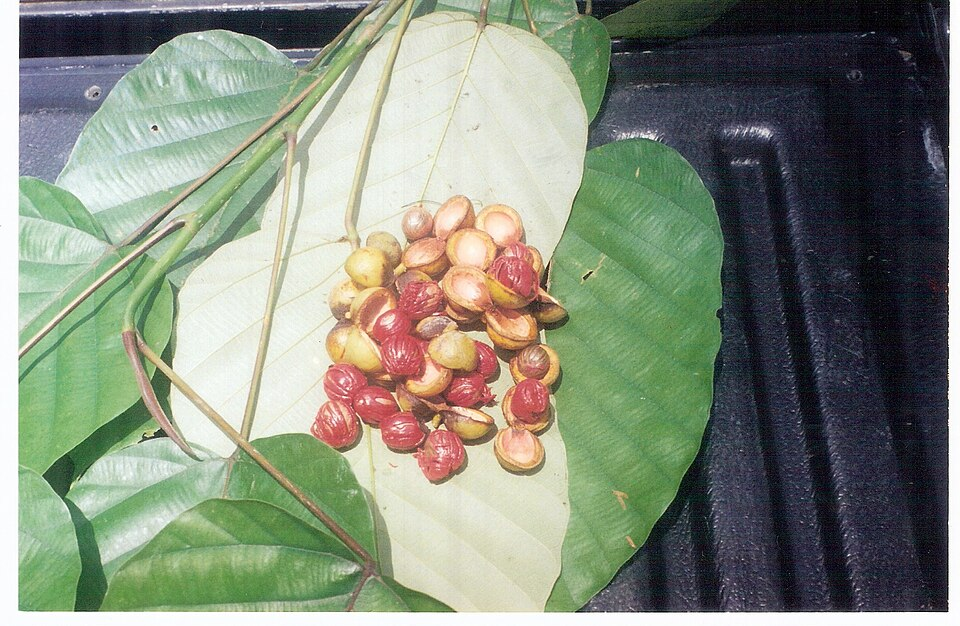
The fruit is a leathery capsule that splits open at maturity, sometimes covered with a rust-colored surface layer. Inside, it contains a single seed, which may be surrounded by an aril—a fleshy covering that can be red, orange, or occasionally whitish and translucent. Inside the there is an endosperm usually uniform in color but occasionally marked by dark patches.
From a chemical perspective, these plants have numerous bioactive compounds identified in leaves, bark, fruits, and seeds. Ecologically, they inhabit a range of tropical forest environments, including lowland rainforests, swamp forests, submontane zones, and even cloud forests up to about 2100 meters in elevation. Although certain anatomical traits suggest an ancestral adaptation to drier habitats, modern representatives are strongly associated with humid tropical ecosystems.
Reproductively, many species exhibit nocturnal flowering, and pollination is typically carried out by small beetles, particularly from the Anthicidae, which feed on pollen. The attraction is mediated by a strong floral scent released from specialized structures of the stamens. In some cases, such as Myristica fragrans, there is evidence suggesting possible pollination by ants, a relatively unusual interaction in flowering plants.
Classification of Myristicaceae
This family if divided in genera. Among them are:
- Coelocaryon (African nutmeg)
- Compsoneura (Amazonian nutmeg)
- Gymnacranthera (wild nutmeg)
- Horsfieldia (wild nutmeg)
- Iryanthera (Amazonian nutmeg)
- Knema (Asian wild nutmeg)
- Myristica (common nutmeg, macis)
- Otoba (tropical nutmeg)
- Pycnanthus (African nutmeg)
- Staudtia (African nutmeg)
- Virola (ucuhuba)
Photo(s):
1. P. S. Sena, CC BY-SA 4.0 https://creativecommons.org/licenses/by-sa/4.0, via Wikimedia Commons