
Chard (Spinach beet)
Cultivar of Beta vulgaris subsp. vulgaris
Food, Plant source foods, Plants (Plantae), Flowering plats (angiospermae), Mesangiosperms, Eudicots, Core eudicots, Superasterids, Caryophyllales, Amaranthaceae, Beta, Beets, Beta vulgaris subsp. vulgaris
Subspecies name: Beta vulgaris subsp. vulgaris
Consumption area(s): Earth
Note: For better understanding, please read the article on flowering plants (angiospermae) first. If you come across unfamiliar words, you can click on any highlighted term to open the glossary with definitions of key botanical terms.
Introduction
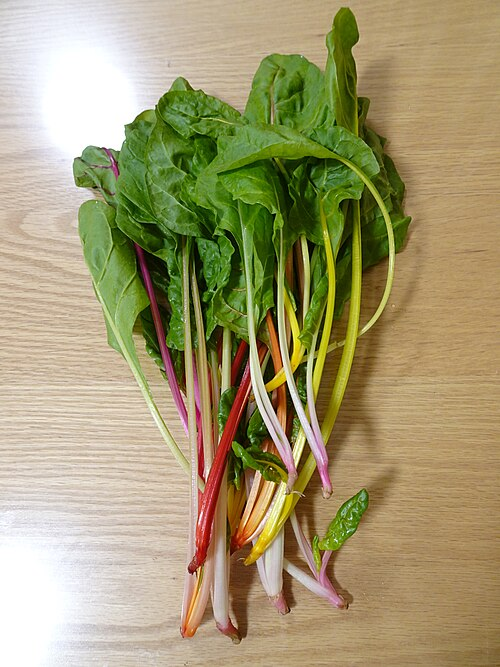
Chard (spinach beet) is a leafy green vegetable valued for its abundant foliage. It is known by several alternative names, including leaf beet and perpetual spinach, reflecting both its botanical identity and its culinary resemblance to spinach. Since it belongs to the same species as beetroot, its common names may sometimes create terminological overlap.
Unlike Swiss chard, spinach beet is characterized by a predominance of tender leaves rather than enlarged stems. The leaf blades, which may appear green or slightly reddish, are the primary edible part and are appreciated for their soft texture and mild flavor, making them suitable for a wide range of culinary preparations.
History of chard as food
This plant has been cultivated for a very long period, with evidence of its use going back to the second millennium BCE. Early domestication is thought to have occurred in the Mediterranean basin, after which the plant spread gradually across a wide geographic range.
Over time, it was introduced into the Middle East, later reaching India, and eventually spreading to China by around 850 CE. In antiquity and the medieval period, it was commonly employed in traditional medicine, particularly in Ancient Greek and European healing practices. Its importance in European agriculture and cuisine later diminished, largely after the widespread adoption of spinach, which gradually replaced it as a preferred leafy vegetable.
Production methods for chard
Chard is a biennial plant, cultivated for its leaf production. In the Northern Hemisphere, sowing typically occurs between early summer and autumn, with timing adjusted according to the intended harvest period. Seeds are often planted in clusters, allowing for dense and continuous growth.
The crop can be collected at different stages of development. When harvested early, the leaves are tender and more delicate in flavor; if left to mature, they become larger with slightly firmer stems. One of its key agronomic traits is the ability to support repeated harvesting, as the plant can regenerate and provide multiple yields over time.
Uses of chard
Fresh chard can be consumed in a variety of ways, including raw preparations such as salads, or incorporated into cooked dishes like stir-fries, soups, and omelettes. The raw leaves may even be used as a wrapping substitute, functioning similarly to a tortilla. Both leaves and stems are commonly prepared through boiling or sautéing, a process that significantly reduces their natural bitterness and improves overall palatability.
In culinary traditions, chard holds particular importance in Croatian cuisine, especially in the Dalmatian region, where it is highly valued and often referred to as the “queen of the Dalmatian garden.” It is used in multiple dishes, including boiled preparations, stews, and traditional recipes such as Soparnik, reflecting its strong integration into local gastronomy.
Nutritional facts table
It should be noted that nutritional values may vary depending on the cultivar.
| Nutrients | Per 100 g |
| Calories (kcal) | 19 |
| Total fat (g) | 0.2 |
| ———Saturated fat (g) | 0.03 |
| Cholesterol (mg) | 0 |
| Sodium (mg) | 213 |
| Total carbohydrates (g) | 3.74 |
| ———Dietary fiber (g) | 1.6 |
| ———Total sugar (g) | 1.1 |
| Protein (g) | 1.8 |
Recipes that use this product as an ingredient:

Photo(s):
1. RuinDig/Yuki Uchida, CC BY 4.0 https://creativecommons.org/licenses/by/4.0, via Wikimedia Commons