
Chiesina Uzzanese
Municipality in the province of Pistoia
Earth, Europe, Italy, Tuscany, Province of Pistoia

Introduction
Chiesina Uzzanese is a small municipality in Tuscany, notable for being the smallest by surface area within the Valdinievole region. It lies in a geographically diverse setting, positioned between the Padule di Fucecchio, the wooded hills of the Cerbaie, and the course of the Pescia Maggiore. The settlement is organized around a main urban center, complemented by three smaller hamlets: Chiesanuova, Molin Nuovo, and Capanna, which together form the administrative and territorial structure of the municipality.
| Area (km² / sq mi) | 7.2 |
| Population | 4.557 (2024) |
History of Chiesina Uzzanese
During the Middle Ages, the area was known as Debbia, and as early as the 13th century there are indications of the presence of a xenodochium, a structure used to host pilgrims and travelers. By 1298, the name Ponte Uzzanese appears in records, referring to a bridge over the Pescia stream, which played a key role in shaping the early development of the settlement.
In 1514, the nobleman Lucantonio Poschi commissioned the construction of a small church dedicated to Santa Maria della Neve, which was elevated to a parish in 1575, taking territory from Uzzano, Montecarlo, and Pescia. Later, in 1626, an oratory linked to a religious confraternity was built on the site of the earlier medieval hospice. The oldest known house, dated 1613, still stands in the town center, with the year carved into a stone. A decisive phase of growth began in 1780, when Pietro Leopoldo of Lorraine initiated major land reclamation projects, encouraging the expansion and consolidation of the settlement.
Originally, Chiesina was divided between the municipalities of Pescia and Uzzano, but in 1893 its western sector was incorporated into Uzzano, becoming its most significant subdivision. From that point onward, a long process toward administrative independence began, eventually achieved on January 23, 1963. The local economy was once centered on fishing in the marshlands, but following reclamation efforts it shifted toward agriculture, reaching its peak in the 19th century. During the Second World War, the town hosted both a liberation committee and a food supply committee, established to manage wartime shortages.
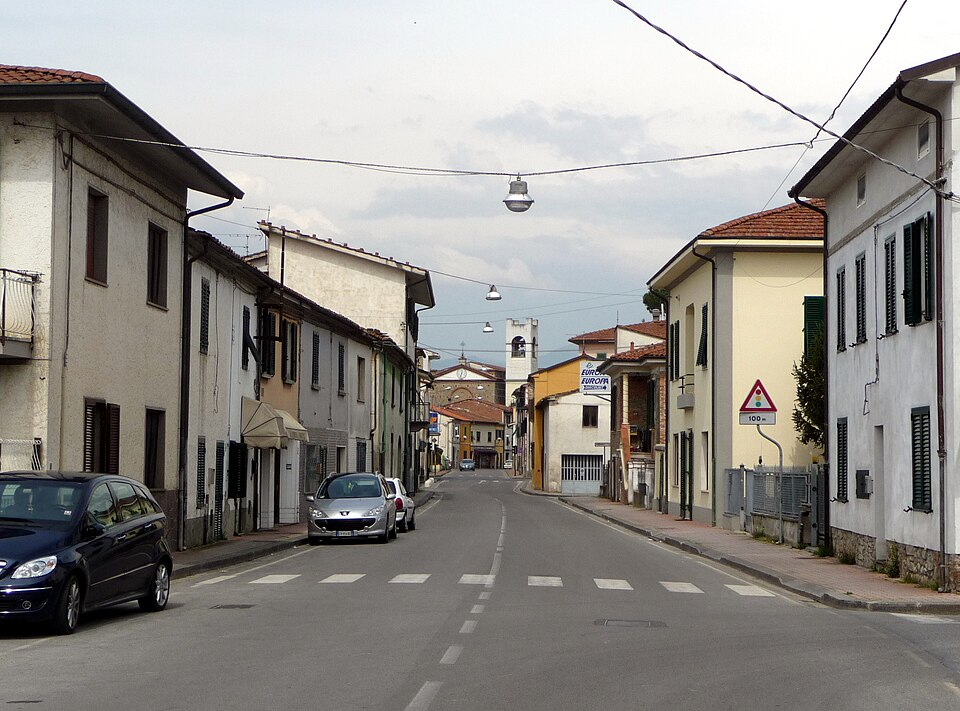
In the 20th century, Chiesina became well known for its floriculture industry, supported by its proximity to the flower market of Pescia. However, from the 1990s onward, this sector experienced a significant decline. Today, the town has largely lost its agricultural character, evolving into a more residential center. Its municipal coat of arms, granted in 1964, symbolically combines industry and agriculture, featuring a gear wheel, a wheat ear, and a carnation, alongside the traditional checkered emblem of Pistoia.
Points of interest and culture in Chiesina Uzzanese
Among the main landmarks is the Church of Santa Maria della Neve, a central religious building tied to the town’s historical development. Also noteworthy is the site of the ancient xenodochium, which reflects the area’s early role in hospitality and transit during the medieval period. In a more contemporary vein, the town features the murals by Filippo Biagioli, which contribute a distinctive artistic identity to the urban landscape. The surrounding hamlets further enrich this heritage with additional churches and small oratories.
From a cultural perspective, one of the most significant events is the Premio Il Fiore, established in 1979, which recognizes works in poetry, photography, and drawing. This award is part of the broader Settimana Chiesinese, a major local festival that represents a key moment of community identity and cultural expression for the town.
Source(s):
https://it.wikipedia.org/wiki/Chiesina_Uzzanese
Photo(s):
1. Vonvikken, Public domain, via Wikimedia Commons
2. Lucarelli, CC BY-SA 3.0 https://creativecommons.org/licenses/by-sa/3.0, via Wikimedia Commons