
Asparagus
Genus of Asparagaceae
Food, Plant source foods, Plants (Plantae), Flowering plats (angiospermae), Mesangiosperms, Monocots, Asparagales, Asparagaceae
Consumption area(s): Earth
Note: For better understanding, please read the article on flowering plants (angiospermae) first. If you come across unfamiliar words, you can click on any highlighted term to open the glossary with definitions of key botanical terms.
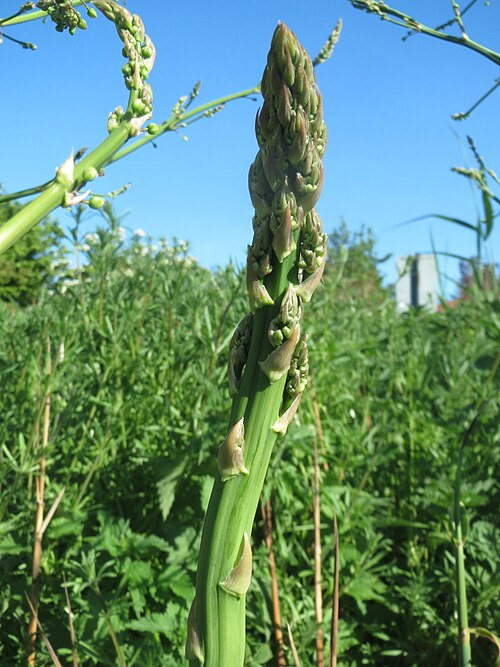
Introduction
The genus Asparagus, whose name derives from the Latin asparagus, belongs to the family Asparagaceae and includes a range of plant species with diverse uses. These plants are primarily native to the Old World, with a natural distribution spanning Europe, Asia and Africa, where they occupy various ecological niches. Within this genus, numerous species and cultivated varieties exist, many of which are appreciated for their decorative value in gardens and landscaping. However, the most economically significant species is Asparagus officinalis, widely known as garden asparagus, which is extensively cultivated for human consumption.
Description of Asparagus
Species of Asparagus develop as perennial herbaceous plants or small shrubs, typically producing short rhizomes that allow the plant to survive during winter. Their stems, which may be erect or climbing, are often branched and bear distinctive phylloclades—green, leaf-like modified shoots that arise from the axils. These structures usually appear in clusters rather than individually and can vary in shape from flattened to triangular or nearly cylindrical. The true leaves are reduced, non-photosynthetic, and generally small, scale-like, with bases often transformed into rigid spines.
The flowers are generally small and grouped, most commonly emerging in the leaf axils, though they may also form racemes or umbel-like inflorescences. Each flower is borne on a jointed pedicel positioned above a thin bract. Structurally, the flowers are trimerous and usually bisexual, although some species bear unisexual flowers, in which case the plants are dioecious.
The six tepals, similar in appearance, range from bell-shaped to nearly spherical and may be either free or partially fused at the base. The reproductive organs include two whorls of three stamens, with filaments often partially attached to the tepals, and a superior ovary formed by the fusion of three carpels, each chamber containing multiple ovules. The fruit is a globose berry, typically enclosing one or several seeds. In certain species, these berries are toxic, highlighting a notable variation in edibility within the genus.
Classification of Asparagus
This genus is further divided into species. Among them:
- Garden asparagus
- Thin-leaved asparagus
- White wild asparagus
- Wild asparagus
Photo(s):
1. AnRo0002, CC0, via Wikimedia Commons