
Asparagaceae
Family of Asparagales
Food, Plant source foods, Plants (Plantae), Flowering plats (angiospermae), Mesangiosperms, Monocots, Asparagales
Consumption area(s): Earth
Note: For better understanding, please read the article on flowering plants (angiospermae) first. If you come across unfamiliar words, you can click on any highlighted term to open the glossary with definitions of key botanical terms.
Introduction
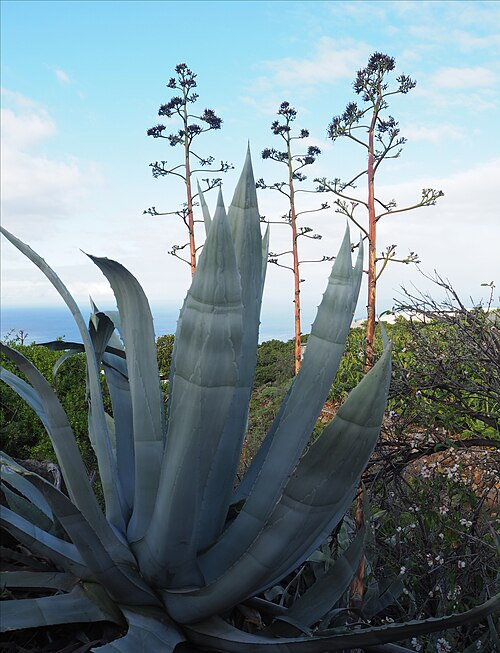
The Asparagaceae family is classified within the order of Asparagales, which belongs to the group of monocotyledonous plants. It has a cosmopolitan distribution, meaning it can be found across many regions of the world, adapting to a wide range of environmental conditions. One of the most widely recognized edible members of this family is the garden asparagus, cultivated globally for its tender shoots used in human consumption. In addition to edible species, the family also includes plants of significant economic importance such as agaves, whose sap is traditionally processed to produce tequila.
Description of Asparagaceae
Members of this group include herbaceous perennials as well as woody plants, such as shrubs and lianas. In many species, the leaves are reduced or absent, and the role of photosynthesis is carried out by the stems. When present, leaves are typically alternate, simple, entire, and characterized by parallel venation. In several cases, foliage is reduced to scale-like and stipules are absent.
The flowers may be solitary or arranged in inflorescences of diverse forms. They are generally small and can be either bisexual or unisexual. When unisexual flowers occur, species may be either monoecious or dioecious. The floral structure is composed of six similar tepals, which may appear in shades of green, white, yellow, brown, reddish, violet, or blue.
There are two whorls of three stamens each; these are free from one another but are often fused at the base to the tepals. In both bisexual and male flowers, the stamens are fully functional and fertile. In female flowers, however, they are reduced to staminodes. The gynoecium is formed by the fusion of three carpels, creating a superior ovary, while the style is generally no longer than the ovary itself. The fruit is typically a berry, although in some cases it may develop as a capsule.
Classification of Asparagaceae
This family is further divided into genus, including:
- Agave (agave)
- Albuca (slime lily)
- Anemarrhena (anemarrhena)
- Anthericum (St. Bernard’s lily)
- Asparagus (asparagus)
- Aspidistra (cast iron plant)
- Arthropodium (renga lily)
- Camassia (camas lily)
- Chlorophytum (spider plant)
- Cordyline (cabbage tree)
- Dasylirion (desert spoon)
- Dracaena (dragon tree)
- Drimia (sea squill)
- Eremocrinum (desert lily)
- Eucomis (pineapple lily)
- Hesperaloe (false yucca)
- Hesperoyucca (Spanish bayonet)
- Hosta (hosta / plantain lily)
- Ledebouria (silver squill)
- Leucocrinum (sand lily)
- Lomandra (mat rush)
- Ornithogalum (star-of-Bethlehem)
- Paradisea (St. Bruno’s lily)
- Polygonatum (Solomon’s seal)
- Ruscus (butcher’s broom)
Photo(s):
1. D2swirl, CC BY-SA 4.0 https://creativecommons.org/licenses/by-sa/4.0, via Wikimedia Commons