
Alchermes (Alkermes)
Food, Plant source foods, Alcoholic beverages, Liqueurs, Multi-flavoured liqueurs
Consumption area(s): Emilia-Romagna, Tuscany
Introduction
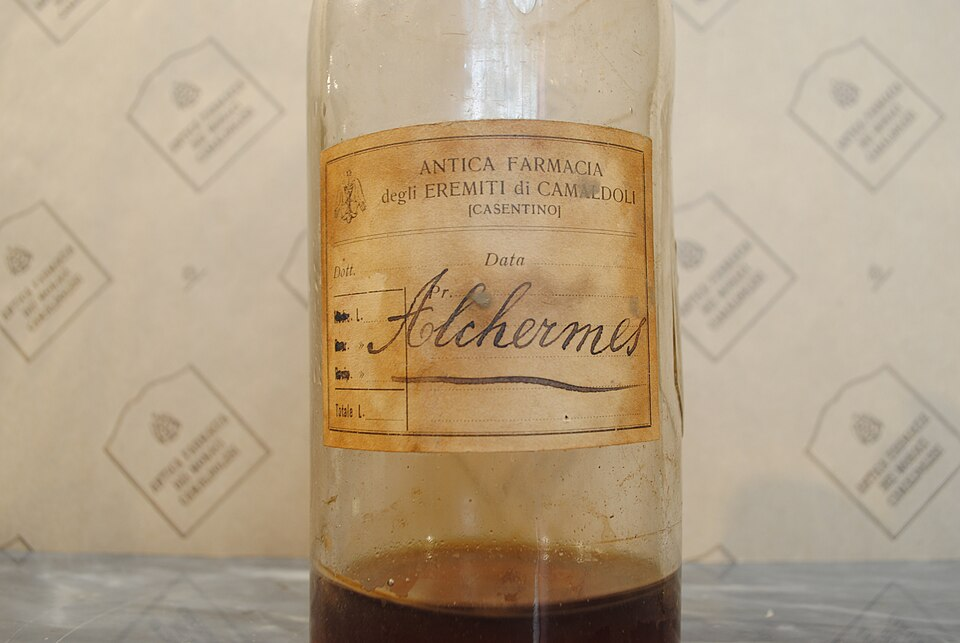
Alchermes is a traditional Italian liqueur characterized by its bright red colour, whose name derives from the Arabic al-qirmiz (meaning cochineal) via the Spanish alquermes. This beverage, with an alcohol content of approximately 35% ABV, has a dry flavour profile and is mainly used in pastry-making, particularly for desserts such as Zuppa Inglese.
Description of Alchermes
Its composition includes a mixture of alcohol, sugar, water, and spices such as cinnamon, cloves, and cardamom, along with rose water and raspberries. The characteristic red colour, originally obtained from cochineal (E120), is now often produced using synthetic colourants such as E122, E124, or E132, which must be declared on labels.
In many areas of Italy, Alchermes is an essential ingredient in traditional desserts, including pesche dolci, rocciata, zuccotto, and Zuppa Inglese. It is also used in the preparation of the traditional Faldacchea di Turi, giving recipes a distinctive flavour and colour. Its versatility makes it a key element in many regional confectionery preparations.
In Sicily, Alkermes (locally known as Archemisi) was also used in popular tradition to treat the so-called “fear worms”, referring to children who had been frightened by a traumatic event. In such cases, grandparents would often give one or two spoonfuls of the liqueur to help the child overcome fear, in a kind of ritualistic remedy against fear.
History of Alchermes
The Alkermes known today originates from a modified version of an 8th-century medicinal preparation called confectio alchermes, a tonic made from ingredients such as raw silk, apple juice, ground pearls, musk, ambergris, gold leaf, rose water, cinnamon, sugar, and honey. In pre-modern medicine, it was considered one of the best cardiac tonics and was commonly prescribed for conditions such as palpitations, syncope, as well as diseases like smallpox and measles, and as a general restorative remedy.
The earliest price list of this liqueur produced at the Officina Profumo-Farmaceutica of Santa Maria Novella dates back to 1859, although the original recipe was written by Fra Cosimo Bucelli, director of the workshop as early as 1743, and is preserved in its historical recipe book. However, the origins of this liqueur go back even further: historical sources report that the Nuns of the Order of Santa Maria dei Servi of Florence, founded in 1233, were already producing Alkermes as an elixir of long life.
In the 16th century, the liqueur was also produced by the monks of Santa Maria Novella and by the Carthusians, who called it “Alkermes of Florence” or “rosolio”. It became internationally known when it was brought to France by Catherine de’ Medici, who introduced it to the French court, contributing to its spread across Europe.
Over time, Alkermes evolved into lower-alcohol and sweeter variants, widely distributed across various Italian regions. Despite these modifications, the essence of the liqueur remains linked to its original formula, albeit adapted for a more modern palate.
Production methods for Alchermes
The production of Alchermes still largely follows an artisanal process, in which spices are macerated in alcohol to obtain a flavour-rich tincture. Subsequently, rose water, orange blossom water, sugar, and the red cochineal-based colourant are added. The mixture is then carefully blended and left to mature in oak barrels for approximately six months, during which it develops its full complexity and balance. After this ageing period, the liqueur is filtered and bottled, ready for consumption.
Nutritional facts table
It should be noted that nutritional values may vary slightly depending on individual manufacturers.
| Nutrients | Per 100 g |
| Calories (kcal) | 304 |
| Total fat (g) | 0 |
| ———Saturated fat (g) | 0 |
| Cholesterol (mg) | 0 |
| Sodium (mg) | 0 |
| Total carbohydrates (g) | 31 |
| ———Dietary fiber (g) | 0 |
| ———Total sugar (g) | 31 |
| Protein (g) | 0 |
Recipes that use this product as an ingredient:
Source(s):
https://it.wikipedia.org/wiki/Alchermes
https://en.wikipedia.org/wiki/Alchermes
http://prodtrad.regione.toscana.it/LIB_ProdTrad/Prodotto.php?ID=478
Photo(s):
1. The original uploader was Bonzopelato at Italian Wikipedia., CC BY 2.5 https://creativecommons.org/licenses/by/2.5, via Wikimedia Commons