
Baking powder
Food, Other items, Leavening agents
Consumption area(s): Earth
Consumption area(s): Since we were unable to find data on the consumption of this food, we limit ourselves to assuming a near-global distribution, with higher usage peaks in Europe and North America.
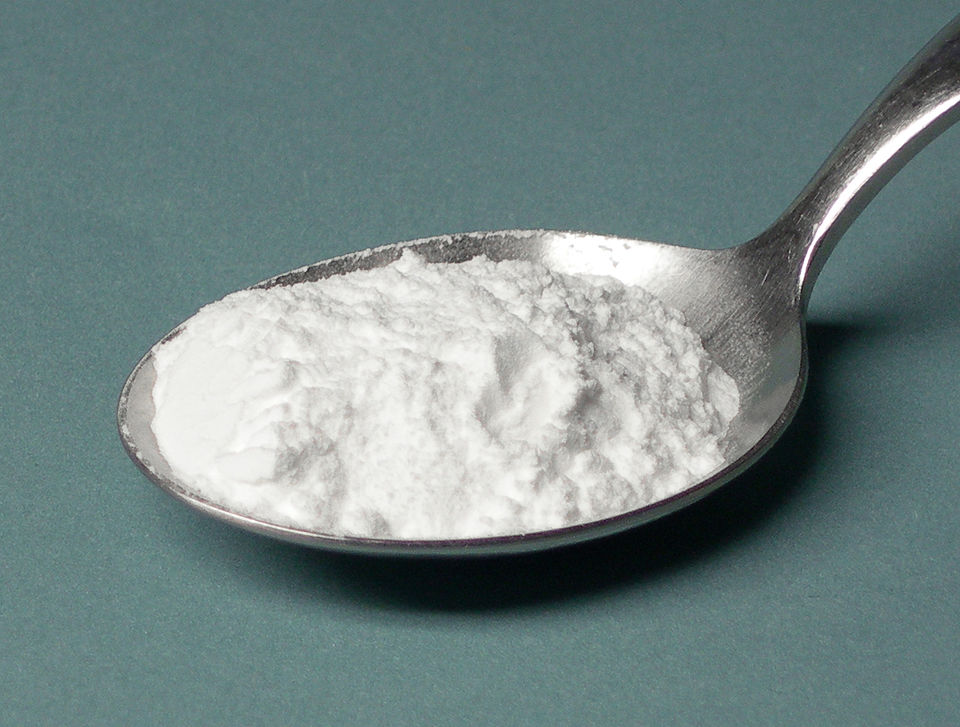
Introduction
Baking powder is a chemical leavening agent composed of a mixture of a weak acid and a base, with the addition of a buffer to prevent premature reaction. Its primary function is to increase volume and improve the texture of baked goods through the release of carbon dioxide, which is generated during the acid–base reaction, causing the dough or batter to rise.
Description of baking powder
Powdered leavening is used as an alternative to natural yeast in cases where fermentation flavors are not desired or when the dough lacks sufficient elasticity to retain gas over extended periods. This method allows for a faster preparation of baked goods, producing quick breads through a chemical reaction that rapidly releases carbon dioxide. The introduction of baking powder has significantly transformed the sector, making the production of cakes, biscuits, and other desserts simpler and quicker.
The acids used in these leavening systems can be classified as fast-acting or slow-acting. In the first case, the acid reacts with the base at room temperature as soon as it comes into contact with a liquid. In the second case, the reaction occurs only in the presence of heat (during baking). A leavening agent containing only one of these types is referred to as “single-acting.” Conversely, a system that includes both types of acids can react both at room temperature and during baking, and is therefore called “double-acting.”
Commercial baking powders typically consist of a base, one or more acid salts, and a buffering agent.
Common bases include:
- Sodium bicarbonate (NaHCO₃), the most widely used
- Ammonium bicarbonate
- Potassium bicarbonate
Typical acid salts include:
- Potassium hydrogen tartrate (cream of tartar, KC₄H₅O₆)
- Monocalcium phosphate
- Sodium acid pyrophosphate
- Sodium aluminum phosphate (SALP)
- Dicalcium phosphate dihydrate
An important variable in these systems is the rate of reaction (ROR), which represents the percentage of carbon dioxide released during the acid–base reaction. This rate depends not only on the specific characteristics of the dough, but also on the type of leavening agent used. Factors such as the solubility and degree of dissociation of the acid, as well as the particle size of the leavening agent, play a crucial role in determining reaction speed.
Finally, the third component of baking powder—the buffering agent—is usually an inert starch that improves both dosage accuracy and shelf stability. It works by absorbing moisture and preventing premature reactions between the acid and the base. Common buffering agents include:
- Cornstarch
- Potato starch
- Flour
History of baking powder
Until the 18th century, leavening relied on natural yeasts, such as brewer’s yeast, or on laborious and unpredictable methods, including spontaneous fermentation. In this pioneering phase, Pearlash (purified potassium carbonate) emerged as one of the first chemical leavening agents used to produce carbon dioxide when combined with an acidic ingredient such as lemon juice, offering a more stable and immediate alternative to traditional yeasts. Amelia Simmons, in her book American Cookery (1796), marked a significant step forward by documenting the use of this ingredient in recipes.
During the 19th century, innovation accelerated with the introduction of sodium bicarbonate and cream of tartar, both derived from chemical processes and used respectively as a base and an acid to generate leavening gases. However, these ingredients had to be purchased separately and carefully managed to avoid premature reactions, a difficulty that encouraged further development. In Europe, Alfred Bird, in 1843, succeeded in developing the first single-acting baking powder, combining sodium bicarbonate, cream of tartar, and starch to prevent uncontrolled reactions.
In the United States, Eben Norton Horsford refined the concept of double-acting leavening, introducing in 1856 a baking powder based on monocalcium phosphate and sodium bicarbonate. This method allowed for a gradual leavening process, with a first reaction occurring in the presence of liquids and a second activated by heat. His company, Rumford Chemical Works, began producing pre-mixed and stable baking powder, further simplifying the baking process.
Dosage and Storage
In general, one tablespoon of baking powder (about 5 g) is sufficient to leaven a preparation containing 120 g of flour, 200 ml of liquid, and 1 egg. However, when the mixture is acidic, the acid components of the baking powder are not fully activated, which can lead to an unpleasant taste in baked goods. Ingredients such as lemon juice, yogurt, citrus fruits, or honey can increase acidity, making it necessary to reduce the amount of baking powder and partially replace it with sodium bicarbonate. For example, when preparing a dessert containing yogurt, it is sufficient to use only half a teaspoon of baking powder.
Although commercial packages of baking powder indicate an expiration date that may often seem somewhat arbitrary, moisture and heat can gradually reduce its effectiveness over time, eventually rendering it inactive. To test its activity, a simple method can be used: add one tablespoon of baking powder to a container of hot water; if the mixture bubbles vigorously, the baking powder is still active and can be used.
Nutritional facts table
Nutritional values may vary slightly depending on the individual manufacturers.
| Nutrients | Per 100 g |
| Calories (kcal) | 53 |
| Total fat (g) | 0 |
| ———Saturated fat (g) | 0 |
| Cholesterol (mg) | 0 |
| Sodium (mg) | 10600 |
| Total carbohydrates (g) | 27.7 |
| ———Dietary fiber (g) | 0.2 |
| ———Total sugar (g) | 0 |
| Protein (g) | 0 |
Recipes that use this product as an ingredient:

Source(s):
https://en.wikipedia.org/wiki/Baking_powder
Photo(s):
1. Rainer Z …, CC BY-SA 3.0 https://creativecommons.org/licenses/by-sa/3.0, via Wikimedia Commons