
Asian rice (common rice)
Species of Oryza
Food, Plant source foods, Plants (Plantae), Flowering plats (angiospermae), Mesangiosperms, Monocots, Poales, Grasses (or Poaceae, cereals), Ehrhartoideae (Oryzoideae), Rice (Oryzeae), Oryza
Species: Oryza Sativa
Consumption area(s): Earth
Note: For better understanding, please read the article on flowering plants (angiospermae) first. If you come across unfamiliar words, you can click on any highlighted term to open the glossary with definitions of key botanical terms.
Introduction
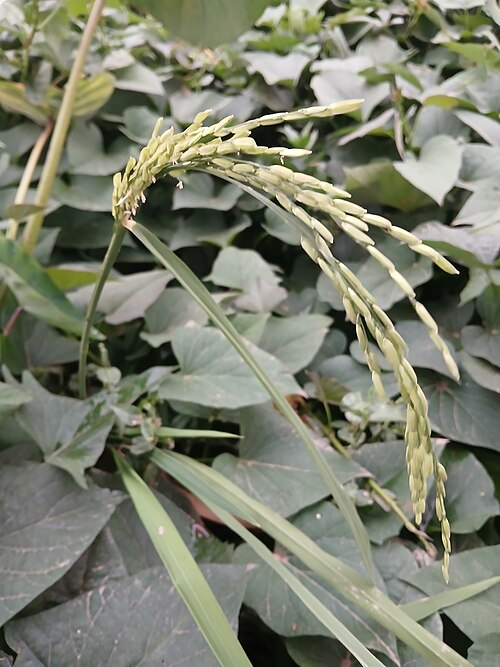
Asian rice (common rice) is an annual herbaceous plant belonging to the Poaceae family, and it originally developed in the tropical regions of Asia. Alongside Oryza glaberrima, a species cultivated in Africa and often characterized by a reddish pericarp, it represents one of the two primary plant sources from which edible rice grains are obtained. However, Oryza sativa overwhelmingly dominates global production, accounting for roughly 95% of the cultivated rice area worldwide.
Description of the plant
Rice is an herbaceous species that typically reaches 120–195 cm in height, although under certain conditions it can grow much taller. It develops adventitious roots, which form specialized aerenchyma tissues. These air-filled structures enable the plant to survive in flooded or aquatic environments. The stem (culm) is characterized by hollow internodes and solid nodes, showing a growth pattern comparable to that of wheat.
The plant bears light green leaves shaped like a sheath, relatively long and about two centimeters wide, covered with short, thick white hairs. The ligule is well developed, and hairy auricles are also present. At the top of the stem, a terminal panicle inflorescence forms, which becomes drooping at maturity. This structure consists of single-flowered spikelets containing hermaphroditic flowers with six stamens and one pistil, while the ovary encloses a single ovule.
Description of the edible parts (fruits)
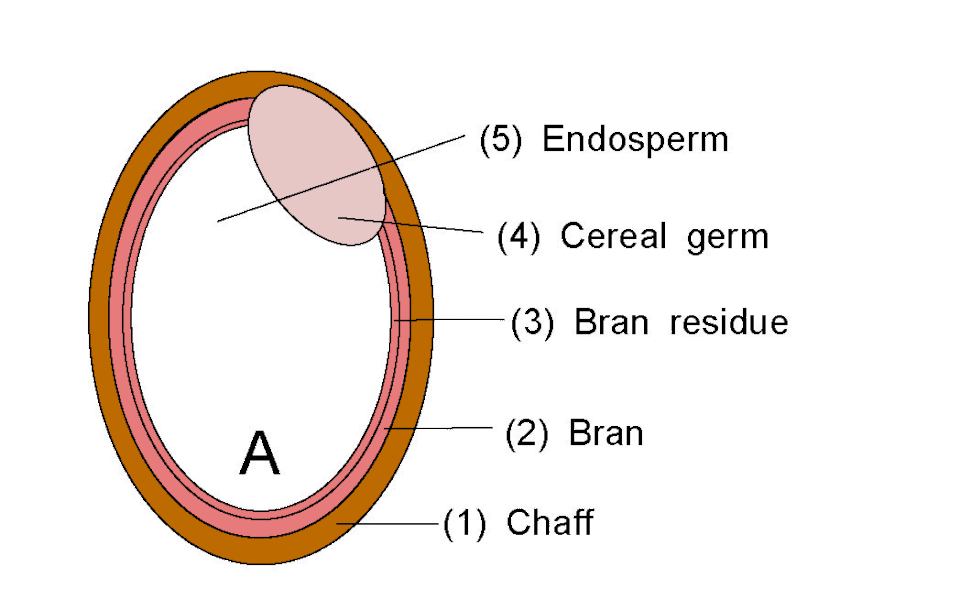
The fruit of this rice is a caryopsis with an elliptical or rounded shape, enclosed by well-developed glumellae, and typically weighing 25–45 mg. The grain is mainly composed of starch (about 80–90%) and protein (around 7–10%), which are the key factors influencing its flavor and culinary properties. Minor constituents such as lipids, fibers, and minerals are present in much smaller quantities, generally below 1% of the total weight.
The texture of cooked rice largely depends on the balance between amylose (linear starch) and amylopectin (branched starch). Most rice varieties are rich in amylopectin, while amylose can range from 0 to 30%. A higher amylopectin content promotes gelatinization and results in a stickier consistency, whereas increased protein levels tend to make grains firmer and less tender. These chemical traits are influenced by cultivation conditions: for instance, greater fertilization raises protein content, while environmental stress (such as heat or water shortage) reduces starch accumulation and leads to a more opaque, chalky grain.
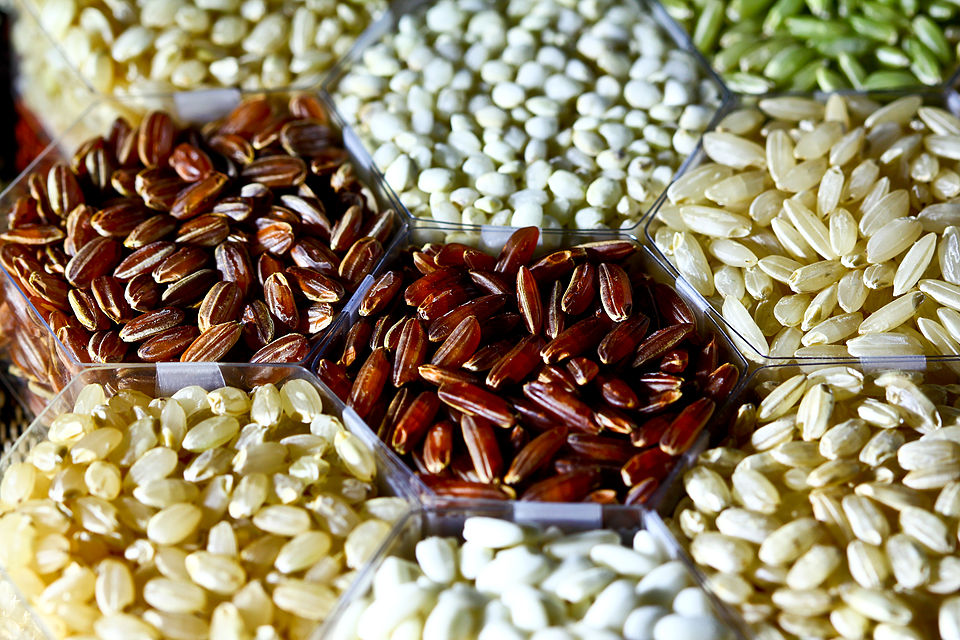
Rice varieties are commonly grouped by grain size into long-, medium-, and short-grain types. Long-grain rice, generally richer in amylose, remains separate and firm after cooking, although some types high in amylopectin become sticky when steamed. Medium-grain rice contains more amylopectin and develops a soft, cohesive texture, making it suitable for dishes like risotto or certain sweet preparations. Short-grain rice is the most adhesive, maintaining its shape easily and widely used in cuisines such as Japanese cooking or for rice-based desserts. Beyond size and composition, rice can also be distinguished by aroma and pigmentation (such as red or black varieties).
History of rice as food
Rice is believed to have been first domesticated in China around nine thousand years ago, within early agricultural communities established along the Yangtze River, both in its upper and lower stretches. These populations were associated with early speakers of the Hmong–Mien languages and ancestral groups related to the Austronesian peoples.
From this initial center, rice cultivation gradually expanded northward, reaching northern China and regions inhabited by Sino-Tibetan groups between 6,000 and 5,600 years ago. It later spread further into Korea and Japan, where it was introduced between 5,500 and 3,200 years ago. Around the same time, it was brought to Taiwan by communities linked to the Dapenkeng culture, and from there it dispersed southward through Austronesian migrations, eventually reaching parts of Southeast Asia, as well as distant locations such as Madagascar and Guam.
Despite this wide movement, rice did not extend deeper into the Pacific Ocean during these early phases. It also became established in southern China and across Southeast Asia approximately 5,000 years ago. Over time, its global distribution was driven by human mobility and trade networks, culminating in its introduction to the Americas after 1492, as part of the exchanges triggered by the Columbian Exchange.
Production methods for asian rice (common rice)
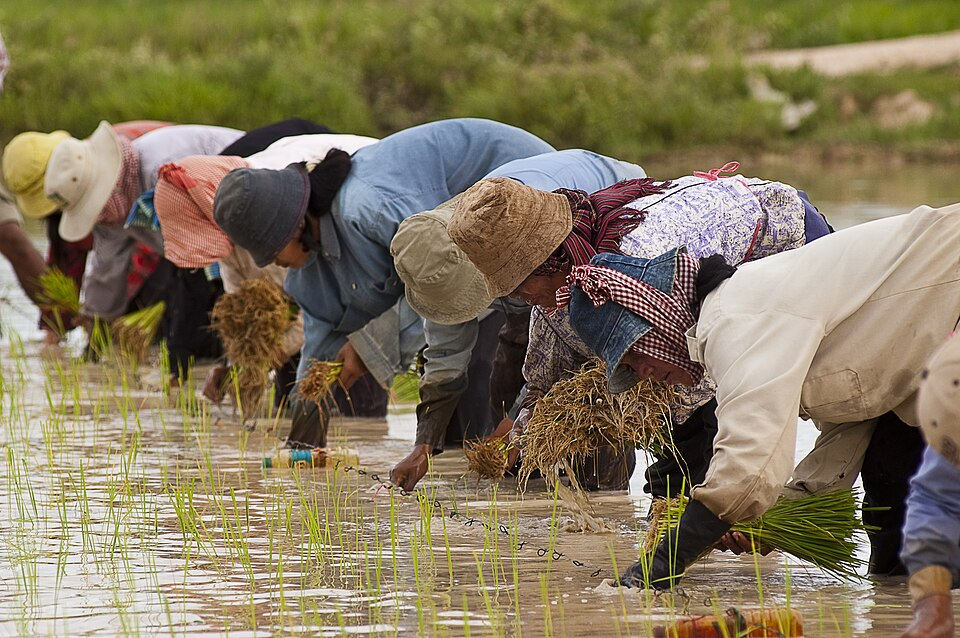
Rice cultivation can begin either through direct seeding in the field or by transplanting seedlings previously grown in nurseries. The first method requires a higher seed input (about 60–80 kg per hectare), whereas transplanting uses smaller quantities (around 40 kg per hectare) but demands greater labor effort. In traditional Asian systems, transplanting is done manually, while in modern agriculture it is often carried out using mechanized transplanters, which require well-prepared soils and specially cultivated seedlings.
A crucial factor in rice farming is water management. Typically, flat fields are enclosed by embankments to maintain a shallow layer of water, kept until shortly before harvest. A more sustainable alternative is the alternate wetting and drying method, where fields are periodically flooded and then allowed to dry partially before re-irrigation. Some rice types tolerate deep and prolonged flooding, while in upland or mountainous areas, rice is cultivated similarly to other cereals, relying mainly on rainfall.
Traditionally, rice was grown by small-scale farmers and harvested by hand, whereas larger farms now employ mechanical harvesters to reduce labor. Harvesting occurs when the grain reaches a moisture content of 20–25% and involves several steps, including cutting, stacking, threshing, and cleaning using tools such as sieves. Freshly harvested rice, known as paddy rice, still retains its outer protective layers (glumes and glumellae). Since these parts are inedible, the grain must undergo a sequence of industrial processing stages to become suitable for consumption.
The first step is drying, performed at about 35–40 °C, which reduces moisture from roughly 24% to 14%, improving storage stability and preparing the grain for further processing. This is followed by storage, which may last from several months to over a year, especially when aging techniques are applied. During this phase, controlled conditions alter the chemical properties of starch and proteins, making the rice firmer during cooking.
Next comes cleaning, aimed at removing impurities such as soil particles, stones, or plant debris. The grain then undergoes dehusking, a process carried out using abrasive machines that remove the outer coverings.
For white rice (refined rice), additional processing eliminates the bran and germ, often through steps like polishing and grading. These treatments result in a product with longer shelf life and different cooking qualities, though with a reduction in certain nutritional components.
Uses of asian rice (common rice)
Washing rice before cooking removes a significant portion of its surface starch, resulting in looser, more separate grains, while skipping this step produces a stickier and creamier texture. However, in some countries such as the United States, rice is often fortified with micronutrients, and rinsing can lead to a loss of these added vitamins and minerals.
Another common practice is soaking, which helps shorten cooking time, reduce fuel consumption, and limit heat exposure. It can also improve texture, as the grains absorb water in advance and expand more evenly. Soaking times vary from 30 minutes to several hours, depending on the variety. In the case of brown rice, prolonged soaking in warm water can trigger germination, activating enzymes and increasing compounds like gamma-aminobutyric acid, thereby enhancing its nutritional profile.
Rice is typically prepared by boiling or steaming, during which it absorbs water. In the absorption method, a measured amount of water is used and fully taken up during cooking, while in the excess-water method, rice is boiled in large quantities of water that are later drained—though this can reduce nutrient content. Modern electric rice cookers simplify the process by automating temperature and timing. In some culinary traditions, rice is first fried in oil or fat before cooking, a technique used in dishes like pilaf, biryani, or risotto, which produces a less sticky and more aromatic result.
Beyond basic preparation, rice serves as a versatile staple in global cuisine. It can be eaten simply as boiled rice, but also forms the basis of complex savory dishes and desserts such as rice pudding or baked sweets. Its adaptability allows it to appear in main courses, side dishes, appetizers, and street foods across cultures.
In Arab cuisine, rice is widely used in soups and dishes with fish, chicken, or meat, as well as for stuffing vegetables or being wrapped in grape leaves. Combined with milk, sugar, or honey, it is also used in sweet preparations. In some regions, rice flour is even employed to make bread. Another important preparation is rice porridge (congee), obtained by cooking rice in excess water for a long time until it becomes soft and semi-liquid, commonly consumed as a breakfast food or as a light meal for the sick.
Classification of asian rice (common rice)
Asian rice is divided into cultivars, including:
- Arborio rice
- Baldo rice
- Basmati rice
- Bomba rice
- Carnaroli rice
- Jasmine rice
- Lido rice
- Maratelli rice
- Originario rice
- Ribe rice
- Roma rice
- Venere rice
- Rosa Marchetti rice
- Vialone Nano rice
Nutritional facts table
It should be noted that nutritional values may vary depending on the specific variety. The following values refer specifically to Basmati rice.
| Nutrients | Per 100 g |
| Calories (kcal) | 354 |
| Total fat (g) | 3 |
| ———Saturated fat (g) | 0 |
| Cholesterol (mg) | 0 |
| Sodium (mg) | 0 |
| Total carbohydrates (g) | 71 |
| ———Dietary fiber (g) | 2 |
| ———Total sugar (g) | 0 |
| Protein (g) | 9 |
Source(s):
https://it.wikipedia.org/wiki/Oryza_sativa
https://en.wikipedia.org/wiki/Rice
Photo(s):
1. Friday musa, CC BY-SA 4.0 https://creativecommons.org/licenses/by-sa/4.0, via Wikimedia Commons
2. IRRI Images, CC BY 2.0 https://creativecommons.org/licenses/by/2.0, via Wikimedia Commons
3. Brad Collis, CC BY 2.0 https://creativecommons.org/licenses/by/2.0, via Wikimedia Commons
4. Namazu-tron, Public domain, via Wikimedia Commons