
Rice (Oryzeae)
Tribe of Ehrhartoideae (Oryzoideae)
Food, Plant source foods, Plants (Plantae), Flowering plats (angiospermae), Mesangiosperms, Monocots, Poales, Grasses (or Poaceae, cereals), Ehrhartoideae (Oryzoideae)
Consumption area(s): Earth
Note: For better understanding, please read the article on flowering plants (angiospermae) first. If you come across unfamiliar words, you can click on any highlighted term to open the glossary with definitions of key botanical terms.
Introduction
Rice (Oryxeae) rapresent a group of monocotyledonous flowering plants classified within the Poaceae family, specifically under the Ehrhartoideae subfamily. These plants are predominantly herbaceous in nature, forming a distinct group among grasses.
Description of rice (Oryzeae)
The species in this tribe generally display a herbaceous growth form, either annual or perennial, often developing rhizomes or stolons. Some species reach a height of up to 3 meters, as seen in Zizania, and several exhibit aquatic adaptations. Their roots are typically fibrous, while the culms can be unbranched, and with nodes ranging from spongy to firm in texture.
The leaves along the stems are alternate and distichous, each consisting of a sheath, a ligule, and a blade. Leaf blades are relatively broad, with shapes ranging from linear to lanceolate and often ending in an acuminate tip; their surfaces can be rough. They may or may not have auricles or a pseudo-petiole and the venation is primarily parallel. Leaves often contain silica bodies, enhancing rigidity and durability.
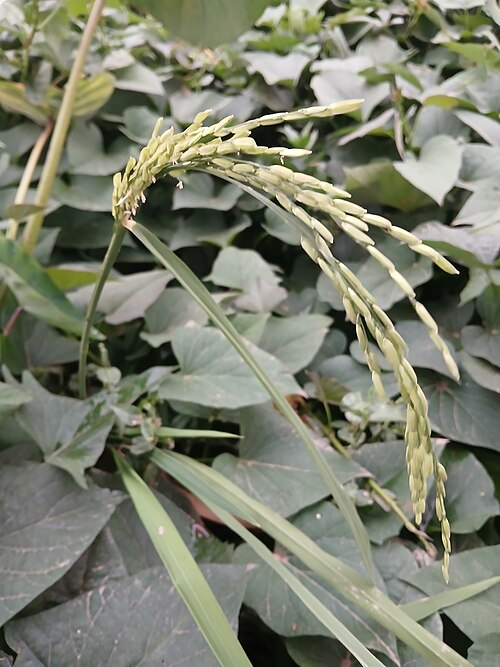
The main inflorescence, typically a panicle or spike, is branched, with angled lateral branches forming open panicles or sometimes raceme-like structures. A leaf can subtend the base of the inflorescence. Spikelets are usually solitary to six per branch, and in some species, both unisexual and bisexual spikelets are present. Spikelets with stamens may occupy lower branches, spiketel with pistils the upper, and central branches may have mixed-sex spikelets.
The secondary inflorescences, or pedicellate spikelets, generally feature a single fertile flower, with zero to two sterile near-base flowers reduced to empty lemmas. Glumes may be absent or reduced, while lemmas range from thin or leathery, with 5–10 veins and often asymmetric and fertile lemmas. Paleas are similar but narrower, with 3–7 veins. Fertile flowers are actinomorphic with three whorls: a reduced perianth, androecium, and gynoecium, the latter absent in sterile flowers. Bracteal structures at the flower base include the lemma and palea.
The perianth consists of two small lodicules, sometimes absent. The androecium has 1–6 basifixed anthers with monocolpate pollen, while the gynoecium has 2–3 fused carpels, a superior ovary, a single ovule, and a single stigma.
Fruits are caryopses, with a thin pericarp fused to the seed, a hard endosperm, and a linear hilum. The embryo has an epiblast, and the scutellar fissure is absent.
Reproduction is mostly wind-pollinated, with their stigmas enhancing pollen capture, though cleistogamous flowers allow self-pollination. Seeds disperse through wind and often rely on ants for further distribution.
Classification of rice (Oryzeae)
This tribe is divided into genus, including:
- Oryza (common rice)
- Zizania ( northern wild rice, Texas wild rice)
In addition, rice can also be classified according to its degree of processing. Thus, we have:
- Rice with germ
- Brown rice
- White rice (Refined rice) (in any recipe where the degree of refinement is not otherwise specified, this category is assumed)
Photo(s):
1. Friday musa, CC BY-SA 4.0 https://creativecommons.org/licenses/by-sa/4.0, via Wikimedia Commons