
Grasses (or Poaceae, cereals)
Famiily of Poales
Food, Plant source foods, Plants (Plantae), Flowering plats (angiospermae), Mesangiosperms, Monocots, Poales
Consumption area(s): Earth
Note: For better understanding, please read the article on flowering plants (angiospermae) first. If you come across unfamiliar words, you can click on any highlighted term to open the glossary with definitions of key botanical terms.
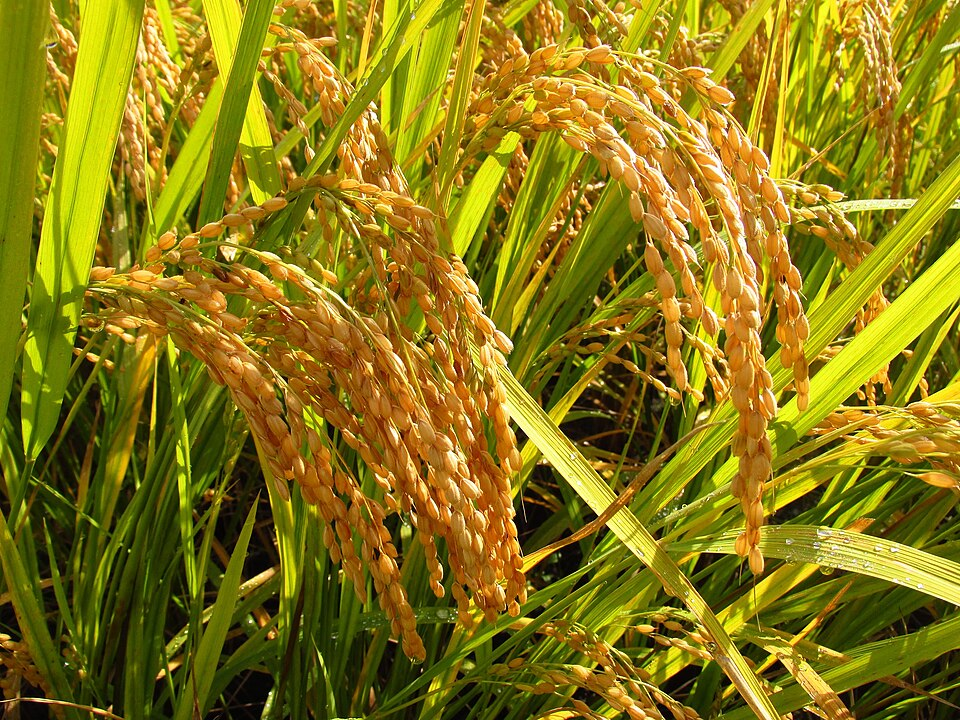
Introduction
The grasses (or Poaceae, cereals) encompass a broad range of species, including major cereal crops, bamboos, naturally occurring grasses in grasslands, and those cultivated for lawns and pastures, making it one of the most recognizable plant families within the broader concept of grasses. With roughly 780 genera and about 12,000 species, this family ranks among the largest in the plant kingdom. Ecosystems dominated by grasses, such as savannas and prairies, cover a substantial portion of the Earth’s land surface, while grasses also contribute significantly to vegetation in environments like wetlands, forests, and even tundra.
Despite the common use of the term “grasses,” not all similar plants belong to this family. Groups such as rushes and sedgesDescr are closely related within the same order (Poales) but are classified separately, whereas seagrasses belong to a different order altogether. Nevertheless, all these plants share a common placement within the monocotyledons.
Description of grasses (or Poaceae, cereals)
Grasses can be either annual or perennial herbaceous plants, characterized by distinctive structural features. Their stems, known as culms, are typically cylindrical, often hollow, and interrupted by nodes where the leaves attach. The leaves are arranged in an alternate pattern along a single plane and display parallel venation. Each leaf is divided into a sheath, which wraps around the stem, and a blade with smooth edges. In many species, the blades contain silica deposits that deter herbivores, while a small structure called the ligule forms a barrier at the junction of sheath and blade, preventing the entry of water and insects.
The reproductive organs of grasses are highly specialized. Their flowers are grouped into spikelets, which in turn form larger arrangements such as spikes or panicles. Each spikelet consists of basal glumes and one or more florets, with each floret enclosed by two bracts known as the lemma and palea. Most flowers are hermaphroditic and primarily rely on wind pollination, although insects may occasionally contribute. The floral envelope is reduced to small structures called lodicules, while the typical fruit is a caryopsis, where the seed coat is fused to the fruit wall.
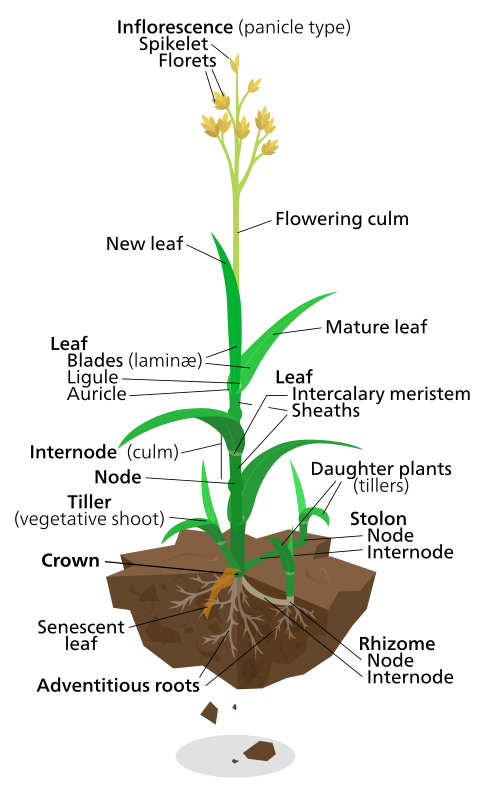
Grasses exhibit a growth pattern in which the growth point is located at the base of the leaf, rather than at the tip, allowing them to withstand repeated grazing or cutting. They can adopt different growth forms, contributing to their ecological success. This adaptability is further enhanced by their diversity, particularly in terms of photosynthesis.
Uses of grasses (or Poaceae, cereals)
Among cultivated plants, grasses dominate, making up roughly 70% of all crops. Those grown specifically for their edible seeds are known as cereals or grains, a term that can also include seeds from other plant types like buckwheat and legumes. Three major cereals—rice, wheat, and maize—account for more than half of the calories consumed worldwide. They are key sources of carbohydrates and, in many regions, protein, with rice predominating in southern and eastern Asia, maize in Central and South America, and wheat and barley across Europe, northern Asia, and the Americas.
Sugarcane represents the primary source of sugar, but its use extends beyond sweetening. The plant’s sprouted seeds, shoots, and rhizomes are consumed as food, while its juice and processed products contribute to beverages such as plant milk, rum, beer, whisky, and vodka. Bamboo shoots are widely incorporated into Asian cuisine, appearing in fresh, fermented, or canned forms in supermarkets. Similarly, lemongrass is cultivated as a culinary herb, prized for its citrus aroma and flavor.
Grasses also play a vital role in livestock agriculture, serving as pasture or fodder for animals like cattle, horses, and sheep. These grasses can be harvested and stored for future feeding in the form of hay or straw bales, or preserved in silos. Additionally, straw and sometimes hay are used as animal bedding.
Classification of grasses (or Poaceae, cereals)
Grasses are divided into subfamilies, including:
- Bambusoideae (bamboo)
- Chloridoideae (finger millet, teff)
- Ehrhartoideae (Oryzoideae) (rice, wild rice)
- Panicoideae (fonio, maize, millet, sorghum, sugarcane)
- Poaideae (barley, oats, wheat)
Photo(s):
1. あおもりくま,(Aomorikuma), CC BY-SA 4.0 https://creativecommons.org/licenses/by-sa/4.0, via Wikimedia Commons
2. Kelvinsong, CC BY 3.0 https://creativecommons.org/licenses/by/3.0, via Wikimedia Commons