
Lemon trees (Lemons)
Hybrid of Citrus
Food, Plant source foods, Plants (Plantae), Flowering plats (angiospermae), Mesangiosperms, Eudicots, Core eudicots, Superrosids, Rosids, Malvids (Eurosids II), Sapindales, Rutaceae, Aurantioideae, Citrus
Hybrid name: Citrus x limon
Consumption area(s) (countries with per capita consumption exceeding 1 kg per year in 2022): Albania 🇦🇱, Algeria 🇩🇿, Andorra 🇦🇩, Antigua and Barbuda 🇦🇬, Argentina 🇦🇷, Armenia 🇦🇲, Australia 🇦🇺, Austria 🇦🇹, Azerbaijan 🇦🇿, Bahamas 🇧🇸, Bahrain 🇧🇭, Barbados 🇧🇧, Belgium 🇧🇪, Bolivia 🇧🇴, Bosnia and Herzegovina 🇧🇦, Brazil 🇧🇷, Brunei 🇧🇳, Bulgaria 🇧🇬, Canada 🇨🇦, Cape Verde 🇨🇻, Chile 🇨🇱, China 🇨🇳, Colombia 🇨🇴, Costa Rica 🇨🇷, Croatia 🇭🇷, Cyprus 🇨🇾, Czech Republic 🇨🇿, Denmark 🇩🇰, Djibouti 🇩🇯, Dominica 🇩🇲, Dominican Republic 🇩🇴, Ecuador 🇪🇨, Egypt 🇪🇬, El Salvador 🇸🇻, Estonia 🇪🇪, Fiji 🇫🇯, Finland 🇫🇮, France 🇫🇷, Georgia 🇬🇪, Germany 🇩🇪, Ghana 🇬🇭, Greece 🇬🇷, Grenada 🇬🇩, Guatemala 🇬🇹, Guinea-Bissau 🇬🇼, Guyana 🇬🇾, Hungary 🇭🇺, Iceland 🇮🇸, India 🇮🇳, Iran 🇮🇷, Iraq 🇮🇶, Ireland 🇮🇪, Israel 🇮🇱, Italy 🇮🇹, Jamaica 🇯🇲, Jordan 🇯🇴, Kenya 🇰🇪, Kuwait 🇰🇼, Laos 🇱🇦, Latvia 🇱🇻, Lebanon 🇱🇧, Libya 🇱🇾, Liechtenstein 🇱🇮, Lithuania 🇱🇹, Luxembourg 🇱🇺, Malaysia 🇲🇾, Maldives 🇲🇻, Malta 🇲🇹, Morocco 🇲🇦, Mauritius 🇲🇷, Mexico 🇲🇽, Moldova 🇲🇩, Monaco 🇲🇨, Montenegro 🇲🇪, Nepal 🇳🇵, Netherlands 🇳🇱, North Macedonia 🇲🇰, Norway 🇳🇴, New Zealand 🇳🇿, Oman 🇴🇲, Palestine 🇵🇸, Paraguay 🇵🇾, Peru 🇵🇪, Poland 🇵🇱, Portugal 🇵🇹, Qatar 🇶🇦, Romania 🇷🇴, Russia 🇷🇺, Saint Lucia 🇱🇨, Saint Vincent and the Grenadines 🇻🇨, San Marino 🇸🇲, Saudi Arabia 🇸🇦, Serbia 🇷🇸, Seychelles 🇸🇨, Singapore 🇸🇬, Slovakia 🇸🇰, Slovenia 🇸🇮, Spain 🇪🇸, Sudan 🇸🇩, Sweden 🇸🇪, Switzerland 🇨🇭, Syria 🇸🇾, Thailand 🇹🇭, Tonga 🇹🇴, Trinidad and Tobago 🇹🇹, Tunisia 🇹🇳, Turkey 🇹🇷, Ukraine 🇺🇦, United Arab Emirates 🇦🇪, United Kingdom 🇬🇧, United States of America 🇺🇸, Uruguay 🇺🇾, Vatican City 🇻🇦, Venezuela 🇻🇪, Yemen 🇾🇪
Note: For better understanding, please read the article on flowering plants (angiospermae) first. If you come across unfamiliar words, you can click on any highlighted term to open the glossary with definitions of key botanical terms.
Introduction
Lemons (Citrus × limon) are a small evergreen tree belonging to the Citrus genus within the Rutaceae family. They are a hybrids, resulting from the crossing of the citron and the bitter orange. While their precise origins are not fully known, historical evidence indicates that lemons may have first appeared in the 1st millennium BCE in the region corresponding to modern northeastern India. Several other citrus fruits are also commonly referred to as lemons, though they differ botanically.
The bright yellow fruit of the lemon tree is highly valued globally, mainly for its juice, which contains roughly 5–6% citric acid, giving it its characteristic sourness. Both the pulp and the peel are widely utilized in culinary applications, including cooking and baking. Lemons are essential in numerous recipes and beverages, such as lemonade and lemon meringue pie, where their acidic flavor provides both taste and balance.
Description of the plant
The lemon tree typically grows to a height of 3 to 6 meters. Its shoots and flowers display shades of white and violet, giving the tree a distinctive appearance during blooming.
Description of the edible parts (fruits)
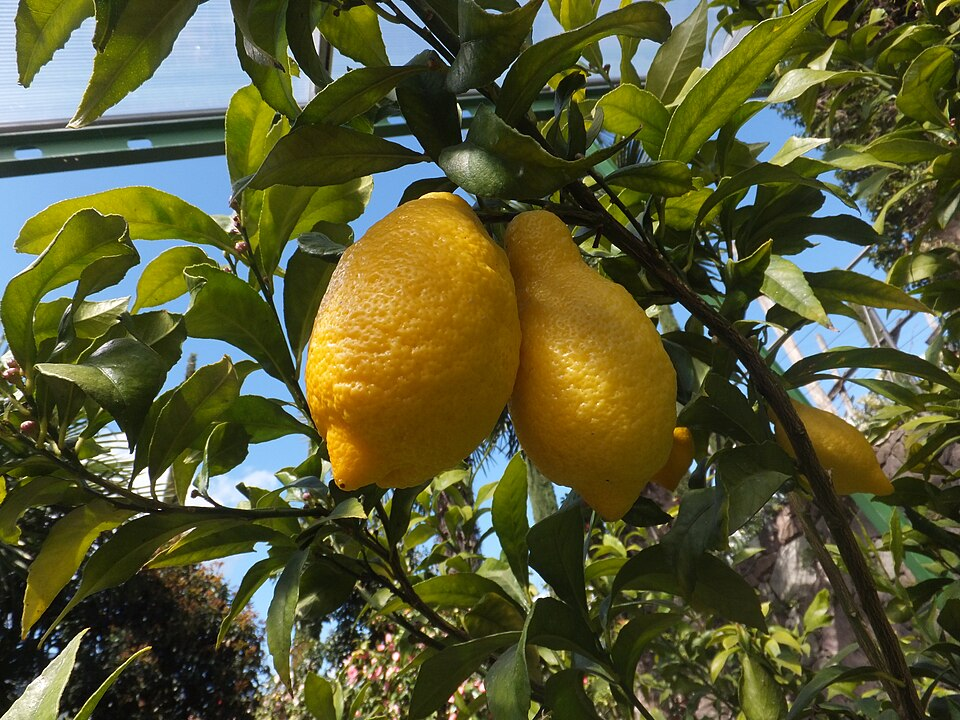
The lemon fruit has a distinctive pointed oval shape and a bright yellow color. Botanically, it is classified as a hesperidium, a type of modified berry with a thick, leathery rind. The rind consists of two layers: the outer colored layer, or flavedo or zest, which is rich in essential oils and highly aromatic, and the inner white layer, known as the albedo or pith, which is spongy and bitter. Inside the fruit, there are several carpels, each containing seeds. These locules store the fruit’s juice, which is prized for its flavor and culinary versatility.
Lemons are also rich in phytochemicals, including polyphenols, terpenes, and tannins. The juice contains a high concentration of citric acid, approximately 47 g/L, making it slightly more acidic than lime juice, nearly twice as acidic as grapefruit juice, and about five times stronger than orange juice.
History of lemons as food
Lemons have a very ancient origin, most likely in northeastern India, and the word itself comes from the Persian “līmūn”, which passed through Arabic, Italian, and Old French. During the Roman era, lemons were already present in southern Italy, as evidenced by finds at Oplontis and depictions in Pompeii. Some theories suggest that the cultivated lemons of that period were etrog, a variety associated with Jewish religious rituals.
After the fall of the Roman Empire, lemon cultivation spread to Persia, Iraq, and Egypt, with the first literary mention appearing in the 10th century in an Arabic treatise. Between 1000 and 1150, lemons became widely distributed throughout the Arab world and the Mediterranean, thanks to the Islamic agricultural revolution.
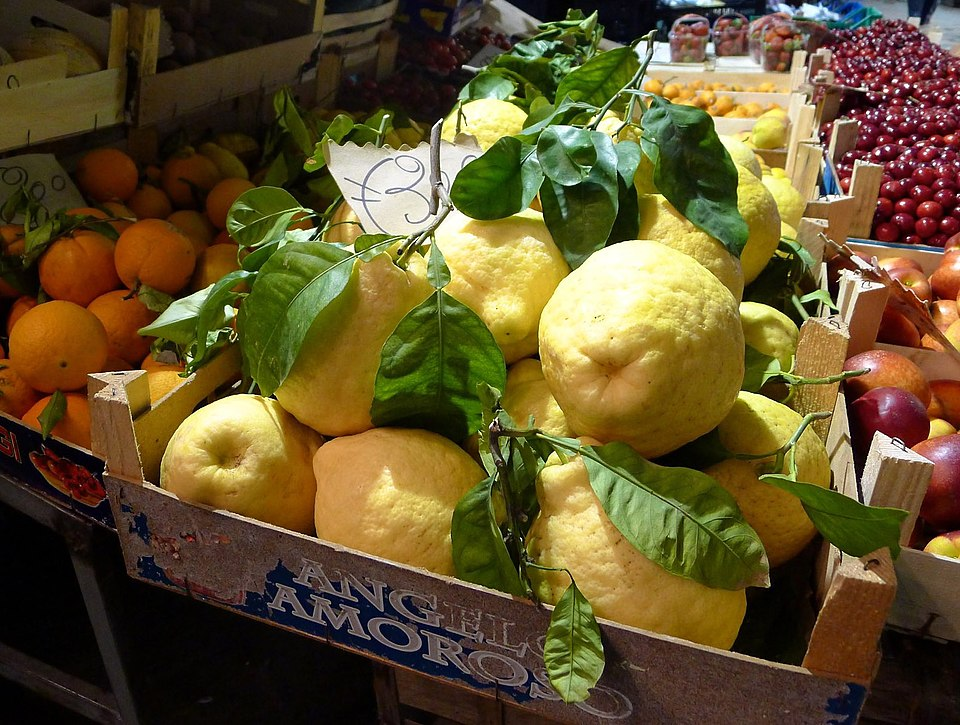
Sicily became an important production center starting in 831, when the Arabs introduced citrus and developed advanced irrigation systems to overcome local climatic challenges. In the 10th century, Ibn Hauqal described Sicilian gardens where oranges and lemons were cultivated. In Andalusia, lemons were included in 12th-century agricultural treatises. Large-scale cultivation began in Genoa during the 15th century, while in the Middle Ages, their culinary use remained mostly limited to Southern Europe. It was only in the 16th century that lemon juice began to be appreciated as a flavoring, becoming a novelty at the court of Henry VIII.
Christopher Columbus introduced lemons to the Americas in 1493, bringing seeds to Hispaniola. Later, the Spanish conquest helped spread them throughout the New World, where they were primarily used as ornamental or medicinal plants. In the 18th century, the physician James Lind discovered the antiscorbutic properties of lemon juice, even though vitamin C was not yet known. This marked a turning point in the practical use of lemons, establishing them as a valuable health food.
Production methods for lemon trees (lemons)
Lemon trees require a minimum temperature of about 7 °C (45 °F) and are not fully hardy year-round in temperate climates, although their resilience increases as they mature. Citrus trees need only minimal pruning, mainly to remove overcrowded branches and to shorten the tallest shoots, which encourages a bushy growth habit. During the summer, pinching the tips of the most vigorous shoots helps promote a more balanced canopy development.
Mature plants may produce undesirable, fast-growing shoots which are removed from the main branches in the lower or central sections of the tree. This practice is crucial for maintaining a harmonious shape and optimizing fruit production. Regular maintenance also supports the tree’s health and ensures more abundant fruiting.
Uses of lemons
Lemons are highly valued in culinary applications, with both the juice and rind used to enhance a wide range of foods. The juice, containing roughly 5–6% citric acid, provides a distinct sour flavor, while the whole fruit is used to prepare marmalades, lemon curd, and liqueurs such as Limoncello. Slices and zest serve as garnishes or flavoring agents, particularly in baked goods, lemonade, and cocktails.
In cooking, lemon juice plays a functional role: its acid helps neutralize amines in fish and partially breaks down collagen in meat, making it more tender. In the United Kingdom, it is traditionally added to pancakes for Shrove Tuesday. Its preservative properties prevent enzymatic browning in fruits such as apples, bananas, and avocados, slowing oxidation and maintaining freshness.
The peel is a source of pectin, used as a gelling agent and stabilizer in various products. In Mediterranean countries like Morocco, lemons are preserved in salt jars or barrels, which softens the peel while allowing the fruit to last for years. Even the leaves of the lemon tree are utilized in culinary practices, often to make tea or to add flavor when preparing cooked meats and seafood.
Classification of lemon trees (lemons)
Lemons are divided into cultivars, including:
- Amalfi Coast lemon
- Bonnie Brae lemon
- Corsican lemon
- Eureka lemon
- Lisbon lemon
- Menton lemon
- Sorrento lemon
- Syracuse lemon
- Yen Ben lemon
Nutrictional facs tables
Nutritional values can vary between individual cultivars, but it is still useful to create three separate tables: one for the whole fruit, one for the juice, and one for the peel.
For the fruit:
| Nutrients | Per 100 g |
| Calories (kcal) | 29 |
| Total fat (g) | 0.3 |
| ———Saturated fat (g) | 0.04 |
| Cholesterol (mg) | 0 |
| Sodium (mg) | 2 |
| Total carbohydrates (g) | 9.32 |
| ———Dietary fiber (g) | 2.8 |
| ———Total sugar (g) | 2.5 |
| Protein (g) | 1.1 |
For the juice:
| Nutrients | Per 100 g |
| Calories (kcal) | 25 |
| Total fat (g) | 0 |
| ———Saturated fat (g) | 0 |
| Cholesterol (mg) | 0 |
| Sodium (mg) | 1 |
| Total carbohydrates (g) | 8.63 |
| ———Dietary fiber (g) | 0.4 |
| ———Total sugar (g) | 2.4 |
| Protein (g) | 0.38 |
For the peel:
| Nutrients | Per 100 g |
| Calories (kcal) | 47 |
| Total fat (g) | 0.3 |
| ———Saturated fat (g) | 0.04 |
| Cholesterol (mg) | 0 |
| Sodium (mg) | 6 |
| Total carbohydrates (g) | 16 |
| ———Dietary fiber (g) | 10.6 |
| ———Total sugar (g) | 4.17 |
| Protein (g) | 1.5 |
Recipes that use this product as an ingredient:


Photo(s):
1. Syrio, CC BY-SA 4.0 https://creativecommons.org/licenses/by-sa/4.0, via Wikimedia Commons
2. Brad Coy, CC BY 2.0 https://creativecommons.org/licenses/by/2.0, via Wikimedia Commons