
Cow butter
Food, Animal source foods, Dairy products, Butter
Consumption area(s): Afghanistan 🇦🇫, Albania 🇦🇱, Andorra 🇦🇩, Antigua and Barbuda 🇦🇬, Australia 🇦🇺, Austria 🇦🇹, Azerbaijan 🇦🇿, Bahamas 🇧🇸, Bahrain 🇧🇭, Barbados 🇧🇧, Belarus 🇧🇾, Belgium 🇧🇪, Bhutan 🇧🇹, Bulgaria 🇧🇬, Canada 🇨🇦, Chile 🇨🇱, Costa Rica 🇨🇷, Croatia 🇭🇷, Cyprus 🇨🇾, Czech Republic 🇨🇿, Denmark 🇩🇰, Egypt 🇪🇬, Estonia 🇪🇪, Fiji 🇫🇯, Finland 🇫🇮, France 🇫🇷, Georgia 🇬🇪, Germany 🇩🇪, Greece 🇬🇷, Hungary 🇭🇺, Iceland 🇮🇸, India 🇮🇳, Iran 🇮🇷, Ireland 🇮🇪, Israel 🇮🇱, Italy 🇮🇹, Kazakhstan 🇰🇿, Kuwait 🇰🇼, Latvia 🇱🇻, Liechtenstein 🇱🇮, Lithuania 🇱🇹, Luxembourg 🇱🇺, Maldives 🇲🇻, Malta 🇲🇹, Mauritius 🇲🇺, Moldova 🇲🇩, Monaco 🇲🇨, Mongolia 🇲🇳, Montenegro 🇲🇪, Morocco 🇲🇦, Nepal 🇳🇵, Netherlands 🇳🇱, New Zealand 🇳🇿, North Korea 🇰🇵, North Macedonia 🇲🇰, Norway 🇳🇴, Palestine 🇵🇸, Pakistan 🇵🇰, Panama 🇵🇦, Poland 🇵🇱, Portugal 🇵🇹, Qatar 🇶🇦, Romania 🇷🇴, Russia 🇷🇺, Samoa 🇼🇸, San Marino 🇸🇲, Saudi Arabia 🇸🇦, Serbia 🇷🇸, Seychelles 🇸🇨, Singapore 🇸🇬, Slovakia 🇸🇰, Slovenia 🇸🇮, South Korea 🇰🇷, Spain 🇪🇸, Sweden 🇸🇪, Switzerland 🇨🇭, Tonga 🇹🇴, Turkey 🇹🇷, Tuvalu 🇹🇻, Ukraine 🇺🇦, United Arab Emirates 🇦🇪, United Kingdom 🇬🇧, United States of America 🇺🇸, Uruguay 🇺🇾, Uzbekistan 🇺🇿, Vatican City 🇻🇦
Chemical composition of commercial butter in Europe and the USA:
Fat: approximately 82%, including triglycerides, phospholipids, and cholesterol
Water: approximately 16%
Non-fat solids: approximately 2%, including lactose (0.5–1%), proteins (0.4–0.8%), and minerals/salts (0.1–0.2%)
Chemical/physical characteristics:
Smoke point: 105°C
Melting point: 28–33°C
Density: 911 g/L
Introduction
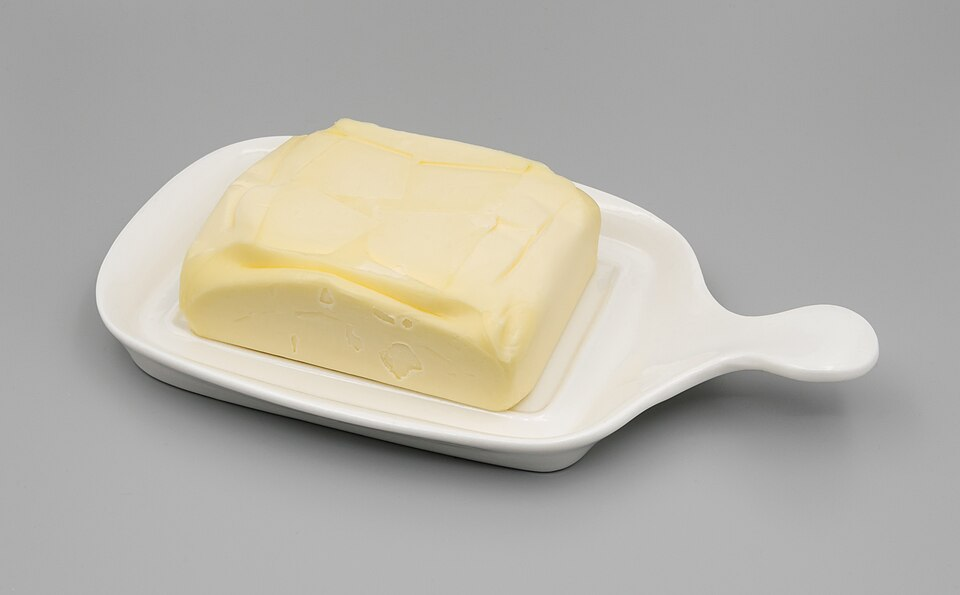
Cow butter is butter obtained from the processing of cow milk. In addition to the general characteristics of butter described on the main page, it should be noted that the color of this butter can range from milky white to deep yellow, influenced by the diet and genetics of the source animal. For example, butter produced in winter tends to be lighter than that produced in summer, due to the presence of natural carotenoids in the forage. In industrial production, the color may be standardized or enhanced using additives such as annatto or carotene.
History of cow butter
Elaine Khosrova attributes the invention of butter to Neolithic Africa, around 8,000 BCE. A Sumerian tablet dating to about 2,500 BCE describes the butter-making process, starting from milking cows, while other tablets identify it as a ritual offering. In the Mediterranean climate, however, unsalted butter deteriorated quickly, making it impractical for preserving the nutrients of milk. The ancient Greeks and Romans primarily used it as an ointment or medicine, considering it a “barbarian” food. Pliny the Elder described it as “the most delicate food among barbarian nations” and praised its healing properties.
During the Middle Ages, the colder climates of northern Europe allowed butter to be stored for longer periods, making it more common, although its reputation remained negative. It was mainly consumed by peasants, but from the 16th century, thanks in part to the Catholic Church’s allowance during Lent, butter began to be accepted by the aristocracy. Butter was also used as fuel for lamps, and in some regions, such as Ireland, it was buried in peat bogs for long-term preservation, developing a strong yet edible flavor.
Until the 19th century, butter production was mostly artisanal, with peasants selling it at local markets and using decorated wooden presses to form discs or bricks. Mechanization began in the 1870s with the introduction of Carl Gustaf Patrik de Laval’s cream centrifuge. The first butter factories appeared in the United States in the 1860s, and in 1920, Otto Hunziker published a text that standardized butter production internationally. France, particularly Normandy and Brittany, became famous for the quality of its butter.
In the 20th century, butter consumption declined sharply due to the rising popularity of margarine, which was cheaper and considered healthier. In the United States, margarine overtook butter in the 1950s, and even today, margarine is consumed more than butter in many Western countries, despite a recent culinary return to butter.
Production methods of cow butter
The variety of butter production methods gives rise to multiple types of butter with differing qualities. Depending on the starting product, a primary distinction is made between milk butter (produced directly from milk) and whey butter (produced from this by-product of dairy processing, generally of lower quality). Milk butter, in turn, is divided according to the production method into centrifuged butter (high-quality, produced from cream obtained by direct milk centrifugation) and churned/skimmed butter (medium quality, produced from cream obtained by natural rising).
To describe the production process in detail, it is therefore necessary to analyze the steps according to the type of butter being produced.
Churned/Skimmed Butter
The first step in this process is the extraction of cream from milk. This is achieved by fermenting the milk in tanks at 15°C for about 20 hours, allowing the cream to rise to the surface for collection. The resulting cream is called “soured”, as this resting period encourages the growth of bacteria and fungi and the production of metabolites.
Once the soured cream is extracted, the butter-making process (burrification) proceeds with the following steps:
- Neutralization: Heating the cream to 80°C in an alkaline environment to reduce acidity from fermentation.
- Pasteurization: Treating the cream at 90–95°C for 30 seconds to stabilize the product and make the fat more fluid, facilitating the next step.
- Crystallization: Rapidly cooling the cream to 6–7°C to promote crystal formation in the fat.
- Flavoring (Aromatization): Inoculating bacterial cultures to develop the butter’s characteristic aroma.
- Maturation: Resting the cream for 12–15 hours at 15–20°C, achieving an ideal pH of 4.7–5.1 through controlled bacterial growth.
- Churning (Zangolatura): Agitating the cream in special churns at 12°C for 40–50 minutes, separating fat lumps, resembling corn kernels, from the remaining liquid (buttermilk).
- Washing: Rinsing the newly formed butter with plenty of potable water to remove residual buttermilk.
- Kneading and packaging: Working the butter to achieve a homogeneous consistency, then shaping, cutting, and packaging.
Centrifuged Butter
For this type of butter, the cream extraction is performed by centrifuging the milk at 6,500–7,000 rpm and a temperature of 32–55°C, producing a “sweet” cream because it lacks the bacterial load introduced by fermentation. From this point, the burrification process continues starting from step 4 (Aromatization).
Whey Butte
To produce whey butter, the fat content in the whey is first extracted using centrifugation (sometimes cream is added to improve product quality). From this point, the burrification process also begins at step 4 (Aromatization).
Classification of cow butter
There are several notable types of cow butter produced locally, including:
- Beurre d’Ardenne
- Beurre d’Isigny
- Beurre Charentes-Poitou
- Beurre Rose
- Mantequilla de Soria
- Mantega de l’Alt Urgell i la Cerdanya
- Rucavas baltais sviests
Nutritional facts table
Please note that nutritional values may vary slightly depending on the type of butter.
| Nutrients | Per 100 g |
| Calories (kcal) | 717 |
| Total fat (g) | 81.11 |
| ———Saturated fat (g) | 51.37 |
| Cholesterol (mg) | 215 |
| Sodium (mg) | 11* |
| Total carbohydrates (g) | 0.06 |
| ———Dietary fiber (g) | 0 |
| ———Total sugar (g) | 0.06 |
| Protein (g) | 0.85 |
*Only in unsalted butter
Recipes that use this product as an ingredient:
Source(s):
https://en.wikipedia.org/wiki/Butter
https://it.wikipedia.org/wiki/Burro
Photo(s):
1. Jacek Halicki, CC BY-SA 4.0 https://creativecommons.org/licenses/by-sa/4.0, via Wikimedia Commons