
Animals (Animalia)
Kingdom
Consumption area(s): Earth
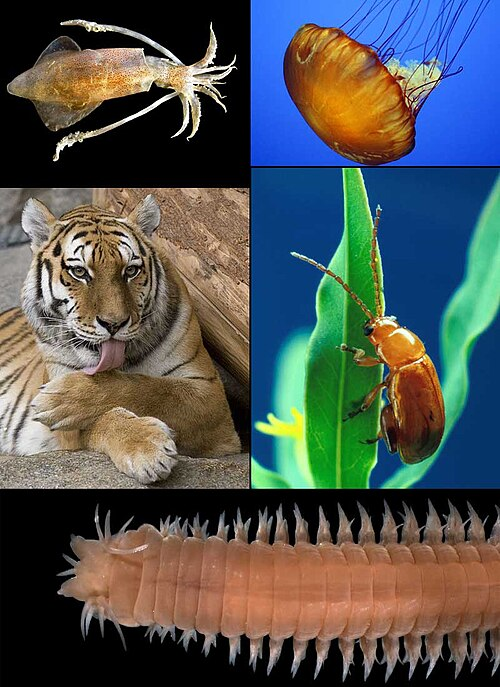
Introduction
The animals (Animalia) form one of the major kingdoms of living organisms. Today, scientists have formally described over 1.8 million species. However, biological exploration is still incomplete, and some researchers suggest that the true diversity of animals could be many times higher than the number currently documented. Among the known forms, a very large proportion belongs to the insects, which represent the most species-rich group within the kingdom.
All members of this kingdom are eukaryotic organisms characterized by a certain degree of cellular specialization and by the ability to exhibit movement during at least one phase of their life cycle. In most cases, animals are heterotrophic, meaning they obtain energy and nutrients by consuming organic matter produced by other living beings. They also typically rely on oxygen-based respiration, show active or potential locomotion, and undergo a distinctive embryonic development that begins with the formation of a hollow sphere of cells known as the blastula.
Description of animals (Animalia)
Across the vast diversity of animal species, certain structural traits can be broadly recognized. With some notable exceptions most animals possess a body organized into four fundamental tissue types: epithelial, connective, muscular, and nervous. Typically, they also show an internal digestive cavity equipped with one or two openings for food intake and waste elimination.
All animals are composed of eukaryotic cells embedded in a distinctive extracellular matrix rich in collagen and others elastic materials. In many groups, this matrix can incorporate minerals, forming protective or supportive elements such as shells or bones. During embryonic development, animal cells are able to migrate and reorganize, allowing the formation of complex anatomical structures. This dynamic growth pattern contrasts with that of plants and fungi, whose cells are usually fixed in place by rigid cell walls.
Except in the most evolutionarily simple forms, the body covering and the muscles are closely interconnected and strongly influenced by the environment in which an organism lives. Besides serving as a protective barrier, the covering may also contribute to additional functions such as sensory perception, respiration, or secretion, depending on the group.
As heterotrophic organisms, animals must obtain nutrients by consuming plants, other animals, or organic remains, since they are unable to produce their own food. Consequently, different groups have evolved a wide range of feeding strategies, digestive mechanisms, and metabolic adaptations that reflect their ecosystems.
The circulatory system is responsible for transporting nutrients and often substances such as hemoglobin throughout the body. This system may be closed, with blood confined to vessels, open, with fluid bathing tissues directly, or in some simpler groups it may be absent altogether.
The respiratory system enables gas exchange, supplying tissues with oxygen and removing carbon dioxide, a by-product of cellular metabolism. Any thin and moist surface can potentially serve this function, though specialized organs such as gills in aquatic animals and lungs in terrestrial ones are common. Alongside respiration, the excretory system eliminates metabolic wastes.
While even unicellular organisms can respond to external stimuli, the transition to multicellular complexity led to the evolution of a coordinated nervous system. This network integrates the activity of tissues and organs, ensuring that the organism functions as a unified whole.
Animal reproduction may occur through sexual or asexual processes. Although asexual reproduction is widespread among simple organism, within the animal kingdom it is comparatively rare and mostly restricted to more primitive animals, which may still retain the capacity for sexual reproduction.
Classification of animals (Animalia)
Animals are primarily classified into phyla, including:
- Annelids (Anellida) (Earthworms)
- Arthropods (Arthropoda) (crustaceans, insects)
- Chordates (Chordata) (amphibians, birds, fish, mammals, reptiles)
- Cnidarians (Cnidaria) (jellyfish)
- Echinoderms (Echinodermata) (sea urchins)
- Mollusks (Mollusca) (cuttlefish, octopuses, shellfish, snails)
Source(s):
https://it.wikipedia.org/wiki/Animalia
Photo(s):
1. User:Stemonitis, CC BY-SA 2.5 https://creativecommons.org/licenses/by-sa/2.5, via Wikimedia Commons